Redis in Action: Why Every Developer Should Know These 4 Game-Changing Use Cases
So you've heard about Redis, right? That super-fast in-memory database that everyone keeps talking about. But here's the thing, most people just think of it as "that caching thing" and call it a day.
Big mistake.
Redis is like that Swiss Army knife you didn't know you needed until you actually used it. Sure, it does caching brilliantly, but it's also your message queue, your leaderboard engine, and your distributed lock manager all rolled into one blazing-fast package.
Let me show you why Redis has become the secret weapon behind some of the biggest applications you use every day, and more importantly, how you can leverage it in your own projects.
What Makes Redis So Special?
Before we dive into the juicy stuff, let's get one thing straight. Redis isn't just another database. It's an in-memory data structure store that can hit sub-millisecond response times. We're talking about performance that makes traditional databases look like they're running on dial-up.
But speed isn't everything. What really sets Redis apart is its versatility. It's like having a performance car that can also haul your furniture and take you off-roading. Not many tools can pull that off.
Use Case #1: Caching That Actually Makes Sense
The Problem Everyone Faces
Your database is getting hammered. Users are complaining about slow page loads. Your server costs are through the roof because you keep throwing more hardware at the problem. Sound familiar?
This is where most developers discover Redis caching, and honestly, it's a game-changer. But here's what most tutorials won't tell you, there are actually three different caching strategies, and picking the wrong one can bite you later.
Cache-Aside: The "Lazy" Approach (But Smart)
This is probably what you'll use 90% of the time. Your app checks Redis first, and if the data isn't there, it hits the database and then stores the result in Redis for next time.
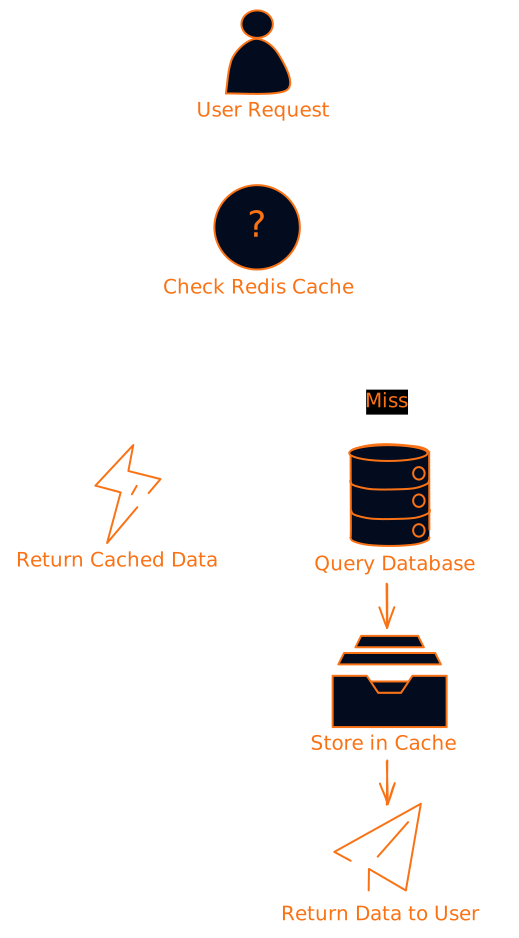
The beauty of this approach? It's simple and it works. The downside? You need to handle cache invalidation, which brings us to the classic computer science problem: "There are only two hard things in Computer Science: cache invalidation and naming things."
Write-Through: The "Always Consistent" Approach
With write-through caching, every write goes to both the cache and the database simultaneously. It's like having a backup singer who never misses a note.
def update_user_profile(user_id, profile_data):
    # Write to database
    database.update_user(user_id, profile_data)

    # Write to cache
    redis_client.hset(f"user:{user_id}", mapping=profile_data)

    return True
This keeps everything in sync, but it's slower for writes. Choose this when consistency matters more than speed.
Write-Behind: The "Trust Me" Approach
This one's interesting. You write to the cache immediately and update the database later in the background. It's fast, but risky. If your cache crashes before the background write happens, you lose data.
Use this only when you can afford to lose some data in exchange for blazing-fast writes.
Real-World Impact
Twitter uses Redis caching for user timelines. Pinterest caches feed data. Shopify caches product catalogs. These aren't small-scale operations, we're talking about systems that serve millions of users.
The performance gains? We're talking about going from 100ms database queries to sub-millisecond cache hits. That's not just faster, that's a completely different user experience.
Use Case #2: Message Queues Without the Complexity
Why Message Queues Matter
In modern applications, services need to talk to each other without being joined at the hip. Think of it like texting instead of phone calls. You send a message, the other person gets it when they're ready, and nobody's waiting around.
Traditional message brokers like RabbitMQ or Kafka are powerful, but they're also complex. Redis gives you message queuing with a much gentler learning curve.
Redis Lists: The Simple Queue
The most basic approach uses Redis Lists. Push messages on one end, pop them off the other. It's like a digital conveyor belt.
# Producer
redis_client.lpush("task_queue", json.dumps({
    "task_type": "send_email",
    "user_id": 12345,
    "template": "welcome"
}))

# Consumer
while True:
    task = redis_client.brpop("task_queue", timeout=1)
    if task:
        process_task(json.loads(task[1]))
This works great for simple use cases, but it has limitations. No message persistence, no replay capability, and if your consumer crashes, messages are gone.
Redis Streams: The Grown-Up Queue
Redis Streams are where things get interesting. They're like Lists but with superpowers: persistence, consumer groups, and message replay.
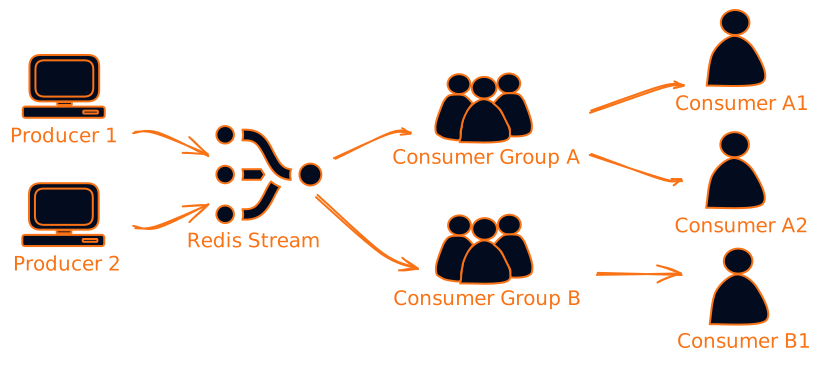
With Streams, you can have multiple consumer groups processing the same messages differently. One group might send emails, another might update analytics. It's like having multiple assembly lines working on the same products.
Redis Pub/Sub: The Real-Time Messenger
For real-time notifications, Redis Pub/Sub is your friend. It's fire-and-forget messaging, perfect for live updates, chat systems, or real-time dashboards.
# Publisher
redis_client.publish("user_notifications", json.dumps({
    "user_id": 12345,
    "message": "Your order has shipped!",
    "timestamp": time.time()
}))

# Subscriber
pubsub = redis_client.pubsub()
pubsub.subscribe("user_notifications")

for message in pubsub.listen():
    if message['type'] == 'message':
        handle_notification(json.loads(message['data']))
The catch? Messages aren't stored. If no one's listening when you publish, the message disappears into the void.
When to Use What?
- Lists: Simple task queues, job processing
- Streams: Event sourcing, audit logs, complex workflows
- Pub/Sub: Real-time notifications, live updates, chat systems
Use Case #3: Leaderboards That Scale
The Gaming Industry's Secret Weapon
Ever wondered how games like League of Legends handle millions of players competing for rankings? Or how social media platforms manage trending topics? The answer is often Redis Sorted Sets.
Sorted Sets are like regular sets, but each element has a score. Redis keeps them sorted automatically, which means you can get rankings instantly, no matter how many players you have.
# Add player scores
redis_client.zadd("global_leaderboard", {
    "player1": 1500,
    "player2": 2100,
    "player3": 1800
})

# Get top 10 players
top_players = redis_client.zrevrange("global_leaderboard", 0, 9, withscores=True)

# Get a player's rank
rank = redis_client.zrevrank("global_leaderboard", "player2")
But What About Scale?
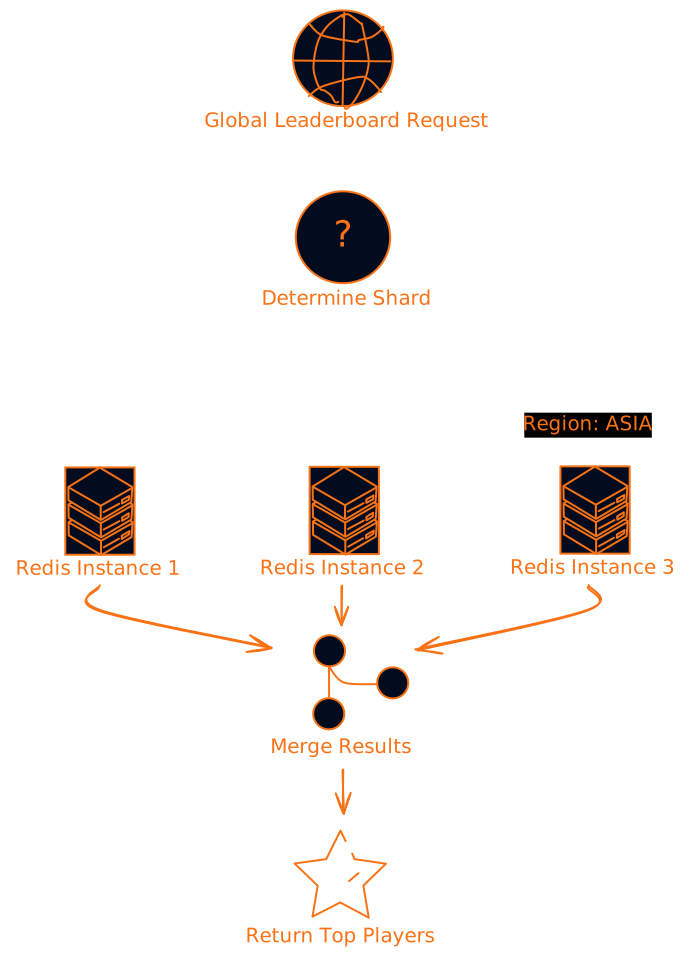
Here's where it gets tricky. What happens when you have millions of players? You can't fit everything in one Redis instance.
The solution is sharding. You split your leaderboard across multiple Redis instances based on some criteria, like geographic region or skill level.
Real-Time Updates
The cool part? You can combine leaderboards with Pub/Sub for real-time updates. When someone's score changes, publish an event, and all connected clients get the update instantly.
def update_score(player_id, new_score):
    # Update the leaderboard
    redis_client.zadd("leaderboard", {player_id: new_score})

    # Get the player's new rank
    rank = redis_client.zrevrank("leaderboard", player_id)

    # Publish the update
    redis_client.publish("leaderboard_updates", json.dumps({
        "player_id": player_id,
        "new_score": new_score,
        "new_rank": rank + 1  # Redis ranks are 0-based
    }))
Beyond Gaming
Leaderboards aren't just for games. E-commerce sites use them for trending products. Social media platforms use them for trending hashtags. News sites use them for popular articles.
The pattern is the same: you have items with scores that change over time, and you need to rank them efficiently.
Use Case #4: Distributed Locks (The Unsung Hero)
The Problem You Didn't Know You Had
Picture this: you have multiple servers processing orders. Two customers try to buy the last item in stock at the exact same time. Without proper coordination, you might oversell.
This is where distributed locks come in. They're like a bouncer for your critical code sections, making sure only one process can access a resource at a time.
The Redis Solution
Redis makes distributed locking surprisingly straightforward. The basic idea is to use a key as a lock. If you can set the key, you have the lock. If the key already exists, someone else has it.
import uuid
import time

def acquire_lock(redis_client, lock_key, timeout=10):
    lock_value = str(uuid.uuid4())

    # Try to acquire the lock
    if redis_client.set(lock_key, lock_value, nx=True, ex=timeout):
        return lock_value
    return None

def release_lock(redis_client, lock_key, lock_value):
    # Lua script to ensure we only release our own lock
    lua_script = """
    if redis.call("get", KEYS[1]) == ARGV[1] then
        return redis.call("del", KEYS[1])
    else
        return 0
    end
    """
    return redis_client.eval(lua_script, 1, lock_key, lock_value)
The Redlock Algorithm
For mission-critical applications, there's the Redlock algorithm. It uses multiple Redis instances to provide stronger guarantees against failures.
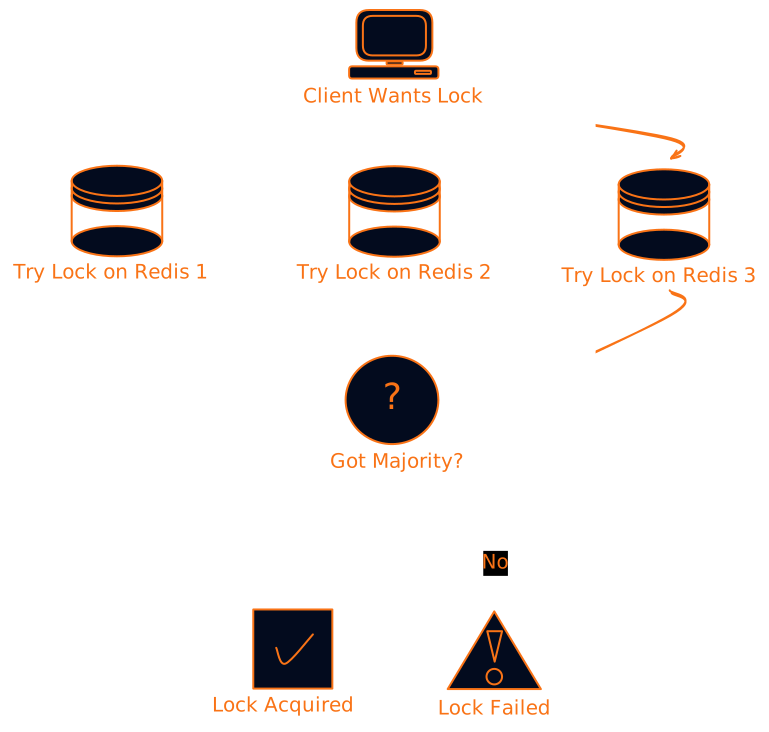
The idea is simple: if you can acquire the lock on the majority of Redis instances, you have the lock. This protects against single points of failure.
Real-World Applications
Distributed locks are everywhere, even if you don't see them:
- E-commerce: Preventing overselling of limited inventory
- Banking: Ensuring account balances don't go negative
- Content Management: Preventing concurrent edits to the same document
- Job Processing: Ensuring the same job doesn't run twice
The Gotchas
Distributed locks aren't magic. They come with challenges:
- Clock Skew: If your servers have different times, locks might expire unexpectedly
- Network Partitions: What happens when Redis instances can't talk to each other?
- Deadlocks: Make sure your locks have timeouts
- Performance: Locks add overhead, especially under high contention
Putting It All Together: A Real-World Architecture
Let's say you're building a multiplayer game. Here's how you might use all four Redis use cases together:
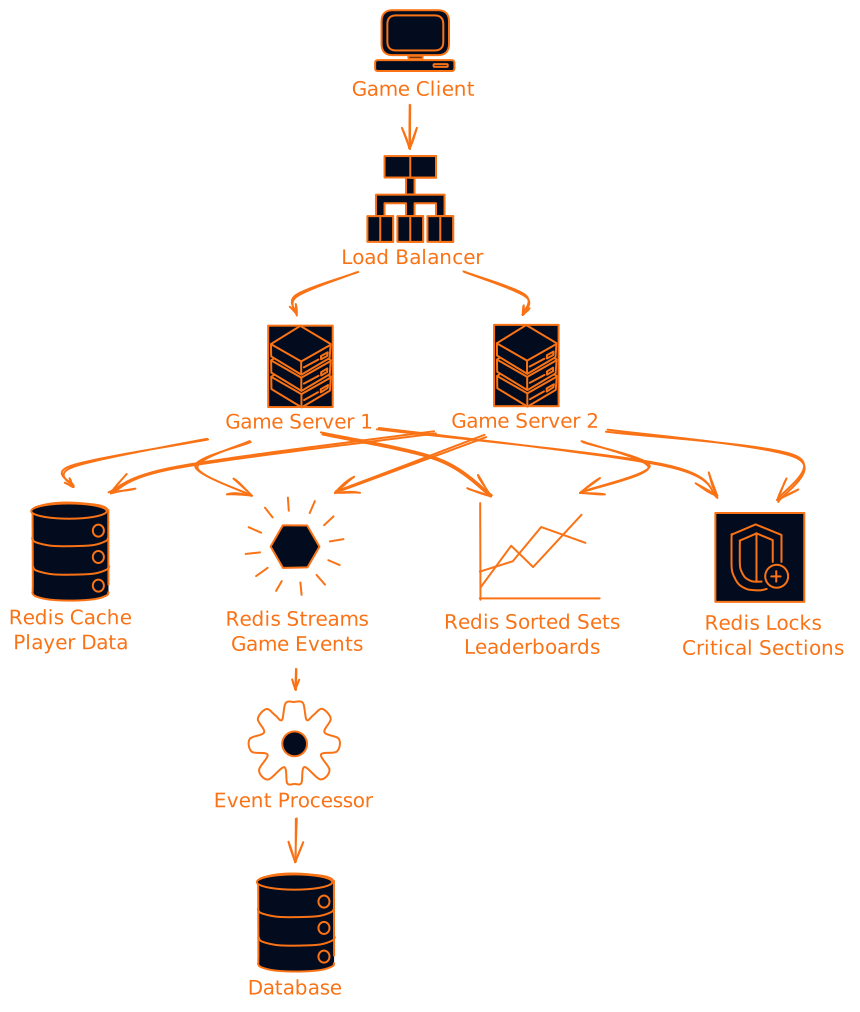
- Caching: Player profiles, game state, frequently accessed data
- Message Queues: Game events, matchmaking requests, notifications
- Leaderboards: Player rankings, tournament standings, achievement tracking
- Distributed Locks: Preventing duplicate transactions, coordinating server actions
Common Pitfalls and How to Avoid Them
Memory Management
Redis stores everything in memory, which is great for speed but terrible if you run out of RAM. Set up proper eviction policies and monitor your memory usage.
# Configure eviction policy
redis_client.config_set("maxmemory-policy", "allkeys-lru")
redis_client.config_set("maxmemory", "2gb")
Data Persistence
By default, Redis can lose data if it crashes. Configure persistence if you can't afford to lose data:
# In redis.conf
save 900 1      # Save if at least 1 key changed in 900 seconds
save 300 10     # Save if at least 10 keys changed in 300 seconds
save 60 10000   # Save if at least 10000 keys changed in 60 seconds
Connection Pooling
Don't create a new Redis connection for every request. Use connection pooling:
import redis

# Create a connection pool
pool = redis.ConnectionPool(host='localhost', port=6379, db=0, max_connections=20)
redis_client = redis.Redis(connection_pool=pool)
Monitoring and Alerting
Set up monitoring for key metrics:
- Memory usage
- Connection count
- Command latency
- Hit/miss ratios for caching
Performance Tips That Actually Matter
Pipeline Your Commands
Instead of sending commands one by one, batch them:
pipe = redis_client.pipeline()
pipe.set("key1", "value1")
pipe.set("key2", "value2")
pipe.set("key3", "value3")
pipe.execute()
Use the Right Data Structure
- Strings: Simple key-value pairs
- Hashes: Objects with multiple fields
- Lists: Ordered collections, queues
- Sets: Unique collections, tags
- Sorted Sets: Ranked collections, leaderboards
Lua Scripts for Atomic Operations
When you need multiple commands to execute atomically, use Lua scripts:
-- Increment counter and get new value atomically
local current = redis.call('GET', KEYS[1])
if current == false then
    current = 0
end
local new_value = current + ARGV[1]
redis.call('SET', KEYS[1], new_value)
return new_value
What's Next?
Redis isn't going anywhere. If anything, it's becoming more important as applications become more distributed and performance requirements get stricter.
Here are some trends to watch:
Redis Modules
The Redis ecosystem is expanding with modules like:
- RedisJSON: Native JSON support
- RedisGraph: Graph database capabilities
- RedisTimeSeries: Time series data handling
- RedisBloom: Probabilistic data structures
Redis Stack
Redis Stack bundles multiple modules together, giving you a more complete data platform out of the box.
Cloud-Native Redis
Services like Redis Cloud, AWS ElastiCache, and Google Cloud Memorystore are making it easier to run Redis at scale without managing infrastructure.
The Bottom Line
Redis isn't just a cache. It's a Swiss Army knife for modern application development. Whether you're building a simple web app or a complex distributed system, Redis probably has a use case that fits.
The key is understanding which tool to use when:
- Caching: When you need speed and can handle some data loss
- Message Queues: When you need asynchronous communication
- Leaderboards: When you need real-time rankings
- Distributed Locks: When you need coordination across multiple processes
Start with one use case, get comfortable with it, then expand. Before you know it, you'll be wondering how you ever built applications without Redis.
And remember, like any powerful tool, Redis can be misused. Don't cache everything, don't use it as your primary database, and always have a backup plan. But when used correctly, Redis can transform your application's performance and capabilities.
The next time someone asks you about Redis, don't just say "it's for caching." Tell them it's the performance multiplier their application has been waiting for.
Want to dive deeper? Check out the Redis documentation, experiment with different data structures, and most importantly, start small. Pick one use case, implement it, measure the results, and then expand from there. Your users (and your servers) will thank you.