
Building Bulletproof Distributed Cache Systems: A Deep Dive Into Modern Architecture
Ever wondered how Netflix serves millions of users without breaking a sweat, or how Amazon handles Black Friday traffic spikes? The secret sauce isn't magic, it's distributed caching. Let's pull back the curtain and explore how these systems actually work.
Why Your App Needs Distributed Caching (And Why It's Not Optional Anymore)
Picture this: you've built an amazing app that suddenly goes viral. Yesterday you had 100 users, today you have 100,000. Your database is crying, your servers are melting, and your users are getting timeout errors. Sound familiar?
This is where distributed caching comes to the rescue. It's like having a super-smart assistant who remembers everything your users need and serves it lightning-fast, without bothering your poor overworked database.
But here's the thing, building a distributed cache isn't just about throwing Redis on a few servers and calling it a day. There's a whole world of complexity hiding underneath that simple concept.
The Core Challenge: Making Data Available Everywhere, All the Time
When you're dealing with distributed systems, you're essentially trying to solve an impossible puzzle. You want your data to be:
- Fast (low latency)
- Available (always accessible)
- Consistent (same data everywhere)
- Scalable (handles growth gracefully)
The cruel reality? You can't have all four perfectly. This is where the fun begins.
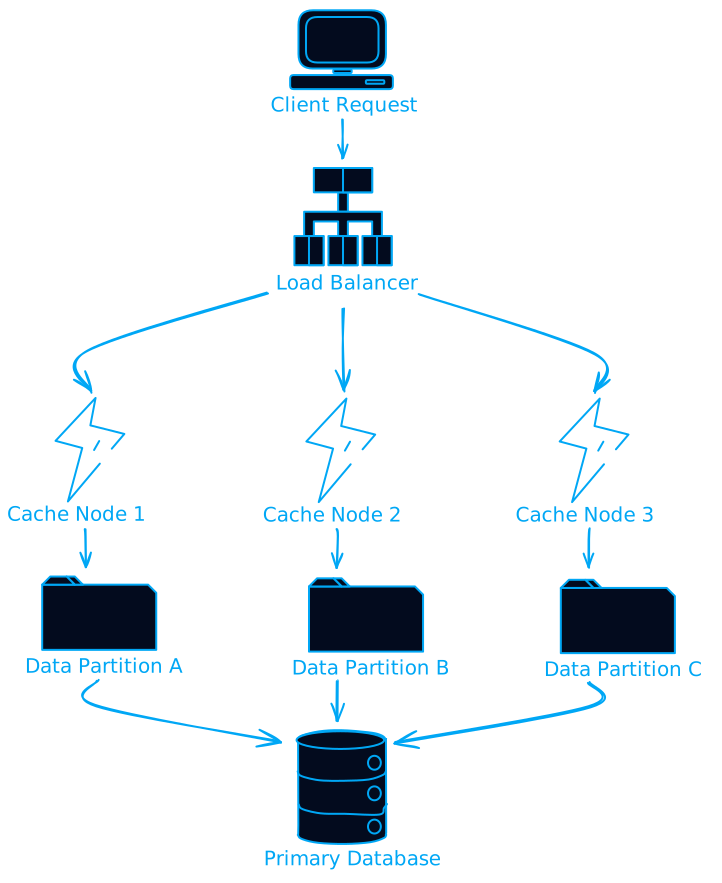
Data Partitioning: The Art of Splitting Without Breaking
Hash-Based Partitioning: The Swiss Army Knife
Hash-based partitioning is like having a really good filing system. You take your data key, run it through a hash function, and boom, you know exactly which server should handle it.
def get_partition(key, num_partitions):
    return hash(key) % num_partitions
Simple, right? But here's where it gets interesting. What happens when you need to add or remove servers? Traditional hashing would require reshuffling almost everything. That's where consistent hashing comes in.
Think of consistent hashing like a circular table where everyone sits in a specific spot. When someone new joins, only the people sitting next to them need to adjust, not the entire table.

Range-Based Partitioning: When Location Matters
Sometimes you want related data to live together. Like storing all user data from the same geographic region on the same server. Range-based partitioning lets you do exactly that.
def get_partition_by_range(key):
    if key.startswith('US_'):
        return 'us_partition'
    elif key.startswith('EU_'):
        return 'eu_partition'
    else:
        return 'global_partition'
This works great when your access patterns are predictable, but it can create hot spots if one range gets way more traffic than others.
Directory-Based Partitioning: The Smart Coordinator
This is like having a really smart receptionist who knows where everything is stored. Instead of using algorithms to figure out where data lives, you maintain a directory that tracks everything.
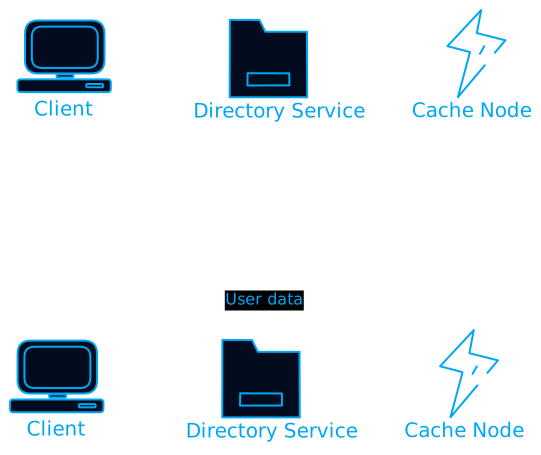
The downside? Your directory service becomes a potential bottleneck and single point of failure. But when done right, it gives you incredible flexibility.
Consistency Models: The Eternal Struggle
Here's where things get philosophically interesting. How consistent does your data need to be? The answer depends on what you're building.
Strict Consistency: The Perfectionist
With strict consistency, every read gets the most recent write, period. It's like having a perfectly synchronized orchestra where every musician plays exactly in time.
class StrictConsistentCache:
    def write(self, key, value):
        # Block until ALL replicas confirm write
        for replica in self.replicas:
            replica.write_and_confirm(key, value)

    def read(self, key):
        # Always read from primary or most up-to-date replica
        return self.primary_replica.read(key)
This sounds great in theory, but it's expensive. Every write operation has to wait for confirmation from all replicas, which can be slow when you have servers spread across the globe.
Eventual Consistency: The Pragmatist
Eventual consistency is like a group chat where messages might arrive out of order, but eventually everyone sees everything. It's messy in the short term but works great at scale.
class EventuallyConsistentCache:
    def write(self, key, value):
        # Write to local replica immediately
        self.local_replica.write(key, value)
        # Propagate to other replicas asynchronously
        self.async_propagate(key, value)

    def read(self, key):
        # Read from any available replica
        return self.any_replica.read(key)
This is what powers systems like Amazon's DynamoDB and Cassandra. You might occasionally read stale data, but your system stays fast and available even when things go wrong.
Suggested image: A timeline showing how data propagates across different nodes over time
The Middle Ground: Causal Consistency
Causal consistency is like having a conversation where you can't respond to something before you've heard it, but multiple conversations can happen simultaneously.
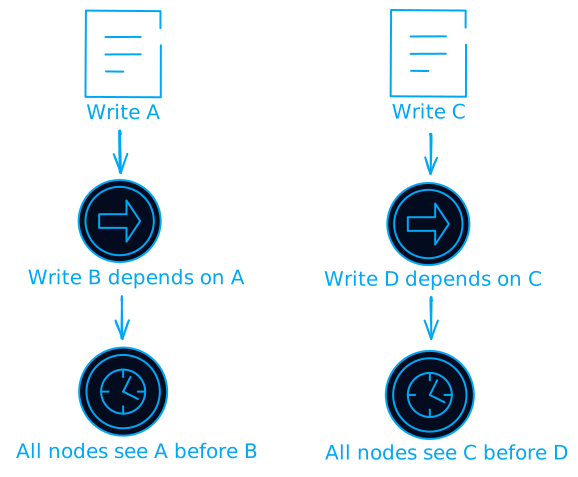
This gives you better performance than strict consistency while still maintaining logical ordering where it matters.
Caching Policies: The Bouncer at the Door
Your cache has limited space, so you need smart policies about what stays and what goes. It's like managing a VIP club, you need to decide who gets in and who gets kicked out.
LRU (Least Recently Used): The Classic
LRU is like that friend who always forgets about people they haven't seen in a while. If data hasn't been accessed recently, it gets evicted.
from collections import OrderedDict

class LRUCache:
    def __init__(self, capacity):
        self.cache = OrderedDict()
        self.capacity = capacity

    def get(self, key):
        if key in self.cache:
            # Move to end (most recently used)
            self.cache.move_to_end(key)
            return self.cache[key]
        return None

    def put(self, key, value):
        if key in self.cache:
            self.cache.move_to_end(key)
        elif len(self.cache) >= self.capacity:
            # Remove least recently used
            self.cache.popitem(last=False)
        self.cache[key] = value
LFU (Least Frequently Used): The Popularity Contest
LFU keeps track of how often data is accessed and evicts the least popular items. It's like a streaming service that removes shows nobody watches.
TLRU (Time-aware LRU): The Smart Hybrid
TLRU combines recency with frequency, giving you the best of both worlds. It's like having a bouncer who considers both how recently someone visited and how often they come.
Suggested image: A bar chart showing access frequency vs. recency for different cached items
Real-World Battle Stories
Netflix: Serving 200+ Million Users
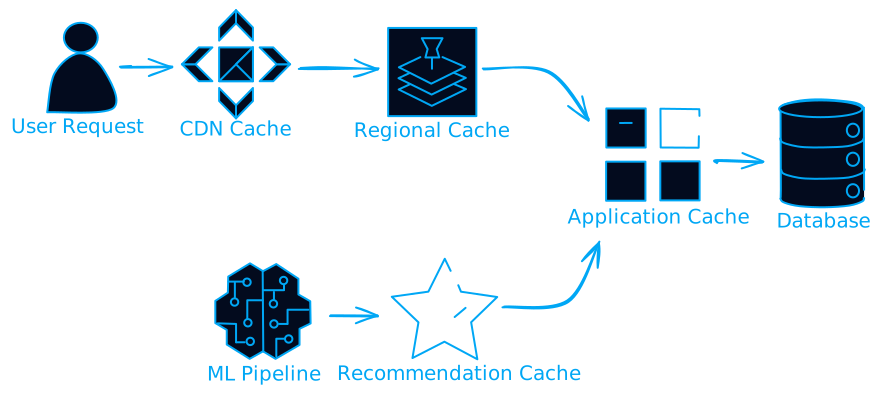
Netflix uses a multi-tiered caching strategy that's absolutely mind-blowing. They cache at the CDN level, application level, and even pre-compute recommendations. Their secret? They cache not just data, but entire rendered pages and video segments.
Facebook: The Social Graph Challenge
Facebook's challenge is unique, they need to cache highly interconnected social data. Their solution? A sophisticated cache hierarchy that understands social relationships and pre-fetches related data.
Amazon: Black Friday and Beyond
Amazon's distributed cache handles traffic spikes that would crush most systems. Their secret sauce includes predictive caching (they know what you'll buy before you do) and geographic distribution that puts data close to users.
The Dark Side: What Can Go Wrong
Cache Stampede: When Everyone Wants the Same Thing
Imagine a popular cache entry expires right when a million users try to access it. Suddenly, all those requests hit your database simultaneously. It's like everyone trying to get through the same door at once.
import asyncio
import time

class CacheWithStampedeProtection:
    def __init__(self):
        self.cache = {}
        self.loading = set()

    async def get(self, key):
        if key in self.cache:
            return self.cache[key]

        if key in self.loading:
            # Wait for another request to load it
            while key in self.loading:
                await asyncio.sleep(0.01)
            return self.cache.get(key)

        # We're the first, let's load it
        self.loading.add(key)
        try:
            value = await self.load_from_database(key)
            self.cache[key] = value
            return value
        finally:
            self.loading.remove(key)
Hot Partitions: The Celebrity Problem
Sometimes one partition gets way more traffic than others. It's like having one checkout line at a grocery store while others sit empty. The solution? Smart load balancing and sometimes manual intervention.
Split Brain: When Nodes Can't Agree
In network partitions, different parts of your system might think they're the authority. It's like having two people both thinking they're in charge of the same project. Chaos ensues.
Building Your Own: A Practical Roadmap
Start Simple, Scale Smart
Don't try to build Netflix's caching system on day one. Start with a simple setup and evolve:
- Single Redis instance (good for prototyping)
- Master-slave replication (adds redundancy)
- Sharding (horizontal scaling)
- Multi-region deployment (global scale)
Choose Your Battles
Ask yourself these questions:
- How consistent does my data need to be? (Banking vs. social media)
- What's my read/write ratio? (News site vs. chat app)
- How much can I afford to lose? (Cache miss vs. data loss)
- Where are my users? (Global vs. regional)
Monitor Everything
You can't manage what you don't measure. Track:
- Hit rates (are you actually helping?)
- Latency (p50, p95, p99)
- Memory usage (are you running out of space?)
- Network traffic (are you creating bottlenecks?)
class CacheMetrics:
    def __init__(self):
        self.hits = 0
        self.misses = 0
        self.latencies = []

    def record_hit(self, latency):
        self.hits += 1
        self.latencies.append(latency)

    def record_miss(self, latency):
        self.misses += 1
        self.latencies.append(latency)

    @property
    def hit_rate(self):
        total = self.hits + self.misses
        return self.hits / total if total > 0 else 0
The Future: What's Coming Next
AI-Powered Caching
Machine learning is starting to predict what data you'll need before you ask for it. Imagine a cache that learns your access patterns and pre-loads data intelligently.
Edge Computing Integration
With 5G and edge computing, caches are moving closer to users than ever before. Your phone might soon have a mini-cache that syncs with nearby edge servers.
Quantum-Resistant Security
As quantum computing advances, cache security needs to evolve. The caches of tomorrow will need to protect against threats we can barely imagine today.
Wrapping Up: The Cache Commandments
Building distributed caches is part art, part science, and part dark magic. Here are the key principles to remember:
- Consistency is a spectrum, not a binary choice
- Measure twice, cache once (know your access patterns)
- Plan for failure (because it will happen)
- Start simple, evolve gradually
- Monitor everything (seriously, everything)
The next time you're streaming a movie, scrolling through social media, or shopping online, remember there's an army of distributed caches working behind the scenes to make it all feel effortless. They're the unsung heroes of the internet, quietly making everything faster and more reliable.
Want to dive deeper? Start with a simple Redis setup, experiment with different consistency models, and gradually add complexity as you learn. The best way to understand distributed caches is to build one yourself, break it, fix it, and break it again.
What's your experience with distributed caching? Have you run into any interesting challenges or found clever solutions? The comments are your cache, feel free to store your thoughts there.
Further Reading: