Unique ID Generators: A Deep Dive Into Distributed Systems Architecture
Unique ID Generators: A Deep Dive Into Distributed Systems Architecture
So you're building a system and suddenly realize you need unique IDs. Sounds simple, right? Just increment a counter and call it a day. Well, if you're dealing with anything beyond a single-threaded toy app, you're about to discover why this problem has kept engineers up at night for decades.
Let me walk you through the real challenges of building unique ID generators that actually work in production, where Murphy's Law isn't just a saying but a daily reality.
Why This Actually Matters (More Than You Think)
Before we dive into the technical stuff, let's talk about why getting this right is crucial. I've seen systems crash because of ID collisions, databases corrupted due to poor referential integrity, and audit trails that became useless because IDs weren't properly tracked.
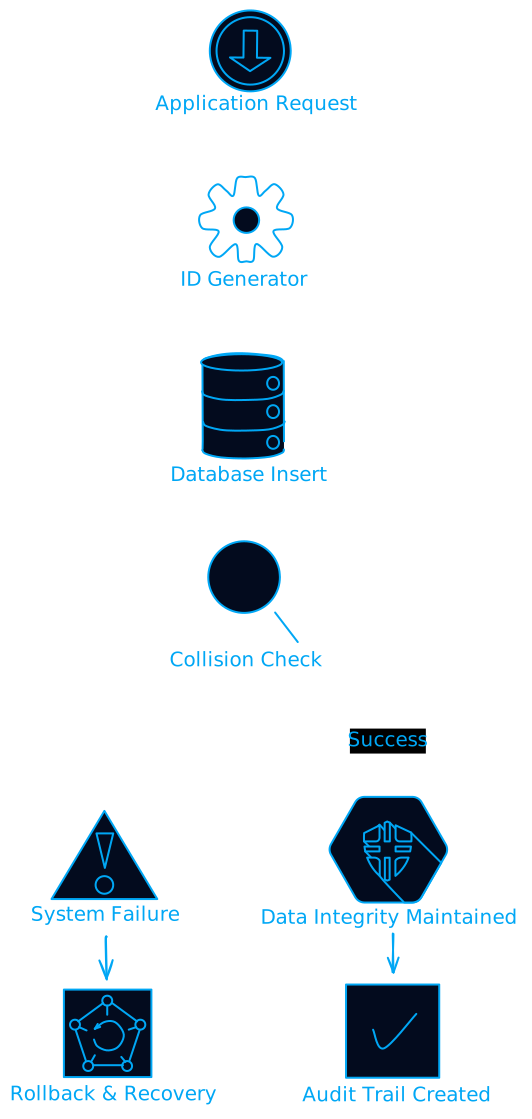
Think of unique IDs as the DNA of your data. Just like biological DNA, they need to be:
- Absolutely unique (no two entities should share the same ID)
- Traceable (you should be able to follow the lineage)
- Scalable (work across distributed systems)
- Resilient (survive failures and network partitions)
The Deceptively Simple Problem
Here's where most people get tripped up. You start with something like this:
# Don't do this in production
class SimpleIDGenerator:
    def __init__(self):
        self.counter = 0

    def generate_id(self):
        self.counter += 1
        return self.counter
This works great until you have multiple instances, concurrent requests, or god forbid, a system restart. Suddenly your "unique" IDs aren't so unique anymore.
But What About Database Auto-Increment?
Sure, database auto-increment works for single-database scenarios. But what happens when you need to:
- Scale across multiple databases?
- Generate IDs before database insertion?
- Work offline or in eventually consistent systems?
- Maintain performance under high load?
That's when you realize you need something more sophisticated.
The Architecture Patterns That Actually Work
1. UUID: The Swiss Army Knife Approach
UUIDs are like that reliable friend who's always there for you. They're not perfect, but they get the job done.
import uuid
import time

class UUIDGenerator:
    @staticmethod
    def generate_v4():
        """Random UUID - 122 bits of randomness"""
        return str(uuid.uuid4())

    @staticmethod
    def generate_v1():
        """Time-based UUID - includes MAC address"""
        return str(uuid.uuid1())

    @staticmethod
    def generate_v7():
        """Time-ordered UUID - best of both worlds"""
        # Custom implementation for time-ordered UUIDs
        timestamp = int(time.time() * 1000)  # milliseconds
        random_part = uuid.uuid4().hex[12:]  # 80 bits of randomness
        return f"{timestamp:012x}{random_part}"
The Good: Practically guaranteed uniqueness, no coordination needed, works offline. The Bad: 128 bits is overkill for many use cases, not naturally sortable (except v7), can leak information (v1).
2. Snowflake: The Twitter Solution
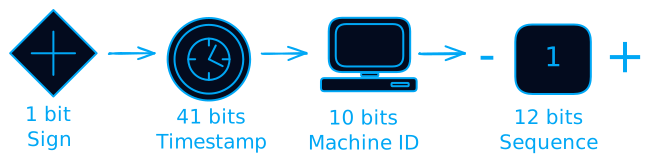
Twitter's Snowflake algorithm is elegant in its simplicity. It packs everything you need into a 64-bit integer:
import time
import threading

class SnowflakeGenerator:
    def __init__(self, machine_id, datacenter_id=0):
        self.machine_id = machine_id & 0x3FF  # 10 bits
        self.datacenter_id = datacenter_id & 0x1F  # 5 bits
        self.sequence = 0
        self.last_timestamp = -1
        self.lock = threading.Lock()

        # Custom epoch (e.g., 2020-01-01)
        self.epoch = 1577836800000

    def generate_id(self):
        with self.lock:
            timestamp = int(time.time() * 1000)

            if timestamp < self.last_timestamp:
                raise Exception("Clock moved backwards!")

            if timestamp == self.last_timestamp:
                self.sequence = (self.sequence + 1) & 0xFFF
                if self.sequence == 0:
                    # Sequence overflow, wait for next millisecond
                    while timestamp <= self.last_timestamp:
                        timestamp = int(time.time() * 1000)
            else:
                self.sequence = 0

            self.last_timestamp = timestamp

            # Combine all parts
            id_value = ((timestamp - self.epoch) << 22) | \
                      (self.datacenter_id << 17) | \
                      (self.machine_id << 12) | \
                      self.sequence

            return id_value
The Good: Sortable by time, compact 64-bit integers, high performance. The Bad: Requires machine coordination, clock synchronization issues, limited to ~4000 IDs per millisecond per machine.
3. Hybrid Approaches: Best of Both Worlds
Sometimes you need to get creative. Here's a hybrid approach that combines multiple techniques:
import hashlib
import socket
import os

class HybridIDGenerator:
    def __init__(self):
        self.machine_fingerprint = self._generate_machine_fingerprint()
        self.process_id = os.getpid()
        self.counter = 0

    def _generate_machine_fingerprint(self):
        """Generate a unique fingerprint for this machine"""
        hostname = socket.gethostname()
        mac = hex(uuid.getnode())[2:]
        fingerprint = hashlib.sha256(f"{hostname}{mac}".encode()).hexdigest()[:8]
        return fingerprint

    def generate_secure_id(self):
        """Generate a secure, non-predictable ID"""
        timestamp = int(time.time() * 1000000)  # microseconds
        self.counter = (self.counter + 1) % 10000

        raw_data = f"{timestamp}{self.machine_fingerprint}{self.process_id}{self.counter}"
        return hashlib.sha256(raw_data.encode()).hexdigest()[:16]

    def generate_readable_id(self, prefix=""):
        """Generate a human-readable ID"""
        timestamp = int(time.time())
        return f"{prefix}{timestamp}{self.counter:04d}"
The Distributed Systems Challenge
Here's where things get really interesting. When you're dealing with multiple nodes, you need to think about:
Coordination Strategies
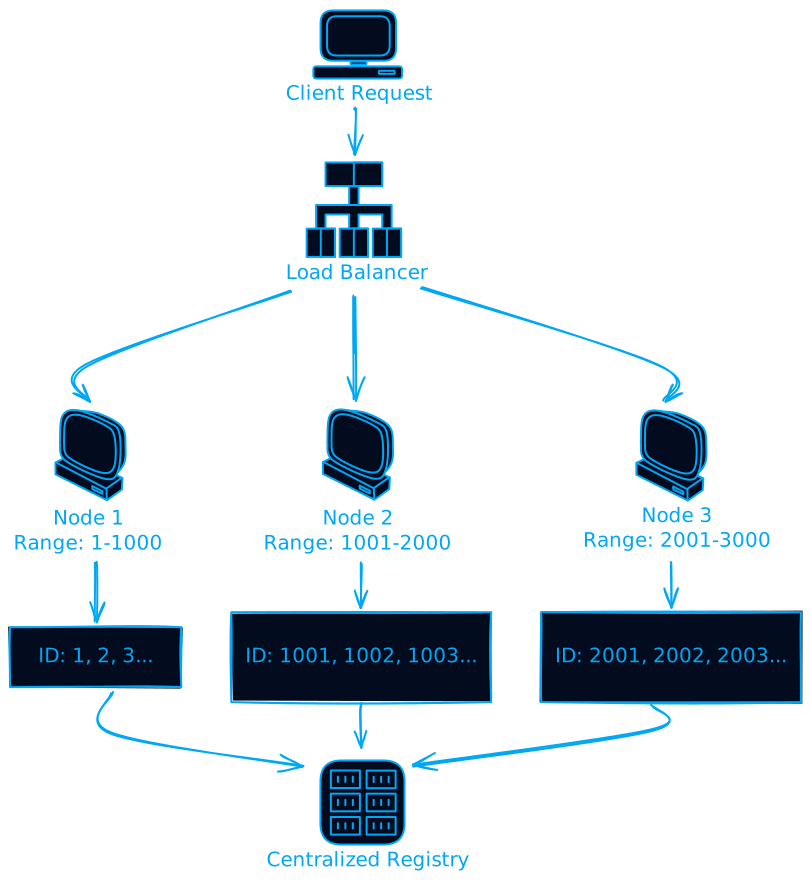
Range Allocation: Each node gets a pre-allocated range of IDs. Simple but requires coordination when ranges are exhausted.
Leader Election: One node becomes the "ID master" and coordinates with others. Works well but creates a single point of failure.
Consensus Protocols: Use Raft or Paxos to maintain consistency. Robust but complex to implement.
Handling Network Partitions
What happens when your nodes can't talk to each other? This is where the CAP theorem hits you in the face:
class PartitionTolerantGenerator:
    def __init__(self, node_id, total_nodes):
        self.node_id = node_id
        self.total_nodes = total_nodes
        self.local_counter = 0

    def generate_id_during_partition(self):
        """Generate IDs even during network partitions"""
        # Use node_id as offset to avoid collisions
        base_id = (self.local_counter * self.total_nodes) + self.node_id
        self.local_counter += 1

        # Add timestamp for additional uniqueness
        timestamp = int(time.time() * 1000)
        return f"{timestamp}-{base_id}"
Security Considerations (Because Hackers Exist)
If your IDs are predictable, you're basically handing attackers a roadmap to your data:
class SecureIDGenerator:
    def __init__(self):
        self.secret_key = os.urandom(32)

    def generate_secure_id(self, entity_type=""):
        """Generate a cryptographically secure ID"""
        # Use CSPRNG for unpredictability
        random_bytes = os.urandom(16)

        # Add entity type for context
        context = f"{entity_type}{int(time.time())}"

        # HMAC for integrity
        hmac_obj = hmac.new(self.secret_key,
                           context.encode() + random_bytes,
                           hashlib.sha256)

        return base64.urlsafe_b64encode(hmac_obj.digest()[:16]).decode().rstrip('=')
Pro tip: Never expose sequential IDs externally. Use UUIDs or encrypted IDs for public-facing APIs.
Performance Optimization Strategies
Batching for High Throughput
class BatchIDGenerator:
    def __init__(self, batch_size=1000):
        self.batch_size = batch_size
        self.current_batch = []
        self.batch_index = 0
        self.lock = threading.Lock()

    def _generate_batch(self):
        """Pre-generate a batch of IDs"""
        base_timestamp = int(time.time() * 1000)
        return [f"{base_timestamp}-{i:06d}" for i in range(self.batch_size)]

    def get_id(self):
        with self.lock:
            if self.batch_index >= len(self.current_batch):
                self.current_batch = self._generate_batch()
                self.batch_index = 0

            id_value = self.current_batch[self.batch_index]
            self.batch_index += 1
            return id_value
Caching and Pre-allocation
For ultra-high performance scenarios, pre-allocate ID ranges and cache them:
class CachedIDGenerator:
    def __init__(self, cache_size=10000):
        self.cache = queue.Queue(maxsize=cache_size)
        self.generator_thread = threading.Thread(target=self._background_generator)
        self.generator_thread.daemon = True
        self.generator_thread.start()

    def _background_generator(self):
        """Background thread to keep cache filled"""
        counter = 0
        while True:
            if not self.cache.full():
                timestamp = int(time.time() * 1000000)
                id_value = f"{timestamp}-{counter:08d}"
                self.cache.put(id_value)
                counter += 1
            time.sleep(0.001)  # Small delay to prevent CPU spinning

    def get_id(self):
        try:
            return self.cache.get(timeout=1.0)
        except queue.Empty:
            # Fallback to direct generation
            return f"fallback-{int(time.time() * 1000000)}"
Monitoring and Observability
You can't manage what you don't measure. Here's what you should track:
import logging
from collections import defaultdict
import time

class MonitoredIDGenerator:
    def __init__(self):
        self.metrics = defaultdict(int)
        self.last_reset = time.time()
        self.logger = logging.getLogger(__name__)

    def generate_id(self):
        start_time = time.time()

        try:
            # Your ID generation logic here
            id_value = self._actual_generate_id()

            # Track success metrics
            self.metrics['ids_generated'] += 1
            self.metrics['total_latency'] += (time.time() - start_time)

            return id_value

        except Exception as e:
            self.metrics['generation_errors'] += 1
            self.logger.error(f"ID generation failed: {e}")
            raise

    def get_metrics(self):
        """Return current performance metrics"""
        elapsed = time.time() - self.last_reset
        return {
            'ids_per_second': self.metrics['ids_generated'] / elapsed,
            'avg_latency_ms': (self.metrics['total_latency'] /
                             max(self.metrics['ids_generated'], 1)) * 1000,
            'error_rate': self.metrics['generation_errors'] /
                         max(self.metrics['ids_generated'], 1),
            'total_generated': self.metrics['ids_generated']
        }
Real-World Implementation Patterns
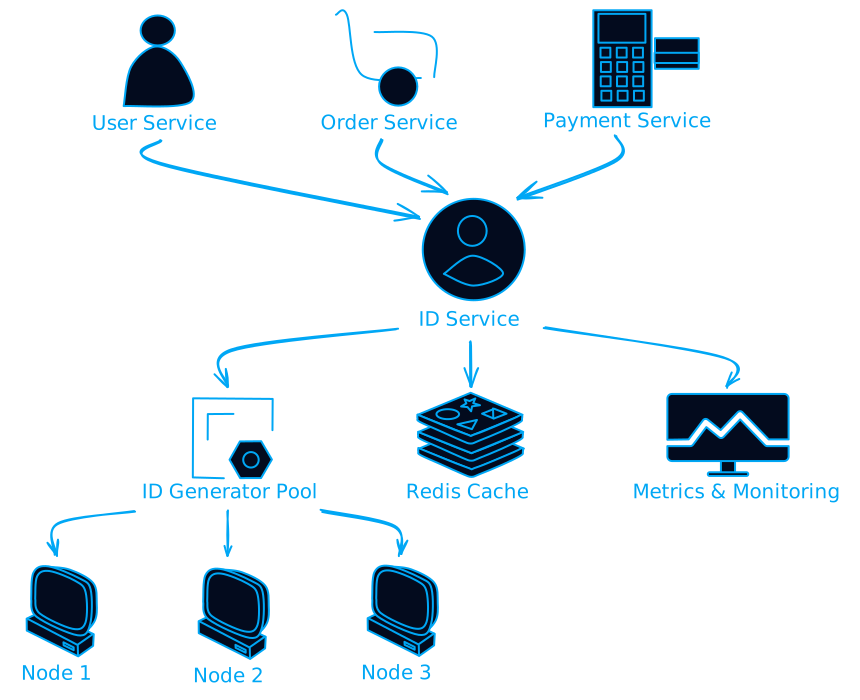
The Microservices Approach
In a microservices architecture, you might want a dedicated ID service:
The Embedded Approach
For lower latency, embed the generator directly in your services:
class EmbeddedIDService:
    def __init__(self, service_name, node_id):
        self.service_name = service_name
        self.node_id = node_id
        self.generators = {
            'user': SnowflakeGenerator(node_id, datacenter_id=1),
            'order': SnowflakeGenerator(node_id, datacenter_id=2),
            'payment': UUIDGenerator()  # High security requirement
        }

    def get_id(self, entity_type):
        generator = self.generators.get(entity_type)
        if not generator:
            raise ValueError(f"No generator for entity type: {entity_type}")

        return generator.generate_id()
Testing Your ID Generator (Because Bugs Happen)
Here's how to test for the most common failure modes:
import unittest
import threading
import time
from collections import defaultdict

class IDGeneratorTests(unittest.TestCase):
    def test_uniqueness_under_load(self):
        """Test uniqueness with concurrent generation"""
        generator = SnowflakeGenerator(machine_id=1)
        generated_ids = set()
        errors = []

        def generate_ids():
            try:
                for _ in range(1000):
                    id_val = generator.generate_id()
                    if id_val in generated_ids:
                        errors.append(f"Duplicate ID: {id_val}")
                    generated_ids.add(id_val)
            except Exception as e:
                errors.append(str(e))

        # Run 10 threads concurrently
        threads = [threading.Thread(target=generate_ids) for _ in range(10)]
        for t in threads:
            t.start()
        for t in threads:
            t.join()

        self.assertEqual(len(errors), 0, f"Errors occurred: {errors}")
        self.assertEqual(len(generated_ids), 10000, "Not all IDs were unique")

    def test_clock_skew_handling(self):
        """Test behavior when system clock goes backwards"""
        generator = SnowflakeGenerator(machine_id=1)

        # Generate an ID
        id1 = generator.generate_id()

        # Simulate clock going backwards
        generator.last_timestamp = int(time.time() * 1000) + 1000

        # This should raise an exception
        with self.assertRaises(Exception):
            generator.generate_id()
Common Pitfalls and How to Avoid Them
The "It Works on My Machine" Syndrome
Your ID generator might work perfectly in development but fail spectacularly in production. Common causes:
- Different system clocks - Use NTP synchronization
- Different machine IDs - Implement proper machine ID allocation
- Different load patterns - Load test with realistic traffic
The Performance Cliff
Many ID generators have a performance cliff where they suddenly become much slower:
# Bad: Linear search for available ID
def find_available_id_bad(used_ids):
    id_candidate = 1
    while id_candidate in used_ids:
        id_candidate += 1
    return id_candidate

# Good: Use a more efficient approach
def find_available_id_good(used_ids, last_id=0):
    # Start from last known good ID
    return max(used_ids) + 1 if used_ids else 1
The Security Blindspot
Don't expose internal IDs externally. Use a mapping layer:
class PublicIDMapper:
    def __init__(self):
        self.internal_to_public = {}
        self.public_to_internal = {}

    def get_public_id(self, internal_id):
        if internal_id not in self.internal_to_public:
            public_id = self._generate_public_id()
            self.internal_to_public[internal_id] = public_id
            self.public_to_internal[public_id] = internal_id

        return self.internal_to_public[internal_id]

    def _generate_public_id(self):
        return base64.urlsafe_b64encode(os.urandom(12)).decode().rstrip('=')
The Future of ID Generation
As systems become more distributed and edge computing grows, we're seeing new patterns emerge:
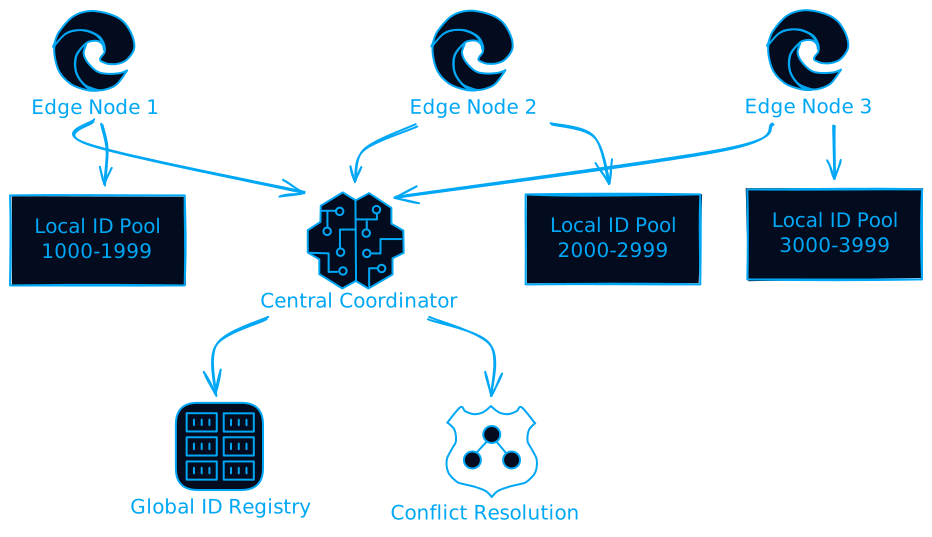
Edge-First ID Generation
Generate IDs at the edge and sync later:
Blockchain-Inspired Approaches
Using cryptographic proofs for ID uniqueness without central coordination.
AI-Optimized Generation
Machine learning models that predict ID usage patterns and optimize generation accordingly.
Wrapping Up: Your ID Generation Strategy
Here's my recommendation for choosing an ID generation strategy:
For simple applications: Database auto-increment or UUID v4 For distributed systems: Snowflake or similar timestamp-based approach For high-security applications: Cryptographically secure random IDs For human-readable needs: Hybrid approach with prefixes and checksums
Remember, the best ID generator is the one that fits your specific requirements. Don't over-engineer, but don't under-estimate the complexity either.
The key is to start simple, measure everything, and evolve your approach as your system grows. And always, always test for the edge cases, because that's where your system will break in production.
Got questions about implementing any of these patterns? The devil's in the details, and every system has its unique challenges. But with these fundamentals, you're well-equipped to build ID generators that won't keep you up at night.
Want to dive deeper? Check out the implementation details of Twitter's Snowflake, Instagram's ID generation system, or Discord's approach to distributed ID generation. Each has unique solutions to the same fundamental problem.