The Saga Pattern: Your Distributed Transaction Lifesaver
So you've gone down the microservices rabbit hole, huh? Welcome to the club. You probably started with a nice, cozy monolith, then someone mentioned "scalability" and "independent deployments," and now you're here, staring at a distributed mess wondering how the hell you're supposed to keep your data consistent across 15 different services.
Let me guess what happened. You tried to process an order that needs to:
- Reserve inventory (Service A)
- Charge the customer (Service B)
- Update loyalty points (Service C)
- Send a confirmation email (Service D)
And somewhere along the way, Service B decided to take a coffee break, leaving you with reserved inventory, no payment, confused customers, and a very angry product manager.
Sound familiar? Yeah, I thought so.
What Even Is This Saga Thing?
The Saga pattern isn't some mystical architecture buzzword (okay, maybe it is a little). It's actually a pretty clever way to handle distributed transactions without losing your sanity or your data integrity.
Think of it like this: instead of trying to coordinate all your services in one massive, all-or-nothing transaction (spoiler alert: that doesn't work well in distributed systems), you break it down into a series of smaller, local transactions. Each service does its own thing, and if something goes wrong, you have a plan to undo everything that already happened.
It's like planning a road trip with friends. Instead of everyone meeting at one place and traveling together (which never works because someone's always late), each person drives their own car to the destination. If someone breaks down, they can turn around and go home without ruining everyone else's trip.
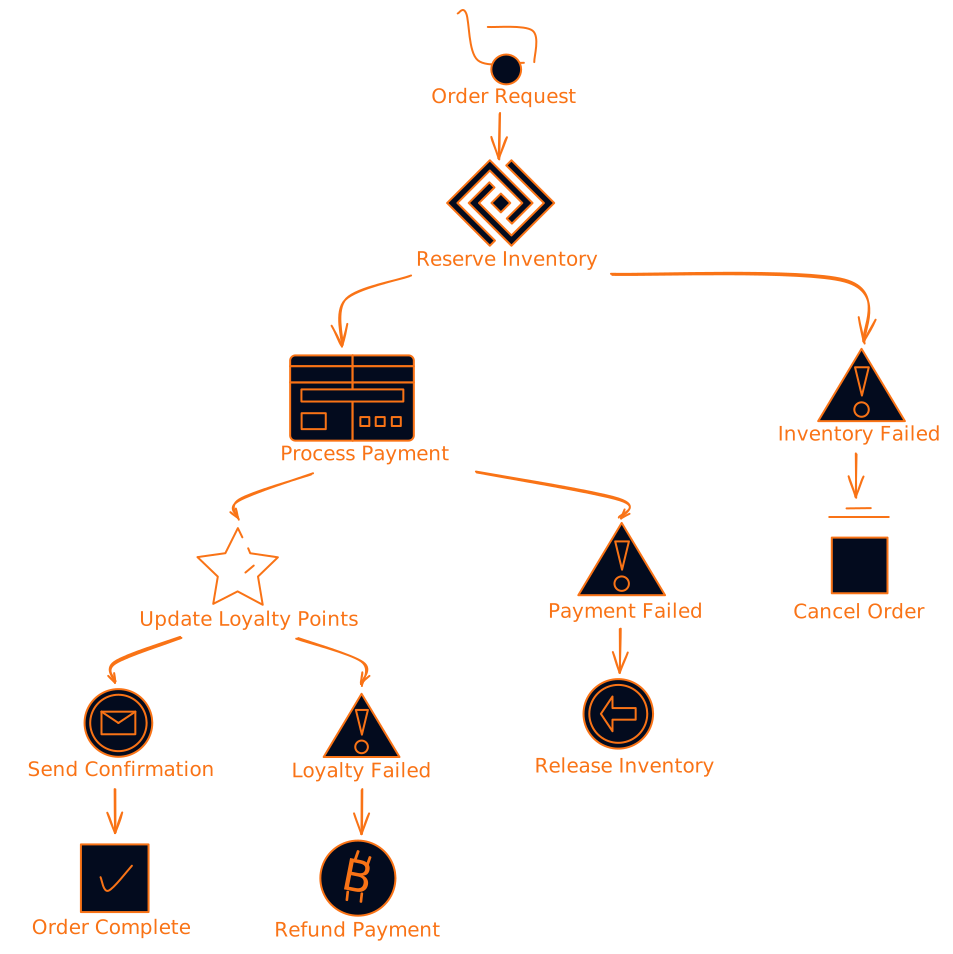
The Two Flavors: Choreography vs Orchestration
Now, there are two main ways to implement this pattern, and choosing between them is like choosing between cats and dogs, everyone has strong opinions.
Choreography: The Democratic Approach
In choreography, each service is like that friend who's really good at organizing group activities. They know what to do next and they just do it, publishing events for others to react to.
// Service A publishes an event
eventBus.publish('inventory-reserved', { orderId: 123, items: [...] });

// Service B listens and reacts
eventBus.on('inventory-reserved', async (event) => {
  await processPayment(event.orderId);
  eventBus.publish('payment-processed', event);
});
Pros:
- No single point of failure
- Services stay loosely coupled
- Scales really well
Cons:
- Debugging is like trying to follow a conversation in a crowded room
- Hard to see the big picture
- Can turn into event spaghetti real quick
Orchestration: The Control Freak Approach
Orchestration is like having that one friend who plans everything down to the minute. There's a central coordinator (the orchestrator) that tells everyone what to do and when.
class OrderSagaOrchestrator {
  async processOrder(orderData) {
    try {
      const inventory = await this.reserveInventory(orderData);
      const payment = await this.processPayment(orderData);
      const loyalty = await this.updateLoyalty(orderData);
      await this.sendConfirmation(orderData);

      return { success: true };
    } catch (error) {
      await this.compensate(error.step, orderData);
      throw error;
    }
  }

  async compensate(failedStep, orderData) {
    // Undo everything in reverse order
    switch(failedStep) {
      case 'loyalty':
        await this.refundPayment(orderData);
      case 'payment':
        await this.releaseInventory(orderData);
        break;
    }
  }
}
Pros:
- Easy to understand and debug
- Clear business logic flow
- Better error handling and monitoring
Cons:
- Single point of failure (the orchestrator)
- Can become a bottleneck
- Tighter coupling between services
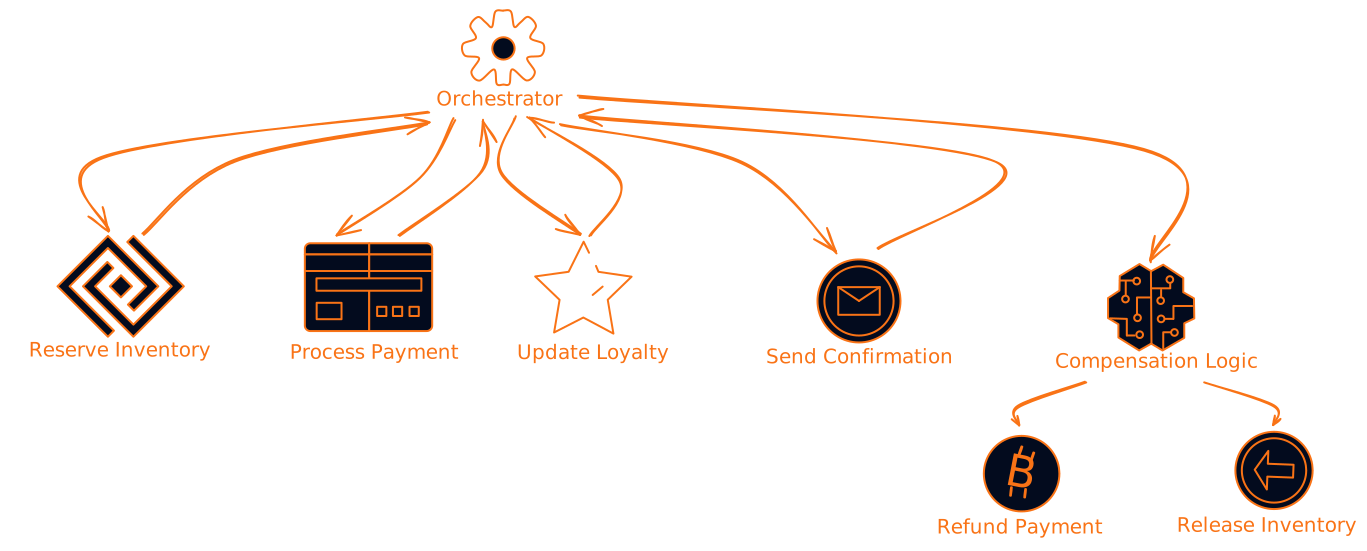
But Wait, What About Consistency?
Here's where things get interesting (and where your database admin starts sweating). The Saga pattern gives you eventual consistency, not the strict ACID consistency you're used to.
This means your system might be temporarily inconsistent during the saga execution. Like, for a few milliseconds, you might have reserved inventory but no payment. That's okay! The saga will either complete successfully or roll everything back.
Think of it like ordering food at a busy restaurant. The waiter takes your order (reserves your table), the kitchen starts cooking (processes your meal), and eventually, you get fed (transaction complete). If the kitchen runs out of ingredients halfway through, they don't serve you half a meal, they cancel the whole order and give you your money back.
The Compensation Game: When Things Go Wrong
This is where the Saga pattern really shines. When something fails, you don't just throw your hands up and cry (though that's tempting). You execute compensating transactions to undo what you've already done.
But here's the tricky part: compensating transactions aren't just "undo" buttons. They're business operations that semantically reverse the effect of a previous operation.
// Original transaction
async function reserveInventory(productId, quantity) {
  await inventory.reserve(productId, quantity);
  return { reserved: true, reservationId: 'res-123' };
}

// Compensating transaction
async function releaseInventory(reservationId) {
  await inventory.release(reservationId);
  // Maybe also log this for audit purposes
  await auditLog.record('inventory-released', { reservationId });
}
Some operations are easier to compensate than others:
- Easy: Reserving inventory → Release inventory
- Medium: Sending an email → Send a "please ignore" email
- Hard: Launching nuclear missiles → ...yeah, maybe don't use sagas for that
Real-World Example: E-commerce Order Processing
Let's walk through a realistic e-commerce scenario because everyone loves shopping, right?
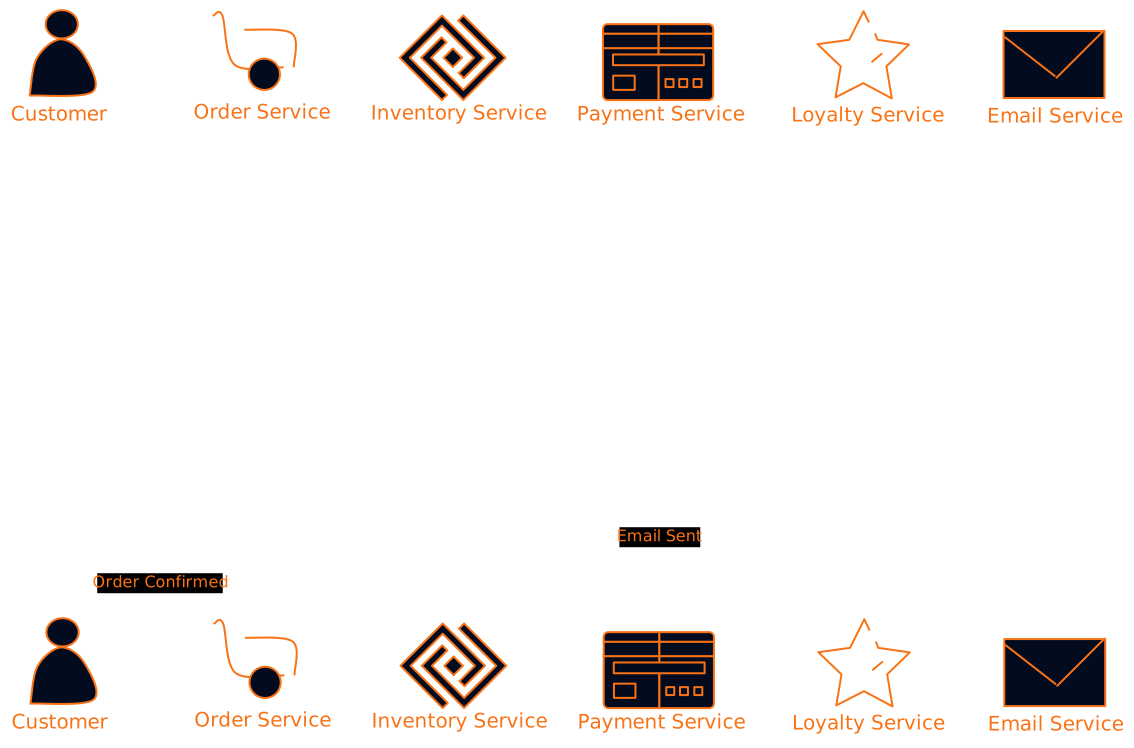
Now, what happens when the payment service decides to have an existential crisis?
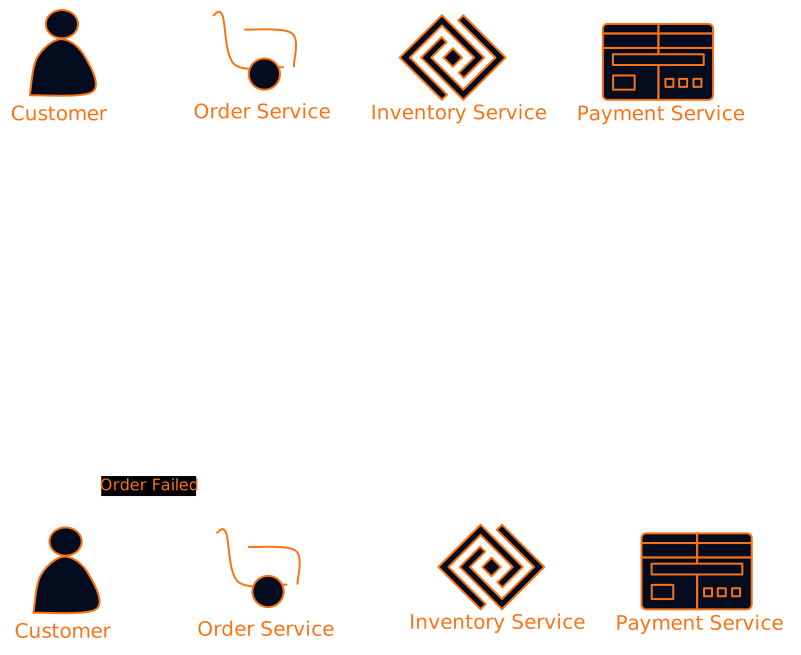
The beauty here is that your customer doesn't end up with reserved inventory and no way to pay for it. The system gracefully handles the failure and cleans up after itself.
The Good, The Bad, and The Ugly
The Good Stuff
Scalability That Actually Scales Unlike traditional distributed transactions (looking at you, two-phase commit), sagas don't lock resources across services. Each service can scale independently without being bottlenecked by the slowest participant.
Fault Tolerance That Doesn't Suck If one service goes down, the others can keep running. The saga can pause and resume when the service comes back online. It's like having a pause button for your business processes.
Service Independence Each service manages its own data and doesn't need to know about the internal workings of other services. This is microservices 101, but sagas actually make it possible to maintain this independence while still coordinating complex workflows.
The Not-So-Good Stuff
Complexity Explosion Every business operation now needs a compensating operation. Your codebase grows, your test suite explodes, and suddenly you're maintaining twice as much code. It's like having to learn to drive in reverse for every forward maneuver.
Debugging Nightmares Tracing a saga execution across multiple services is like following breadcrumbs through a forest during a windstorm. You'll need serious observability tooling to make sense of what's happening.
Eventual Consistency Confusion Your business stakeholders need to understand that "eventually consistent" doesn't mean "maybe consistent." There will be brief periods where the system state looks weird, and that's okay.
When Should You Actually Use This?
Don't just implement sagas because they sound cool (though they are pretty cool). Use them when:
You Have Long-Running Business Processes If your workflow takes minutes or hours to complete, you can't hold database locks that long. Sagas let you break it down into manageable chunks.
You Need Cross-Service Transactions When a single business operation spans multiple services and you need transactional guarantees, sagas are your friend.
You Can Live With Eventual Consistency If your business can handle brief periods of inconsistency, sagas are perfect. If you need strict consistency, you might need to reconsider your service boundaries.
You Have Compensatable Operations Not every operation can be easily compensated. If you can't undo what you've done, sagas might not be the right fit.
Implementation Tips (From Someone Who's Been There)
Start Simple
Don't try to build the perfect saga framework on day one. Start with a simple orchestrator and evolve from there.
// Start with something like this
class SimpleSaga {
  constructor(steps) {
    this.steps = steps;
    this.completedSteps = [];
  }

  async execute(data) {
    try {
      for (const step of this.steps) {
        const result = await step.execute(data);
        this.completedSteps.push({ step, result });
        data = { ...data, ...result };
      }
      return data;
    } catch (error) {
      await this.compensate();
      throw error;
    }
  }

  async compensate() {
    // Execute compensation in reverse order
    for (const { step, result } of this.completedSteps.reverse()) {
      if (step.compensate) {
        await step.compensate(result);
      }
    }
  }
}
Invest in Observability
You'll need distributed tracing, correlation IDs, and comprehensive logging. Trust me on this one. When things go wrong (and they will), you'll want to know exactly what happened and when.
Make Compensation Idempotent
Your compensating operations should be safe to run multiple times. Networks are unreliable, and you might end up retrying compensation logic.
// Bad: Not idempotent
async function refundPayment(paymentId, amount) {
  await payments.refund(paymentId, amount);
}

// Good: Idempotent
async function refundPayment(paymentId, amount) {
  const existingRefund = await payments.getRefund(paymentId);
  if (!existingRefund) {
    await payments.refund(paymentId, amount);
  }
}
Handle Partial Failures Gracefully
Sometimes a step might partially succeed. Design your operations to be resumable or at least detectable.
Common Pitfalls (And How to Avoid Them)
The "Everything Is a Saga" Trap
Not every operation needs to be a saga. If you're just updating a single service, use a regular transaction. Sagas are for coordinating across service boundaries.
Ignoring the Business Context
Your compensating operations should make business sense, not just technical sense. Canceling an order isn't the same as never placing it in the first place.
Poor Error Handling
Don't just catch exceptions and hope for the best. Design your error handling strategy upfront, including what happens when compensation fails.
Forgetting About Timeouts
Long-running sagas need timeout handling. What happens if a step takes 10 minutes instead of 10 seconds? Plan for it.
The Future Is Saga-Shaped
The Saga pattern isn't just a nice-to-have anymore, it's becoming essential as systems get more distributed and complex. With the rise of event-driven architectures, serverless computing, and edge computing, the ability to coordinate loosely coupled services while maintaining data integrity is crucial.
Tools and frameworks are getting better too. AWS Step Functions, Azure Logic Apps, and various open-source saga frameworks are making implementation easier. But remember, tools don't solve design problems, they just make good designs easier to implement.
Wrapping Up
The Saga pattern isn't a silver bullet (nothing ever is), but it's a powerful tool for managing distributed transactions in microservices architectures. It lets you maintain data consistency without the tight coupling and performance bottlenecks of traditional distributed transactions.
Yes, it adds complexity. Yes, you'll need better tooling and monitoring. Yes, your team will need to understand eventual consistency. But the payoff in terms of scalability, resilience, and service independence is worth it.
Just remember: start simple, invest in observability, design for failure, and always think about the business context of your operations. Your future self (and your on-call rotation) will thank you.
Now go forth and saga responsibly. And maybe keep that product manager happy while you're at it.
Want to dive deeper? Check out the AWS Prescriptive Guidance on the Saga pattern, or if you're feeling brave, try implementing a simple saga in your favorite language. Just don't blame me when you end up in a rabbit hole of distributed systems theory at 2 AM.