Service Discovery - How Microservices Actually Find Each Other
Ever wondered how your Netflix app knows which server to hit when you're binge-watching your favorite show? Or how Uber connects you to the nearest driver without breaking a sweat? The answer lies in something called service discovery, and it's way more interesting than it sounds.
If you're building microservices (or just curious about how distributed systems work), you've probably hit that moment where you realize your services need to talk to each other. But here's the thing, they're scattered across different servers, containers, and maybe even different data centers. So how do they find each other?
Let's dive into the world of service discovery and see how the magic actually happens.
What's the Big Deal with Service Discovery?
Picture this: you're running a food delivery app with separate services for user management, restaurant listings, order processing, and payment handling. Each service might have multiple instances running on different servers for redundancy and load distribution.
Now, when a user places an order, your order service needs to:
- Talk to the user service to verify the customer
- Hit the restaurant service to check availability
- Connect to the payment service to process the transaction
But here's where it gets tricky. These services are constantly starting up, shutting down, scaling up and down. Their IP addresses and ports change. Hardcoding these locations is like trying to navigate with a map from 1995, it's just not going to work.
That's where service discovery comes in. It's basically a phone book for your microservices, but one that updates itself automatically.
The Three Ways Services Find Each Other
Client-Side Discovery: "I'll Find It Myself"
In client-side discovery, each service is responsible for figuring out where other services live. It's like being your own detective.
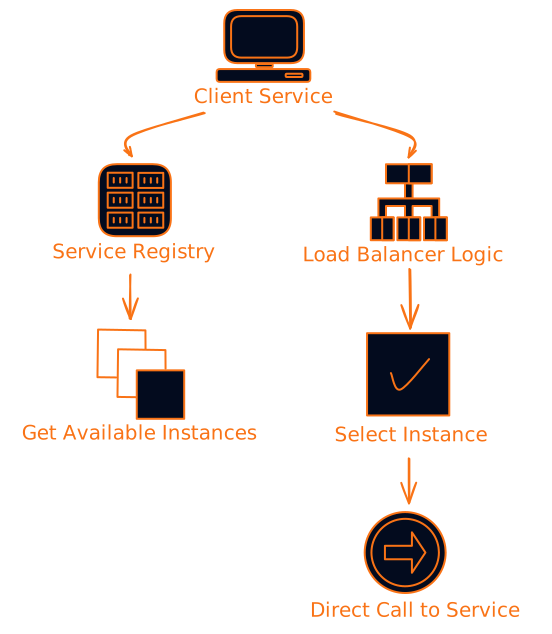
Here's how it works:
- Services register themselves with a central registry when they start up
- When Service A needs to talk to Service B, it queries the registry
- The registry returns a list of healthy Service B instances
- Service A picks one (using round-robin, random, or some other strategy)
- Service A makes a direct call to the chosen instance
The Good: You get full control over load balancing and can implement custom retry logic. Plus, there's no extra network hop, so it's potentially faster.
The Not-So-Good: Every client needs to implement discovery logic, which can get messy. And if you have 50 different services, that's 50 places where things can go wrong.
Popular tools for this approach include Netflix Eureka, HashiCorp Consul, and Apache Zookeeper.
Server-Side Discovery: "Let Someone Else Handle It"
Server-side discovery is like having a really good concierge. You tell them what you need, and they figure out the details.
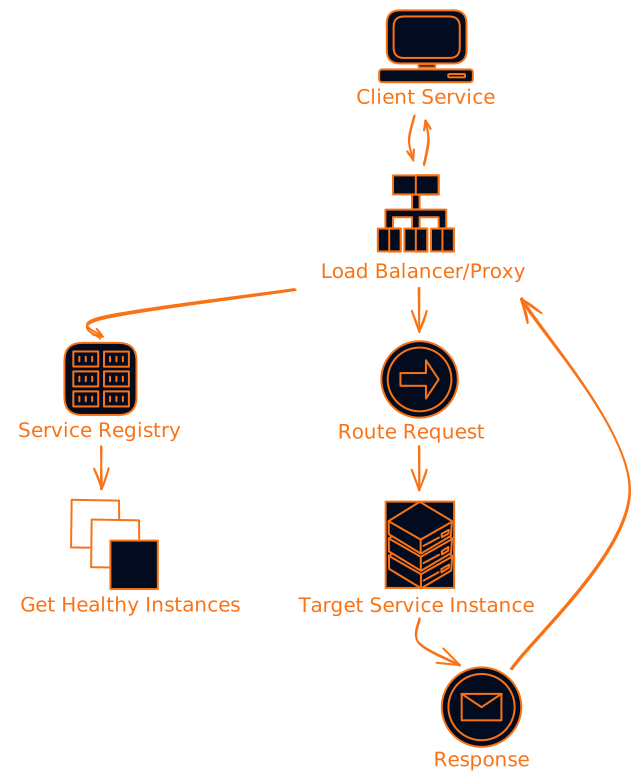
The process looks like this:
- Services still register with a registry
- Client sends requests to a load balancer or API gateway
- The load balancer queries the registry to find healthy instances
- It forwards the request to an appropriate instance
- The response comes back through the same path
The Good: Clients stay simple since they don't need discovery logic. You get centralized control over routing, security, and monitoring.
The Not-So-Good: There's an extra network hop, which adds latency. Plus, your load balancer becomes a potential single point of failure.
Tools like NGINX, HAProxy, and Kubernetes Ingress controllers excel at this pattern.
DNS-Based Discovery: "Keep It Simple"
Sometimes the old ways are the best ways. DNS-based discovery uses the Domain Name System that's been around since the internet was young.
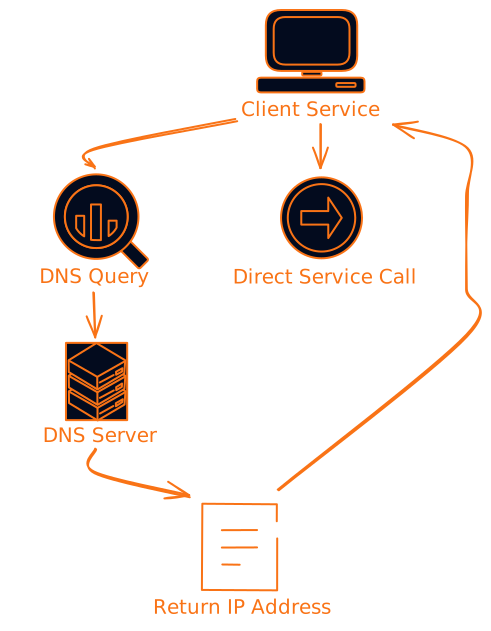
Each service gets a DNS name, and clients use standard DNS resolution to find the IP address. It's beautifully simple, but it has limitations. DNS caching can make updates slow, and you don't get fancy load balancing features out of the box.
The Service Registry: The Heart of It All
No matter which discovery pattern you choose, you'll likely need a service registry. Think of it as the central database that keeps track of all your services.
Registration: "Hey, I'm Here!"
When a service starts up, it needs to announce itself:
{
  "serviceName": "user-service",
  "instanceId": "user-service-001",
  "host": "192.168.1.100",
  "port": 8080,
  "healthCheckUrl": "/health",
  "metadata": {
    "version": "1.2.3",
    "region": "us-west-2"
  }
}
This can happen in two ways:
- Self-registration: The service registers itself (simple but requires each service to know about the registry)
- Third-party registration: A separate component handles registration (cleaner separation but adds complexity)
Health Checking: "Are You Still There?"
Just because a service registered doesn't mean it's still healthy. The registry needs to continuously check if services are responsive.
Most registries send periodic heartbeat requests to each service. If a service fails to respond within a certain timeframe, it gets marked as unhealthy and removed from the available instances list.
Discovery: "Where Can I Find...?"
When services need to communicate, they query the registry:
GET /services/user-service
The registry responds with a list of healthy instances, and the client can pick one to call.
Client-Side vs Server-Side: The Eternal Debate
So which approach should you choose? Like most things in software engineering, it depends.
| Factor | Client-Side | Server-Side |
|---|---|---|
| Latency | Lower (direct calls) | Higher (extra hop) |
| Client Complexity | Higher | Lower |
| Control | Fine-grained | Centralized |
| Single Point of Failure | No | Potentially yes |
| Language Independence | Requires libraries | Works with any client |
Go client-side when:
- You have a small number of services
- You want maximum control over load balancing
- Latency is critical
- You're okay with more complex clients
Go server-side when:
- You have many services or polyglot environments
- You want to keep clients simple
- You need centralized policy enforcement
- You can afford the extra latency
Real-World Patterns and Gotchas
The Hybrid Approach
Many successful systems use a combination of both patterns. For example:
- External traffic goes through an API gateway (server-side)
- Internal service-to-service communication uses client-side discovery
- Critical paths might use direct service-to-service calls for performance
Circuit Breakers: When Things Go Wrong
In distributed systems, failures are inevitable. That's why you need circuit breakers:
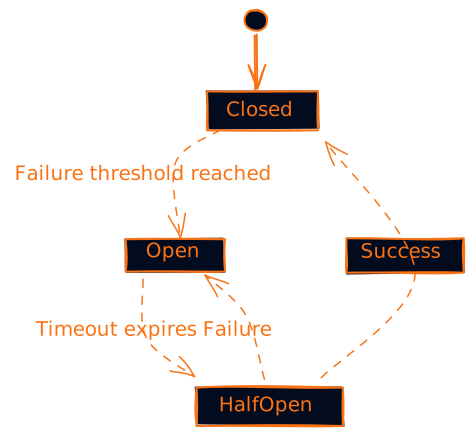
When a service starts failing, the circuit breaker "opens" and stops sending requests to it. After a timeout, it tries again with a single request. If that succeeds, it "closes" the circuit and resumes normal operation.
Service Mesh: The New Kid on the Block
Service meshes like Istio, Linkerd, and Consul Connect are changing the game. They handle service discovery, load balancing, encryption, and observability at the infrastructure level.
With a service mesh, your application code doesn't need to worry about discovery, it just makes calls to localhost, and the mesh handles the rest.
Best Practices That Actually Matter
1. Health Checks Are Critical
Don't just check if the service is running, check if it's actually functional:
@app.route('/health')
def health_check():
    # Check database connectivity
    if not database.is_connected():
        return {'status': 'unhealthy', 'reason': 'database down'}, 503

    # Check external dependencies
    if not external_api.is_reachable():
        return {'status': 'degraded', 'reason': 'external api slow'}, 200

    return {'status': 'healthy'}, 200
2. Graceful Shutdown
When services shut down, they should deregister themselves:
import signal
import sys

def signal_handler(sig, frame):
    print('Deregistering service...')
    service_registry.deregister(service_id)
    sys.exit(0)

signal.signal(signal.SIGINT, signal_handler)
signal.signal(signal.SIGTERM, signal_handler)
3. Retry with Backoff
Network calls fail. Build in intelligent retry logic:
import time
import random

def call_service_with_retry(service_name, max_retries=3):
    for attempt in range(max_retries):
        try:
            instances = registry.get_healthy_instances(service_name)
            if not instances:
                raise ServiceUnavailableError(f"No healthy instances of {service_name}")

            instance = random.choice(instances)
            return make_request(instance)

        except Exception as e:
            if attempt == max_retries - 1:
                raise

            # Exponential backoff with jitter
            delay = (2 ** attempt) + random.uniform(0, 1)
            time.sleep(delay)
4. Monitor Everything
You can't fix what you can't see. Implement comprehensive monitoring:
- Service registration/deregistration events
- Health check success/failure rates
- Discovery query latency
- Service-to-service call patterns
The Future: Where We're Heading
Service discovery is evolving rapidly. Here are some trends to watch:
Service Mesh Adoption: More organizations are moving to service meshes for their built-in discovery, security, and observability features.
Kubernetes Native: If you're running on Kubernetes, the platform's built-in service discovery is becoming the default choice for many teams.
Edge Computing: As applications move closer to users, service discovery needs to work across multiple regions and edge locations.
AI-Driven Load Balancing: Machine learning is starting to influence how traffic gets routed based on real-time performance metrics.
Wrapping Up
Service discovery might seem like a solved problem, but the devil's in the details. The pattern you choose depends on your specific requirements around latency, complexity, and control.
Start simple. If you're just getting started with microservices, DNS-based discovery or your platform's built-in solution (like Kubernetes Services) might be all you need. As you scale and your requirements become more complex, you can always evolve to more sophisticated patterns.
Remember, the best service discovery solution is the one that your team can understand, operate, and debug at 3 AM when things go wrong. Because in distributed systems, things will go wrong, and when they do, you'll be glad you kept it as simple as possible while still meeting your needs.
The key is to start with your requirements, understand the trade-offs, and pick the approach that fits your team and your system. And always, always plan for failure, because in the world of microservices, it's not a matter of if, but when.
Want to dive deeper into microservices patterns? Check out the resources mentioned throughout this post, and don't forget to test your service discovery setup under failure conditions. Your future self (and your on-call rotation) will thank you.