How to Build Scalable Systems: Real-World Techniques That Actually Work
How to Build Scalable Systems: Real-World Techniques That Actually Work
So you built an app. It works great on your laptop, handles a few hundred users just fine, and you're feeling pretty good about yourself. Then suddenly, you get featured on Product Hunt, your user base explodes overnight, and everything crashes harder than a Windows 95 machine trying to run Crysis.
Welcome to the world of scalability problems, where good intentions meet harsh reality.
What Actually Is Scalability (Beyond the Buzzwords)
Let's cut through the marketing speak. Scalability isn't just "making things bigger" or "adding more servers." It's your system's ability to handle growing workloads without completely falling apart. Think of it like a highway system, if you only build two-lane roads and suddenly everyone in the city decides to drive at the same time, you're going to have problems.
But here's where it gets interesting. Scalability isn't one-dimensional. There are actually five different ways your system needs to scale, and most developers only think about one or two of them.
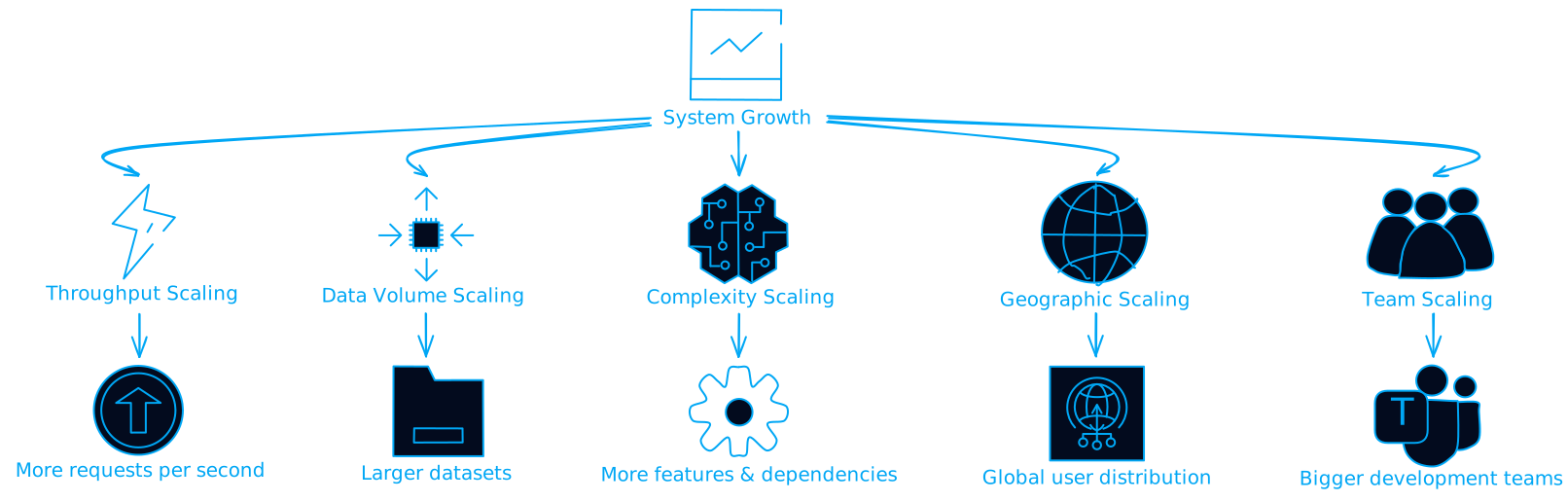
The Five Dimensions That'll Make or Break You
1. Throughput Scalability: The Speed Demon
This is what most people think of first. Can your system handle 10x more requests per second? It's like asking if your kitchen can handle cooking for 100 people instead of 10. Same ingredients, same recipes, just way more volume.
2. Data Volume Scalability: The Storage Monster
Your cute little PostgreSQL database that handles 10GB just fine? Wait until you hit 10TB. Suddenly those table scans that took milliseconds are taking minutes. Your indexes are bloated, your queries are timing out, and your DBA is having nightmares.
3. Complexity Scalability: The Feature Creep Nightmare
Every new feature adds complexity. Every integration adds dependencies. Before you know it, your simple three-tier architecture looks like a bowl of spaghetti that someone threw at a wall. This is where microservices either save you or make everything infinitely worse.
4. Geographic Scalability: The Global Headache
Your app works great for users in California. But what about users in Tokyo? Or Mumbai? Suddenly you're dealing with latency, data sovereignty laws, and the joy of debugging issues that only happen at 3 AM in a timezone you've never heard of.
5. Team Scalability: The Human Factor
This one's sneaky. Your team of 5 developers can coordinate just fine. But what happens when you have 50? Or 500? Conway's Law isn't just a cute observation, it's a prediction of how your architecture will mirror your org chart, for better or worse.
The Techniques That Actually Work (And When They Don't)
Load Balancing: The Traffic Cop
Load balancing is like having a really smart traffic cop who knows exactly which lane is moving fastest. But here's the thing, not all load balancing algorithms are created equal.
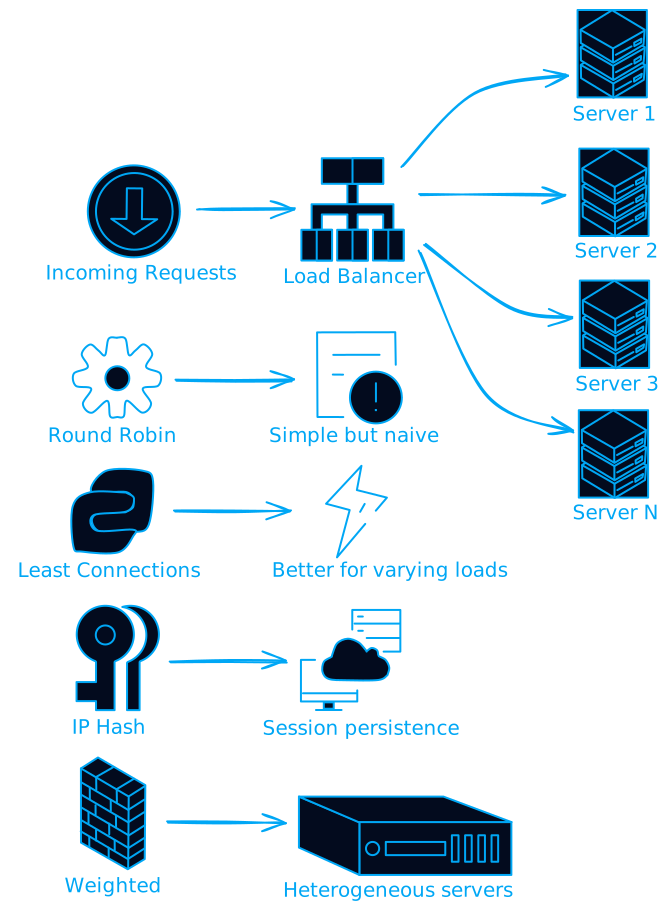
Round-Robin: Works great until one of your servers is a potato and the others are rockets. Suddenly 1/3 of your users are having a terrible time.
Least Connections: Smarter, but what if connections have wildly different processing times? That "least connections" server might actually be the most overloaded.
IP Hash: Great for session stickiness, terrible for hot-spotting. If all your traffic comes from a corporate NAT, good luck with that.
The real trick? Use multiple algorithms in layers. Geographic routing at the edge, least connections for regional distribution, and maybe some custom logic for your specific use case.
Caching: The Memory Palace
Caching is like having a really good memory. Instead of going to the library every time you need to look something up, you remember the important stuff. But caching is also where most developers shoot themselves in the foot.
# This looks innocent enough
def get_user_profile(user_id):
    cache_key = f"user_profile_{user_id}"
    profile = cache.get(cache_key)

    if profile is None:
        profile = database.get_user_profile(user_id)
        cache.set(cache_key, profile, ttl=3600)  # 1 hour

    return profile
But what happens when you update a user's profile? Suddenly you have stale data for up to an hour. Cache invalidation isn't just one of the "two hard problems in computer science" for fun, it's genuinely tricky.
The Cache Hierarchy That Actually Works:
- Browser Cache: Free performance, but you have zero control
- CDN Cache: Great for static assets, terrible for dynamic content
- Application Cache: Fast but limited by memory
- Database Query Cache: Helps with repeated queries
- Database Buffer Pool: The unsung hero of database performance
Database Sharding: The Divide and Conquer Approach
Sharding is like organizing a massive library by splitting it into multiple buildings. Each building (shard) has part of the collection, and you need to know which building to visit for which book.
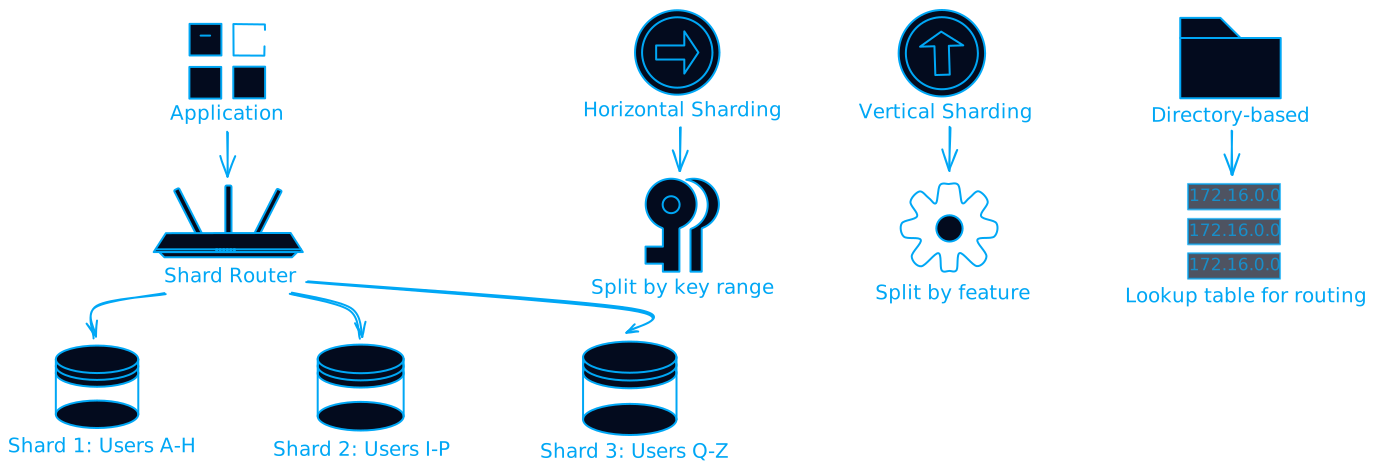
But here's where sharding gets nasty:
- Cross-shard queries become expensive joins across the network
- Rebalancing shards is like reorganizing that library while people are still trying to read
- Hot shards (looking at you, celebrity user accounts) can still overwhelm individual nodes
The key is choosing your shard key wisely. User ID? Great until you have power users. Geographic region? Perfect until everyone moves to the same city for a conference.
Asynchronous Processing: The "I'll Get Back to You" Strategy
Sometimes the best way to handle a request is to not handle it immediately. Async processing is like having a really efficient assistant who takes messages and handles them when they have time.
# Synchronous: User waits for everything
def process_order(order_data):
    validate_payment(order_data.payment)  # 200ms
    update_inventory(order_data.items)    # 500ms
    send_confirmation_email(order_data)   # 1000ms
    generate_shipping_label(order_data)   # 800ms
    return "Order processed"  # User waited 2.5 seconds

# Asynchronous: User gets immediate response
def process_order_async(order_data):
    validate_payment(order_data.payment)  # Still need to wait for this

    # Queue the rest for background processing
    task_queue.enqueue('update_inventory', order_data.items)
    task_queue.enqueue('send_confirmation_email', order_data)
    task_queue.enqueue('generate_shipping_label', order_data)

    return "Order received"  # User waited 200ms
The Async Toolbox:
- Message Queues: RabbitMQ, Apache Kafka, AWS SQS
- Task Queues: Celery, Sidekiq, Bull
- Event Streaming: Apache Kafka, AWS Kinesis
- Serverless Functions: AWS Lambda, Google Cloud Functions
But async isn't magic. You're trading immediate consistency for eventual consistency, and that comes with its own set of problems. What happens if the background job fails? How do you handle partial failures? How do you debug a system where cause and effect are separated by time and space?
Microservices: The Double-Edged Sword
Microservices are like having a bunch of specialists instead of generalists. Each service does one thing really well, but coordinating them becomes its own challenge.
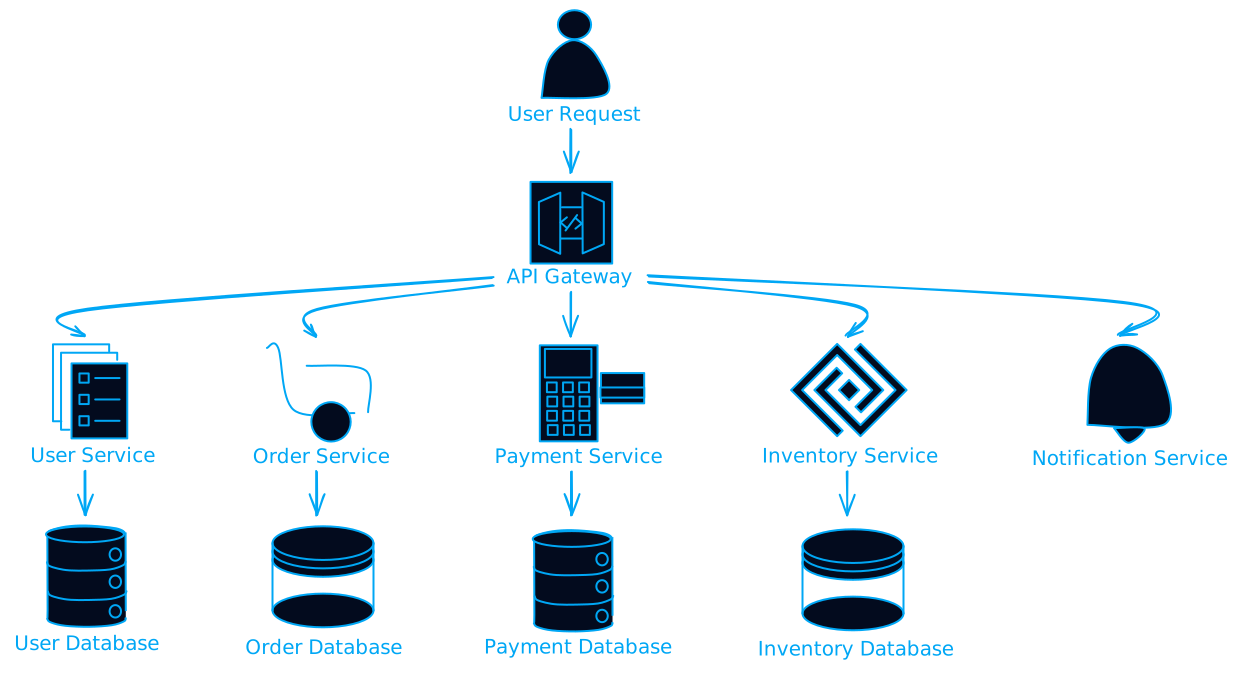
The Good:
- Each service can scale independently
- Different teams can work on different services
- Technology diversity (use the right tool for the job)
- Fault isolation (one service failing doesn't kill everything)
The Bad:
- Network calls everywhere (latency and failure points)
- Distributed debugging is a nightmare
- Data consistency across services is hard
- Operational complexity explodes
The Ugly:
- You've traded simple problems for complex ones
- Your monitoring and logging needs to be top-notch
- Testing becomes significantly more complex
The Challenges That'll Keep You Up at Night
Database Scaling: The Final Boss
Databases are often the bottleneck that kills scalability dreams. Here's why:
Resource Limitations: Your database server has finite CPU, memory, and I/O. Throwing more hardware at it (vertical scaling) works until it doesn't. There's only so much RAM you can stuff into a single machine.
Distributed Complexity: Once you go distributed (sharding, replication, etc.), you're playing a different game entirely. CAP theorem isn't just academic theory, it's a daily reality check.
Data Consistency: ACID properties are great until you need to scale across multiple nodes. Suddenly you're choosing between consistency and availability, and both choices hurt.
High Concurrency: Locks, deadlocks, and contention become your enemies. That elegant transaction that works fine with 10 concurrent users becomes a bottleneck with 10,000.
-- This looks innocent
BEGIN TRANSACTION;
UPDATE inventory SET quantity = quantity - 1 WHERE product_id = 123;
INSERT INTO orders (user_id, product_id, quantity) VALUES (456, 123, 1);
COMMIT;

-- But with high concurrency, you get:
-- Deadlocks, lock timeouts, phantom reads, and general sadness
Legacy Systems: The Technical Debt Monster
Every successful system eventually becomes a legacy system. That beautiful, clean architecture you started with? Give it a few years of feature requests, bug fixes, and "temporary" workarounds, and it becomes a Frankenstein's monster of technical debt.
The Legacy Trap:
- Can't rewrite it (too risky, too expensive)
- Can't easily modify it (too complex, too fragile)
- Can't ignore it (it's making money, users depend on it)
The solution? Gradual modernization. Strangler fig pattern. API facades. Lots of patience and even more coffee.
Best Practices That Actually Work in the Real World
Start with Monitoring and Observability
You can't scale what you can't measure. Before you start optimizing, you need to know where the bottlenecks actually are, not where you think they are.
# Instrument everything
import time
import logging
from functools import wraps

def monitor_performance(func):
    @wraps(func)
    def wrapper(*args, **kwargs):
        start_time = time.time()
        try:
            result = func(*args, **kwargs)
            logging.info(f"{func.__name__} completed in {time.time() - start_time:.2f}s")
            return result
        except Exception as e:
            logging.error(f"{func.__name__} failed after {time.time() - start_time:.2f}s: {e}")
            raise
    return wrapper

@monitor_performance
def expensive_operation():
    # Your code here
    pass
The Observability Stack:
- Metrics: Prometheus, Grafana, DataDog
- Logging: ELK Stack, Splunk, Fluentd
- Tracing: Jaeger, Zipkin, AWS X-Ray
- APM: New Relic, AppDynamics, Dynatrace
Design for Failure
Everything will fail. Your servers will crash, your network will partition, your database will corrupt, and your cloud provider will have an outage. Design for it.
Circuit Breaker Pattern:
class CircuitBreaker:
    def __init__(self, failure_threshold=5, timeout=60):
        self.failure_threshold = failure_threshold
        self.timeout = timeout
        self.failure_count = 0
        self.last_failure_time = None
        self.state = 'CLOSED'  # CLOSED, OPEN, HALF_OPEN

    def call(self, func, *args, **kwargs):
        if self.state == 'OPEN':
            if time.time() - self.last_failure_time > self.timeout:
                self.state = 'HALF_OPEN'
            else:
                raise Exception("Circuit breaker is OPEN")

        try:
            result = func(*args, **kwargs)
            if self.state == 'HALF_OPEN':
                self.state = 'CLOSED'
                self.failure_count = 0
            return result
        except Exception as e:
            self.failure_count += 1
            self.last_failure_time = time.time()

            if self.failure_count >= self.failure_threshold:
                self.state = 'OPEN'

            raise e
Embrace Horizontal Scaling
Vertical scaling (bigger servers) is easy but limited. Horizontal scaling (more servers) is harder but unlimited. Design your system to scale out, not up.
Stateless Services: If your service stores state locally, you can't easily add more instances. Push state to external stores (databases, caches, message queues).
Load Distribution: Use consistent hashing, partition keys, and other techniques to distribute load evenly across instances.
Auto-scaling: Don't manually add servers at 3 AM. Use auto-scaling groups, Kubernetes HPA, or similar tools to scale automatically based on metrics.
Cache Strategically
Caching isn't just "add Redis and hope for the best." You need a strategy.
Cache-Aside Pattern:
def get_user(user_id):
    # Try cache first
    user = cache.get(f"user:{user_id}")
    if user:
        return user

    # Cache miss, get from database
    user = database.get_user(user_id)

    # Store in cache for next time
    cache.set(f"user:{user_id}", user, ttl=3600)
    return user

def update_user(user_id, user_data):
    # Update database
    database.update_user(user_id, user_data)

    # Invalidate cache
    cache.delete(f"user:{user_id}")
Write-Through Pattern:
def update_user(user_id, user_data):
    # Update database and cache together
    database.update_user(user_id, user_data)
    cache.set(f"user:{user_id}", user_data, ttl=3600)
Write-Behind Pattern:
def update_user(user_id, user_data):
    # Update cache immediately
    cache.set(f"user:{user_id}", user_data, ttl=3600)

    # Queue database update for later
    task_queue.enqueue('update_user_in_db', user_id, user_data)
The Real-World Reality Check
When Microservices Make Things Worse
Microservices aren't always the answer. Sometimes they're the problem.
You Probably Don't Need Microservices If:
- Your team has fewer than 10 developers
- Your system handles fewer than 1000 requests per second
- You don't have mature DevOps practices
- You can't afford the operational complexity
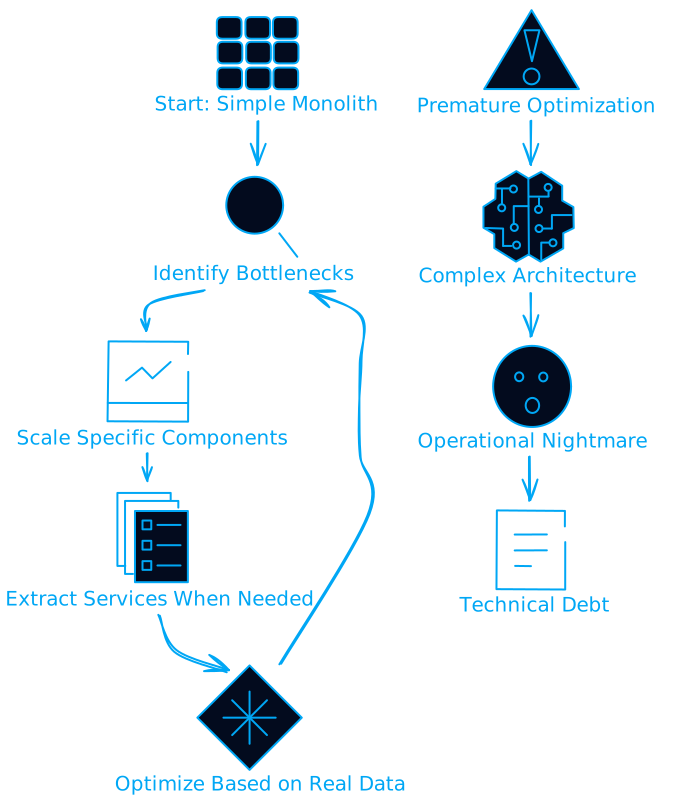
Start with a modular monolith. Get the boundaries right first, then extract services when you actually need to scale them independently.
When Caching Becomes a Nightmare
Caching can make your system faster, but it can also make it more complex and harder to debug.
Cache Invalidation Hell:
- User updates their profile
- Cache still shows old data
- User complains
- You invalidate the cache
- Now the database is getting hammered
- Performance degrades
- You increase cache TTL
- Back to stale data problems
The Solution: Think about your cache invalidation strategy from day one. Use cache tags, implement proper cache hierarchies, and have monitoring for cache hit rates.
When Auto-scaling Goes Wrong
Auto-scaling sounds great in theory. In practice, it can be a source of chaos.
The Thundering Herd Problem:
- Traffic spike hits
- Auto-scaler spins up 10 new instances
- New instances all start at the same time
- They all try to warm up their caches simultaneously
- Database gets hammered
- Everything slows down
- Health checks fail
- Auto-scaler thinks instances are unhealthy
- Spins up more instances
- Chaos ensues
The Solution: Gradual scaling, proper health checks, circuit breakers, and cache warming strategies.
The Path Forward: Building Scalable Systems That Don't Suck
Start Simple, Scale Smart
Don't over-engineer from day one. Start with a simple architecture that works, then scale the parts that actually need scaling.
Measure Everything, Optimize Selectively
Data beats intuition every time. Measure your system's performance, identify the actual bottlenecks, and optimize those. Don't optimize the parts that are already fast enough.
Plan for Growth, But Don't Over-Plan
Think about how your system might need to scale, but don't build for scale you don't have yet. It's easier to refactor a working system than to debug a complex system that doesn't work.
Invest in Your Team
The best architecture in the world won't save you if your team can't operate it. Invest in training, documentation, and processes. Conway's Law is real, your system will reflect your organization's structure.
The Bottom Line
Scalability isn't just a technical problem, it's a business problem, an organizational problem, and a human problem. The best scaling strategy is the one that fits your specific context, constraints, and goals.
Don't chase the latest trends or copy what works for companies 100x your size. Build something that works for your users, your team, and your business. Scale when you need to, not before.
And remember, the most scalable system is the one that doesn't exist. Sometimes the best solution is to not build something at all, or to build something much simpler than you originally planned.
The goal isn't to build the most scalable system possible. The goal is to build a system that can grow with your business without breaking your team, your budget, or your sanity.
Now go forth and scale responsibly. Your future self (and your on-call rotation) will thank you.
Want to dive deeper into specific scaling techniques? Check out the resources below or drop a comment with your scaling war stories. We've all been there, and sharing the pain makes it hurt less.
Further Reading:
- Designing Data-Intensive Applications by Martin Kleppmann
- Building Microservices by Sam Newman
- Site Reliability Engineering by Google
- The Architecture of Open Source Applications
Tools Worth Exploring:
- Load Testing: k6, JMeter, Artillery
- Monitoring: Prometheus + Grafana, DataDog, New Relic
- Caching: Redis, Memcached, Varnish
- Message Queues: RabbitMQ, Apache Kafka, AWS SQS
- Databases: PostgreSQL, MongoDB, Cassandra, DynamoDB