Monolithic vs Microservices: The Architecture Decision That'll Make or Break
So you're sitting there, staring at your screen, trying to figure out whether to build your next app as one big monolith or split it into a bunch of microservices. Trust me, I've been there. This decision feels huge because, well, it kind of is. Get it wrong and you'll be dealing with the consequences for years.
Let me walk you through everything I've learned about this architectural showdown. No fluff, just the real stuff that matters when you're actually building something.
What Are We Even Talking About Here?
Before we dive deep, let's get our definitions straight. I see too many people throwing these terms around without really understanding what they mean.
Monolithic Architecture is like having everything in one house. Your user interface, business logic, data access layer, everything lives together in a single deployable unit. Think of it as a traditional desktop application, but for the web.
Microservices Architecture is more like a neighborhood. Each service is its own little house with a specific purpose, and they all talk to each other through well-defined streets (APIs). Each house can be built differently, renovated independently, and even torn down without affecting the others.
The Monolith: Your Reliable Old Friend
Let's start with monoliths because, honestly, they get a bad rap these days. Everyone's so hyped about microservices that they forget monoliths actually solve a lot of problems really well.
Why Monoliths Rock (Yes, Really)
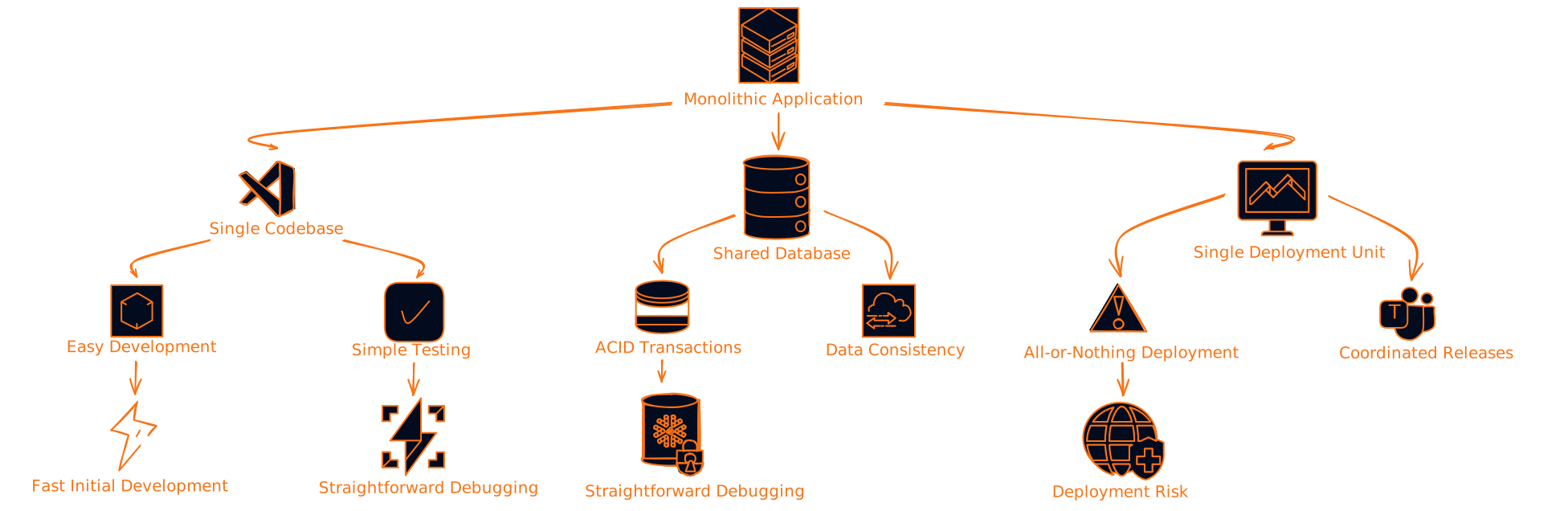
Development Speed That Actually Matters When you're building a monolith, you're working with one codebase, one database, one deployment process. No complex service discovery, no network calls between components, no distributed debugging nightmares. You just write code, test it, and ship it.
I've seen teams prototype and ship MVPs in weeks with monoliths that would have taken months with microservices. When you're trying to validate a business idea quickly, this speed advantage is huge.
Testing That Makes Sense Testing a monolith is straightforward. You spin up the app, run your tests, and you're done. No mocking dozens of service calls, no complex test environments with multiple services running. Your integration tests actually test the real integrations.
Resource Efficiency Here's something people don't talk about enough: monoliths are resource-efficient. No network overhead between services, no duplicate libraries loaded in memory, no container orchestration overhead. For smaller applications, this can mean significantly lower infrastructure costs.
When Monoliths Start to Hurt
But let's be real, monoliths aren't perfect. As your application grows, you'll start hitting some walls.
The Scaling Wall When your user service needs more resources but your payment processing doesn't, tough luck. You're scaling everything together. It's like having to buy a bigger house when you just need a bigger garage.
The Technology Prison Chose Java in 2015? Well, you're probably still using Java in 2025. Want to try that new framework everyone's talking about? Good luck rewriting your entire application.
The Deployment Anxiety Every deployment is a big deal because you're deploying everything. One small bug in a rarely-used feature can take down your entire application. I've seen teams become so afraid of deployments that they only ship once a month.
Microservices: The Distributed Dream (and Nightmare)
Now let's talk about microservices. They're like that friend who's really cool but also really complicated.
The Microservices Superpowers
Independent Scaling That Actually Works This is the big one. When your image processing service is getting hammered but your user authentication is cruising along, you can scale just what you need. It's like being able to add more lanes to the highway where traffic is actually backed up.
Technology Freedom Want to use Go for your high-performance service and Python for your machine learning pipeline? Go for it. Each service can use the best tool for its specific job. This isn't just theoretical, I've seen teams use 5+ different languages in production successfully.
Fault Isolation That Saves Your Bacon When your recommendation engine crashes, your users can still browse products and make purchases. The system degrades gracefully instead of falling over completely. This is huge for user experience.
Team Autonomy That Scales Small teams can own entire services end-to-end. No more waiting for the database team to make a schema change or the frontend team to update an API. Conway's Law is real, and microservices work with it instead of against it.
The Microservices Tax
But here's what the microservices evangelists don't always tell you: there's a tax. And it's not small.
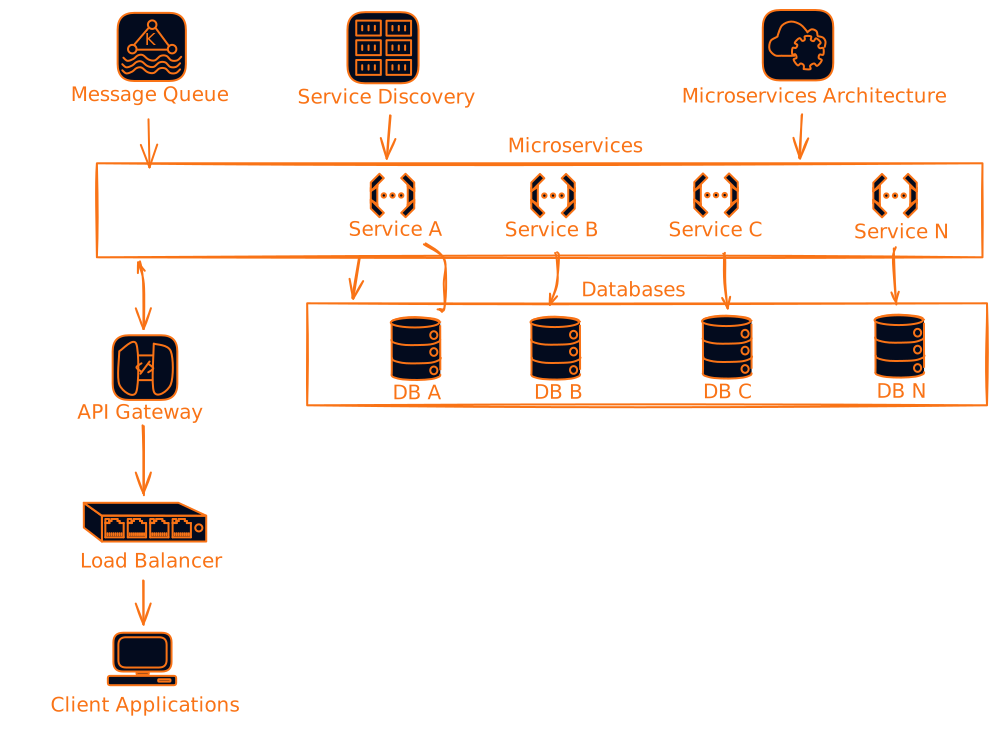
Complexity That Compounds You're not just building an application anymore, you're building a distributed system. Network calls fail, services go down, data gets out of sync. You need service discovery, load balancing, circuit breakers, distributed tracing. The operational overhead is real.
The Testing Nightmare How do you test a system with 20 services? Unit tests are easy, but integration testing becomes a logistical nightmare. You need sophisticated test environments, contract testing, and a lot of patience.
Data Consistency Headaches Forget ACID transactions across services. You're in eventual consistency land now. Hope you like saga patterns and event sourcing because you're going to need them.
The Real Decision Framework (Not the Buzzword Bingo)
Okay, so how do you actually decide? Here's my framework based on real projects, not conference talks.
Start With Your Team
Small Team (< 10 people)? Probably go monolith. You don't have the bandwidth to manage distributed systems complexity. Focus on building features, not infrastructure.
Large Organization (> 50 people)? Microservices start making sense. You need the team autonomy and independent deployment capabilities.
In Between? This is where it gets interesting. Consider a modular monolith first, then extract services as clear boundaries emerge.
Look at Your Domain
Well-Understood, Stable Domain? Monolith works great. E-commerce, content management, traditional CRUD apps, these are well-understood problems with established patterns.
Complex, Evolving Domain? Microservices might help. If you're building something new where requirements change frequently and different parts of the system have very different characteristics.
Consider Your Operational Maturity
This is the big one that people ignore. Microservices require serious operational chops:
- Automated deployment pipelines
- Comprehensive monitoring and alerting
- Distributed tracing capabilities
- Container orchestration (probably Kubernetes)
- Service mesh understanding
- On-call processes for distributed systems
If you don't have these, microservices will hurt more than they help.
The Scalability Reality Check
Do you actually need independent scaling? Most applications don't. If your entire system scales together, a well-architected monolith with horizontal scaling might be simpler and cheaper.
Do different parts have wildly different performance characteristics? Then microservices make sense. Think Netflix with their recommendation engine vs. their user management.
The Migration Patterns That Actually Work
Here's the thing: you don't have to choose once and stick with it forever. Smart teams evolve their architecture.
The Strangler Fig Pattern
This is my favorite migration approach. You gradually replace parts of your monolith with new microservices, like a strangler fig slowly taking over a tree.
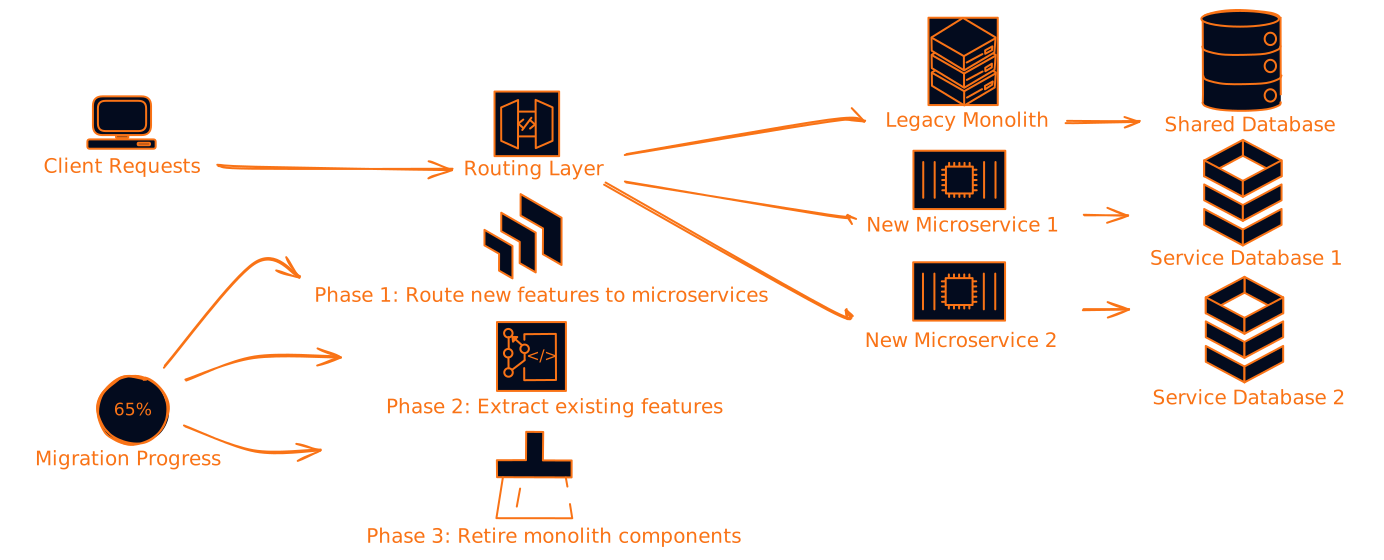
Start with new features as microservices. Then gradually extract existing functionality. The key is having a good routing layer that can direct traffic to either the monolith or the new services.
The Modular Monolith Stepping Stone
Before going full microservices, try a modular monolith. Structure your code as if it were separate services, but deploy it as one unit. This helps you:
- Identify good service boundaries
- Build team ownership patterns
- Develop operational practices
- Reduce the risk of the eventual split
The Anti-Corruption Layer
When you do extract services, use an anti-corruption layer to prevent your new microservices from being polluted by the monolith's data model and business logic. It's like a translator that keeps the old and new systems from directly depending on each other.
The Data Problem Nobody Talks About
Let's address the elephant in the room: data management in microservices is hard. Really hard.
The Database-Per-Service Principle
Each microservice should own its data. No shared databases. This sounds great in theory but creates real challenges:
How do you handle transactions across services? You can't. You need to design for eventual consistency and use patterns like sagas.
What about reporting and analytics? You'll need data pipelines to aggregate data from multiple services into a data warehouse or lake.
How do you avoid data duplication? You don't. Some duplication is acceptable and even beneficial for service independence.
Event-Driven Architecture to the Rescue
The best microservices architectures I've seen use events heavily. Services publish events when something interesting happens, and other services subscribe to what they care about.
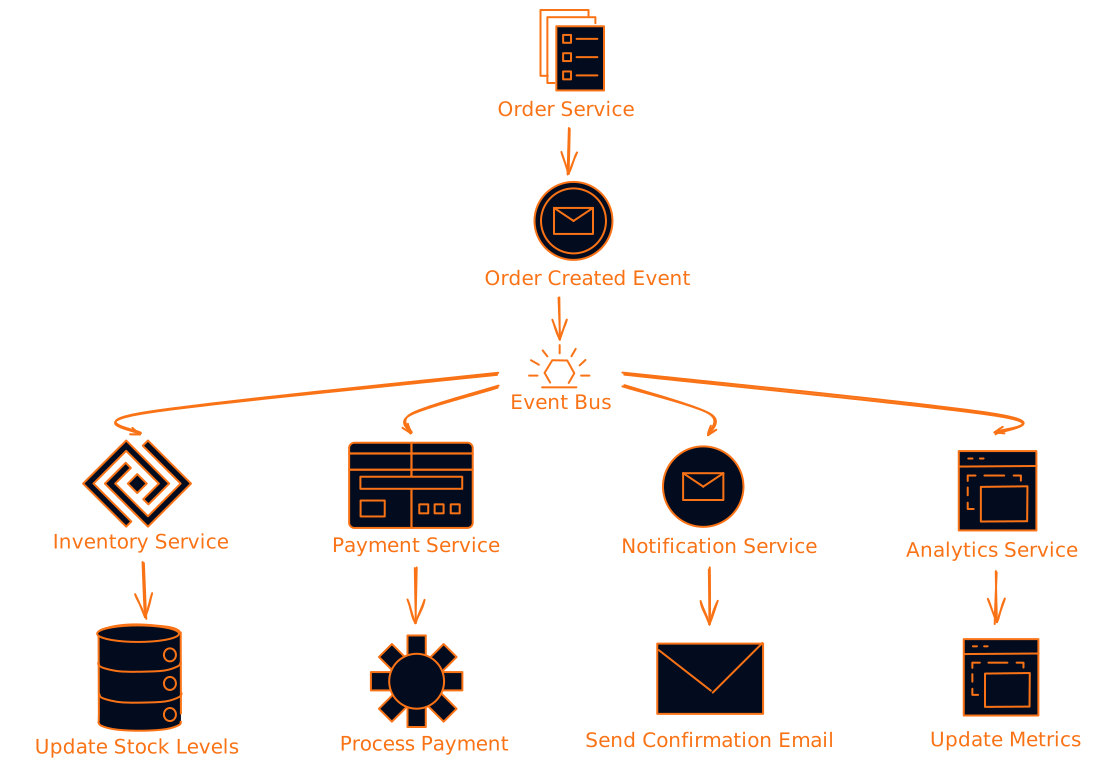
This decouples services while maintaining data consistency through eventual consistency patterns.
The Operational Reality Check
Let's talk about what running these architectures actually looks like in production.
Monolith Operations: Simple but Scary
Deployment: One big deployment. Everything changes at once. Rollbacks affect everything.
Monitoring: One application to monitor. Easier to understand what's happening, but when something breaks, everything breaks.
Debugging: Stack traces make sense. Logs are in one place. But finding the root cause of performance issues can be tricky when everything is interconnected.
Microservices Operations: Complex but Resilient
Deployment: Multiple independent deployments. You can deploy services independently, but you need sophisticated deployment pipelines and coordination.
Monitoring: Distributed tracing is essential. You need to track requests across multiple services. Tools like Jaeger or Zipkin become critical.
Debugging: When something breaks, it might be any of 20+ services. You need excellent observability and logging aggregation.
Common Pitfalls (And How to Avoid Them)
I've seen teams make the same mistakes over and over. Here are the big ones:
The Premature Microservices Trap
Starting with microservices for a new project is usually a mistake. You don't understand your domain boundaries yet. You'll end up with services that are too small or have the wrong boundaries, leading to a distributed monolith that's worse than a regular monolith.
Solution: Start with a well-structured monolith. Extract services when you have clear evidence they should be separate.
The Distributed Monolith Anti-Pattern
This happens when you split a monolith into services but they're all still tightly coupled. Every change requires coordinating updates across multiple services. You get all the complexity of microservices with none of the benefits.
Solution: Focus on service boundaries that minimize inter-service communication. Services should be as independent as possible.
The Technology Diversity Trap
Just because you can use different technologies doesn't mean you should. I've seen teams use 8 different programming languages and 12 different databases. The operational overhead becomes crushing.
Solution: Standardize on 2-3 core technologies. Allow diversity only when there's a clear business case.
The Testing Complexity Explosion
Teams often underestimate how hard testing becomes with microservices. Integration tests become incredibly complex when you have dozens of services.
Solution: Invest heavily in contract testing and test automation. Consider consumer-driven contracts to catch breaking changes early.
The Performance Question Everyone Asks
"But what about performance? Aren't network calls slower than method calls?"
Yes, network calls are slower than method calls. But this isn't usually the bottleneck you think it is.
Monolith Performance Characteristics
- Pros: No network latency between components, shared memory, efficient resource usage
- Cons: Everything competes for the same resources, harder to optimize individual components, scaling limitations
Microservices Performance Characteristics
- Pros: Independent scaling, optimized resource allocation per service, better caching strategies
- Cons: Network latency, serialization overhead, more complex performance optimization
In practice, well-designed microservices often perform better than monoliths at scale because you can optimize each service independently and scale only what needs scaling.
Real-World Examples (Without Naming Names)
Let me share some patterns I've seen work in the real world:
The E-commerce Platform
Started as a monolith handling products, orders, payments, and user management. As they grew, they extracted:
- Payment Service (different compliance requirements)
- Recommendation Engine (different scaling needs, ML workloads)
- Inventory Service (high write volume, different database needs)
The core product catalog and user management stayed in the monolith because they were stable and well-understood.
The Content Management System
Kept content management as a monolith but extracted:
- Image Processing Service (CPU-intensive, different scaling pattern)
- Search Service (different technology stack, Elasticsearch)
- Analytics Service (different data model, time-series data)
The Financial Services Platform
Had to use microservices from the start due to regulatory requirements. Different services had different compliance needs, audit requirements, and security levels. But they paid the complexity tax upfront with significant investment in tooling and processes.
The Decision Tree That Actually Helps
Here's a practical decision tree based on real projects:
Question 1: Is this a new project or existing system?
- New: Start with monolith unless you have compelling reasons not to
- Existing: Consider extraction patterns
Question 2: How many developers will work on this?
- < 10: Monolith
- 10-50: Modular monolith or selective microservices
- > 50: Microservices architecture
Question 3: Do you have strong DevOps/operational capabilities?
- No: Stick with monolith until you build these capabilities
- Yes: Microservices become viable
Question 4: Are there clear, stable domain boundaries?
- No: Don't split yet, wait for boundaries to emerge
- Yes: Consider service extraction
Question 5: Do different parts have significantly different scaling/performance needs?
- No: Monolith is probably fine
- Yes: Microservices can help
The Hybrid Approach That's Often Best
Here's what I see working well in practice: a hybrid approach.
Keep your core, stable functionality in a well-structured monolith. Extract services for:
- New features with unclear requirements
- Components with different scaling needs
- Functionality requiring different technology stacks
- Services with different team ownership
This gives you the stability of a monolith for your core business logic while allowing flexibility where you need it.

The Tools That Make It Work
If you do go the microservices route, here are the tools that are pretty much essential:
Container Orchestration
Kubernetes is the standard, but it's complex. Docker Swarm is simpler but less powerful. AWS ECS or Google Cloud Run are good managed alternatives.
Service Mesh
Istio is powerful but complex. Linkerd is simpler. These handle service-to-service communication, security, and observability.
API Gateways
Kong, Ambassador, or cloud-native options like AWS API Gateway. These handle routing, authentication, rate limiting, and more.
Monitoring and Observability
Prometheus + Grafana for metrics. Jaeger or Zipkin for distributed tracing. ELK Stack or Fluentd for log aggregation.
Message Queues
Apache Kafka for high-throughput event streaming. RabbitMQ for traditional message queuing. AWS SQS for simple cloud-based queuing.
What About Serverless?
Serverless functions (AWS Lambda, Google Cloud Functions, etc.) are like microservices taken to the extreme. Each function is a tiny service that scales automatically.
When serverless works well:
- Event-driven workloads
- Irregular traffic patterns
- Simple, stateless functions
- Teams comfortable with cloud-native development
When it doesn't:
- Long-running processes
- Complex state management
- Predictable, steady workloads
- Teams preferring traditional deployment models
Serverless can be a great middle ground, giving you some microservices benefits without the operational complexity.
The Future of This Debate
Here's where I think things are heading:
Better Tooling: The operational complexity of microservices is decreasing as tooling improves. Service meshes, better orchestration, and improved observability are making microservices more accessible.
Modular Monoliths: More teams are recognizing that you can get many microservices benefits with a well-structured monolith. This middle ground is becoming more popular.
Domain-Driven Design: The focus is shifting from technical boundaries to business boundaries. Whether you choose monolith or microservices, good domain modeling is crucial.
Platform Engineering: Companies are building internal platforms that make microservices easier to operate. If your company has a good platform team, microservices become much more viable.
My Honest Recommendation
After working with both approaches extensively, here's my honest take:
Start with a monolith. But design it well. Use clear module boundaries, dependency injection, and good separation of concerns. Think about how you might split it later, but don't actually split it until you have a good reason.
Extract services gradually when you have evidence they should be separate. Clear signs include:
- Different scaling requirements
- Different team ownership
- Different technology needs
- Different release cycles
- Clear domain boundaries
Don't extract services just because they seem logically separate. Logical separation can be achieved within a monolith through good design.
Invest in operational capabilities before going microservices. You need automated deployment, comprehensive monitoring, and distributed systems expertise.
Consider your team structure. If you have multiple teams that need to move independently, microservices can help. If you have one team, a monolith is probably simpler.
The Bottom Line
The monolith vs microservices decision isn't really about technology. It's about your team, your domain, your operational capabilities, and your business needs.
Monoliths aren't legacy. Microservices aren't magic. Both are tools with different trade-offs. The key is understanding those trade-offs and choosing the right tool for your specific situation.
Don't let anyone tell you there's one right answer. The right answer depends on your context. And that context changes over time, so be prepared to evolve your architecture as your needs change.
The most successful teams I've worked with focus on building good software first, then worry about how to structure it. Whether that structure is a monolith, microservices, or something in between is secondary to building something that actually solves real problems for real users.
Start simple, evolve gradually, and always optimize for your team's ability to deliver value. Everything else is just implementation details.
What's your experience with monoliths vs microservices? Have you made the transition from one to the other? I'd love to hear about your real-world experiences in the comments below.