When Your Data Can't Wait: The Real Talk on Batch vs Stream Processing
So you're building a system and suddenly you're faced with that age-old question: should I process this data in batches or stream it real-time? It's like choosing between a slow cooker and a microwave, both get the job done, but the approach is completely different.
Let me break this down for you without the marketing fluff. I've been through this decision more times than I care to count, and trust me, getting it wrong can cost you sleep, money, and your sanity.
What We're Actually Talking About Here
Before we dive deep, let's get our definitions straight because I've seen too many teams argue about this without even agreeing on what they mean.
Batch processing is like doing your laundry. You collect a bunch of dirty clothes, throw them in the washer all at once, and wait for the cycle to complete. Your data sits around, accumulates, and then gets processed in chunks at scheduled intervals.
Stream processing is more like washing dishes as you cook. Each plate gets cleaned immediately after you use it. Data gets processed the moment it arrives, no waiting around.
Both approaches have their place, and honestly, most real-world systems end up using both. But let's figure out when to use what.
The Batch Processing Deep Dive
How Batch Processing Actually Works
Think of batch processing as your reliable, methodical friend who plans everything in advance. Here's what's happening under the hood:
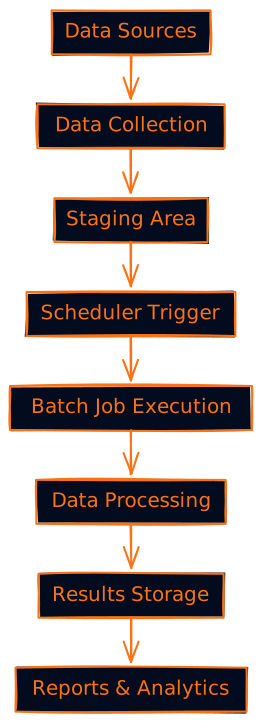
The beauty of batch processing is in its simplicity. You're not trying to handle data as it flies by, you're taking your time to do it right. This means you can:
- Process massive datasets efficiently
- Run complex analytics that need the full picture
- Optimize for throughput over latency
- Handle failures gracefully with retries
When Batch Processing Makes Sense
I always tell people to consider batch processing when:
You're doing heavy analytics work. If you need to crunch numbers across your entire dataset, batch is your friend. Think end-of-month financial reports, machine learning model training, or data warehouse ETL jobs.
Latency isn't critical. If your users can wait minutes or hours for results, batch processing will give you better resource utilization and lower costs.
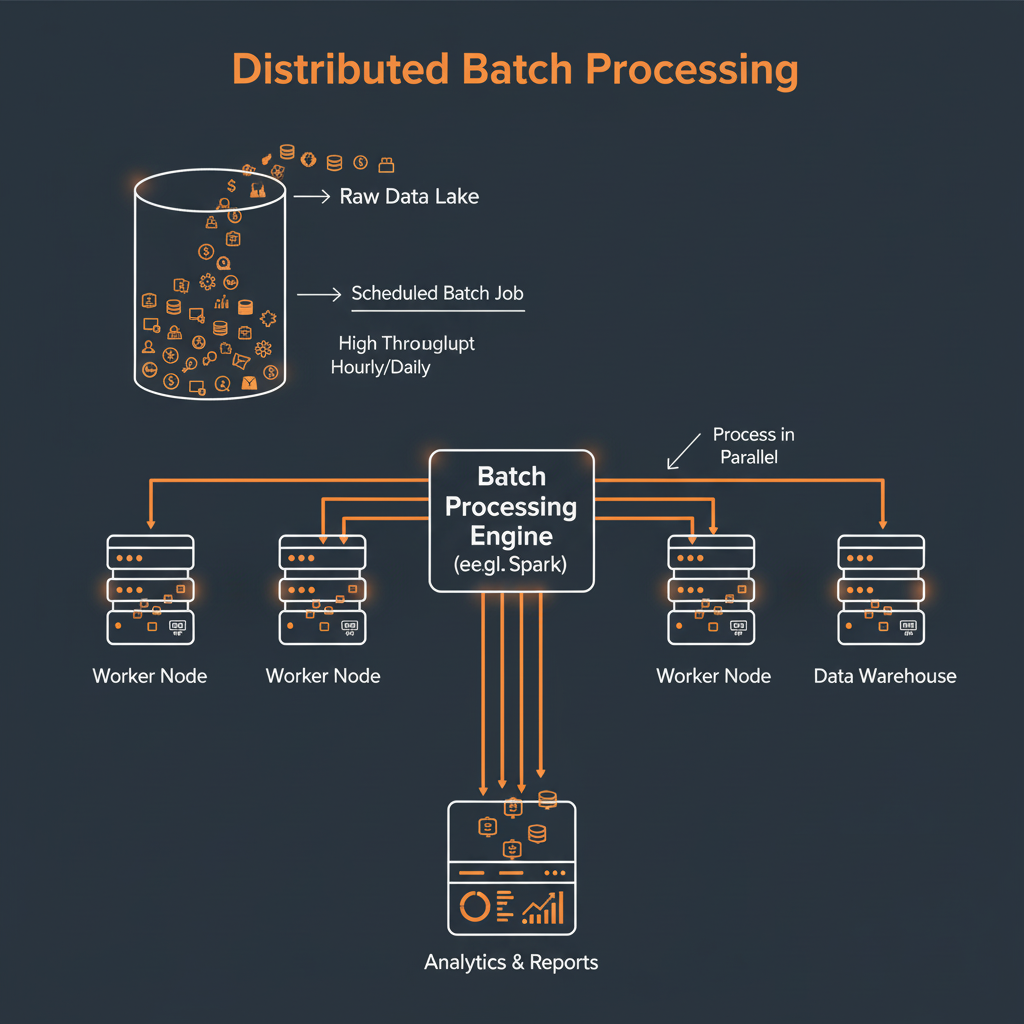
You're dealing with huge volumes. Batch processing frameworks like Spark and Hadoop are built to handle petabytes of data. They'll parallelize your work across hundreds of machines without breaking a sweat.
The Batch Processing Toolkit
Let's talk tools. The batch processing ecosystem is mature and battle-tested:
Apache Spark is probably your best bet for most use cases. It's fast, has great APIs in multiple languages, and can handle both batch and streaming (more on that later).
Apache Hadoop is the old reliable. It's been around forever, handles massive scale, and has a huge ecosystem. But it's also complex and can be overkill for smaller datasets.
Cloud services like AWS Batch, Google Dataflow, or Azure Batch take care of the infrastructure headaches. You just submit your jobs and let them handle the scaling.
Here's a simple example of what batch processing code might look like:
# Pseudo-code for a daily batch job
def process_daily_sales():
    # Read yesterday's sales data
    sales_data = read_from_database(yesterday)

    # Process and aggregate
    processed_data = sales_data.groupBy("region").sum("amount")

    # Write results
    write_to_warehouse(processed_data)

    # Generate reports
    generate_daily_report(processed_data)

# Schedule this to run every night at 2 AM
schedule_job(process_daily_sales, cron="0 2 * * *")
The Dark Side of Batch Processing
But let's be real, batch processing isn't perfect. The biggest pain point? Latency. If something goes wrong with your morning batch job, you might not know until the afternoon. That's not great if you're trying to catch fraud or respond to system issues.
Complexity creep is another issue. As your batch jobs grow, managing dependencies between them becomes a nightmare. Job A needs to finish before Job B can start, but Job C can run in parallel with Job A... you get the picture.
Resource waste can also be a problem. Your batch jobs might need massive compute power for a few hours, then sit idle the rest of the day. That's expensive in the cloud.
Stream Processing: When Every Millisecond Counts
The Stream Processing Mindset
Stream processing is a completely different beast. Instead of "collect then process," it's "process as you go." This fundamental shift changes everything about how you design your system.
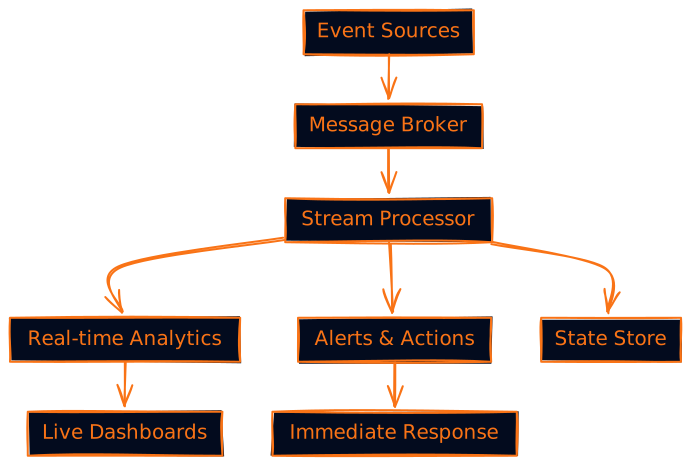
The key insight here is that you're not just processing data faster, you're fundamentally changing your architecture to be event-driven. This opens up possibilities that batch processing simply can't handle.
When Stream Processing Shines
Stream processing is your go-to when:
Real-time decisions matter. Fraud detection, trading systems, IoT monitoring, these all need immediate responses. Waiting for the next batch job isn't an option.
You're building reactive systems. Modern applications need to respond to user actions immediately. Think recommendation engines, personalization, or real-time notifications.
Data has a short shelf life. Some data is only valuable when it's fresh. Stock prices, sensor readings, user clicks, these lose value quickly.
The Stream Processing Challenge: State Management
Here's where things get interesting (and complicated). Unlike batch processing where you have all your data available, stream processing often needs to maintain state across events.
Let's say you're tracking user sessions. Each click event needs to be associated with the user's ongoing session. But sessions can span hours, and you're processing millions of events per second. How do you keep track?
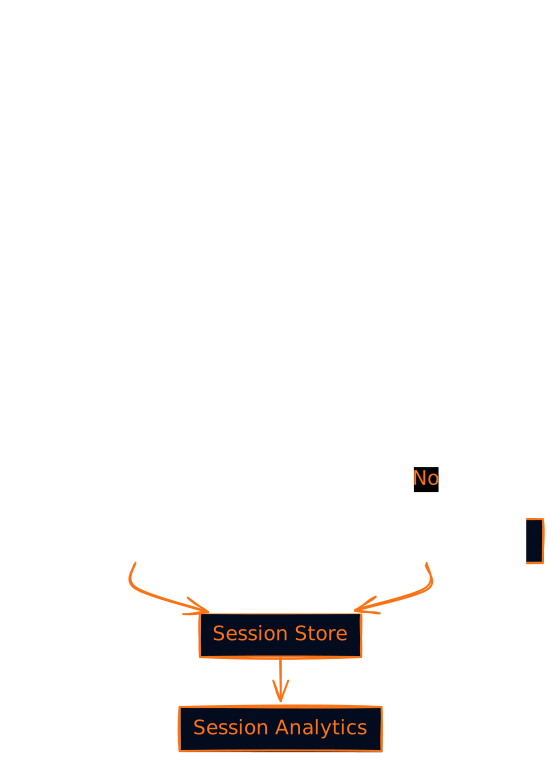
This is where stream processing frameworks like Apache Flink, Kafka Streams, or Apache Storm earn their keep. They handle the complexity of distributed state management, fault tolerance, and exactly-once processing guarantees.
Windowing: Making Sense of Infinite Streams
One of the trickiest concepts in stream processing is windowing. Since streams are infinite, how do you do aggregations like "count of events in the last 5 minutes"?
You create windows. There are several types:
Tumbling windows are fixed-size, non-overlapping chunks. Think "every 5 minutes, count the events."
Sliding windows overlap. "Count events in the last 5 minutes, updated every minute."
Session windows are based on activity. "Group events by user session, ending after 30 minutes of inactivity."
# Pseudo-code for windowed stream processing
stream = kafka_stream("user-events")

# Count events per user in 5-minute tumbling windows
windowed_counts = (stream
    .window(tumbling_window(minutes=5))
    .group_by("user_id")
    .count())

# Trigger alerts for users with >100 events in a window
alerts = windowed_counts.filter(lambda count: count > 100)
The Stream Processing Ecosystem
The tooling landscape for stream processing is more fragmented than batch processing, but there are some clear winners:
Apache Kafka is the backbone of most streaming architectures. It's not just a message broker, it's a distributed streaming platform that can handle millions of messages per second.
Apache Flink is probably the most advanced stream processing engine. It handles complex event processing, has excellent state management, and provides strong consistency guarantees.
Kafka Streams is great if you're already using Kafka. It's a library rather than a separate system, which simplifies deployment.
Cloud services like AWS Kinesis, Google Dataflow, or Azure Stream Analytics handle the infrastructure complexity for you.
The Hybrid Reality: Why You Probably Need Both
Here's the thing nobody talks about enough: most real-world systems aren't purely batch or purely streaming. They're hybrid.
Lambda Architecture: The Belt and Suspenders Approach
The Lambda Architecture acknowledges that both batch and stream processing have their place. It runs both in parallel:
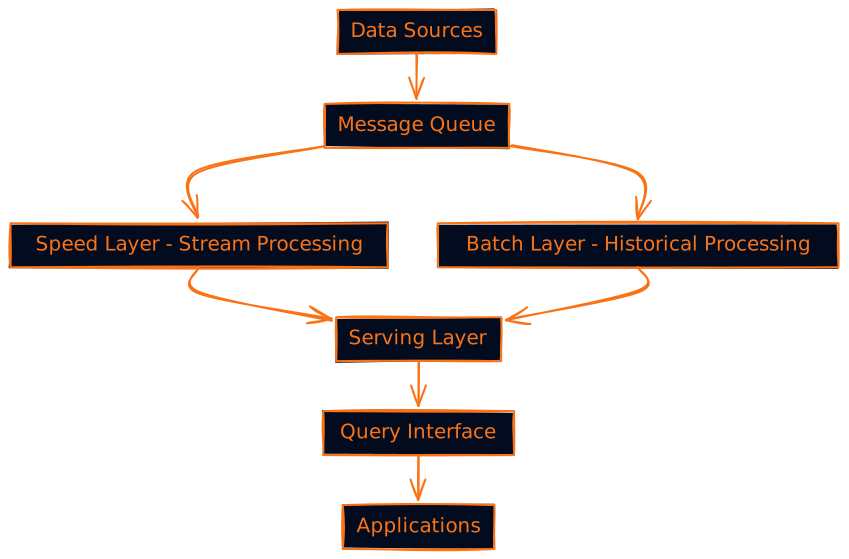
The speed layer handles real-time processing with approximate results. The batch layer processes the complete dataset for accurate results. The serving layer combines both to give you the best of both worlds.
This sounds great in theory, but in practice, it means maintaining two separate codebases that do similar things. That's a maintenance nightmare.
Kappa Architecture: Stream Everything
The Kappa Architecture takes a different approach: treat everything as a stream. Even "batch" processing is just stream processing over historical data.
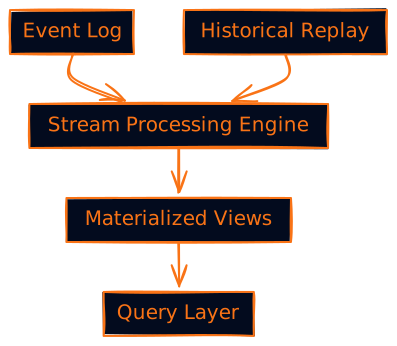
The key insight is that if you can replay your event stream, you can reprocess historical data using the same stream processing logic. This eliminates the dual codebase problem of Lambda Architecture.
But Kappa isn't perfect either. Stream processing complex batch workloads can be inefficient, and not all use cases fit the streaming model.
Micro-Batch: The Middle Ground
Some frameworks like Spark Streaming take a micro-batch approach. They process small batches of data (say, every few seconds) to approximate real-time processing while keeping the batch processing model.
This gives you near real-time latency with the simplicity of batch processing. It's not true streaming, but for many use cases, it's good enough.
Making the Decision: A Practical Framework
So how do you actually decide? Here's my framework:
Start with Your Requirements
What's your latency requirement? If you need sub-second responses, you need stream processing. If minutes or hours are fine, batch might be simpler.
How much data are you processing? Batch processing scales better for large volumes. Stream processing is better for high-velocity data.
What's your fault tolerance requirement? Batch processing is generally easier to make fault-tolerant. Stream processing requires more sophisticated error handling.
What's your team's expertise? Batch processing is conceptually simpler. Stream processing has a steeper learning curve.
Consider Your Data Characteristics
Is your data bursty or steady? Bursty data might be better handled in batches. Steady streams work well with stream processing.
Do you need the complete dataset for processing? Some analytics require seeing all the data at once. That's a natural fit for batch processing.
How long is your data valuable? If data loses value quickly, stream processing makes sense.
Think About Your Infrastructure
What's your budget? Stream processing often requires more infrastructure to run 24/7. Batch processing can run on cheaper, scheduled resources.
What's your operational complexity tolerance? Stream processing systems are generally more complex to operate.
Do you have existing systems? It might be easier to extend existing batch systems than to build new streaming ones.
Real-World Examples: Learning from the Trenches
Let me share some examples from systems I've worked on:
E-commerce Recommendation Engine
We started with a batch system that updated recommendations daily. It worked fine initially, but as we grew, daily updates weren't enough. Users would buy something and still see it recommended for hours.
We moved to a hybrid approach: batch processing for the heavy machine learning model training (still daily), but stream processing for real-time updates based on user behavior. When a user buys something, we immediately update their recommendations.
Financial Fraud Detection
This was pure stream processing from day one. We couldn't wait for batch jobs to detect fraudulent transactions. Every transaction gets scored in real-time, and suspicious ones are flagged immediately.
But we also run batch jobs nightly to retrain our fraud models and to do deeper analysis that requires looking at patterns across all transactions.
IoT Sensor Monitoring
We have thousands of sensors sending data every few seconds. Stream processing handles real-time alerting when sensors go out of range. But we use batch processing for longer-term trend analysis and predictive maintenance models.
The Operational Reality: What Nobody Tells You
Monitoring and Debugging
Batch processing is easier to debug. If a job fails, you can look at the logs, fix the issue, and rerun it. Stream processing failures are trickier because the data is constantly flowing.
You need different monitoring strategies too. For batch jobs, you monitor job completion and duration. For streaming, you monitor lag, throughput, and error rates.
Data Quality and Schema Evolution
Batch processing gives you more opportunities to validate and clean data. You can reject entire batches if the data quality is poor.
With stream processing, bad data can poison your streams. You need robust error handling and dead letter queues to handle problematic events.
Schema evolution is also trickier with streaming. You need to handle multiple schema versions simultaneously as old and new events flow through your system.
Cost Considerations
Don't underestimate the cost differences. Batch processing can use cheaper, preemptible instances since jobs are fault-tolerant. Stream processing needs always-on infrastructure.
But stream processing can also save costs by enabling real-time optimizations. Catching fraud immediately saves more money than catching it in the next batch job.
Looking Forward: The Convergence
The lines between batch and stream processing are blurring. Modern frameworks like Apache Beam provide unified APIs for both. Cloud services are making it easier to switch between modes based on your needs.
We're also seeing more sophisticated hybrid approaches. Some systems use stream processing for hot data (recent events) and automatically age out to batch processing for cold data (historical analysis).
The future probably isn't choosing between batch and stream processing, it's about having systems that can seamlessly handle both modes depending on the data and use case.
The Bottom Line
Here's my advice: start simple. If batch processing meets your requirements, go with that. It's easier to build, test, and operate. You can always add streaming later when you need it.
But if you need real-time responses, don't try to hack it with faster batch jobs. Embrace stream processing, but be prepared for the additional complexity.
And remember, most successful systems end up being hybrid. Don't feel like you have to choose just one approach. Use the right tool for each part of your problem.
The key is understanding the trade-offs and making conscious decisions rather than just following the latest trends. Both batch and stream processing have their place in modern data architectures. The art is knowing when to use which.
What's Next?
If you're just getting started, I'd recommend:
- Try Apache Spark for batch processing. It's approachable and handles most use cases well.
- Experiment with Kafka Streams for stream processing. It's easier than Flink but still powerful.
- Start with cloud services if you don't want to manage infrastructure. AWS Kinesis or Google Dataflow are good starting points.
- Build monitoring from day one. You'll need it more than you think.
The data processing landscape keeps evolving, but the fundamental trade-offs between batch and stream processing remain. Understanding these trade-offs will serve you well regardless of which specific technologies you choose.
Remember, the best architecture is the one that solves your actual problems, not the one that looks good in conference talks. Keep it as simple as possible, but no simpler.
What's your experience with batch vs stream processing? Have you run into challenges I didn't cover? I'd love to hear about your real-world experiences in the comments.