
Distributed Job Scheduler Design Patterns: Core Concepts and Architecture
Introduction
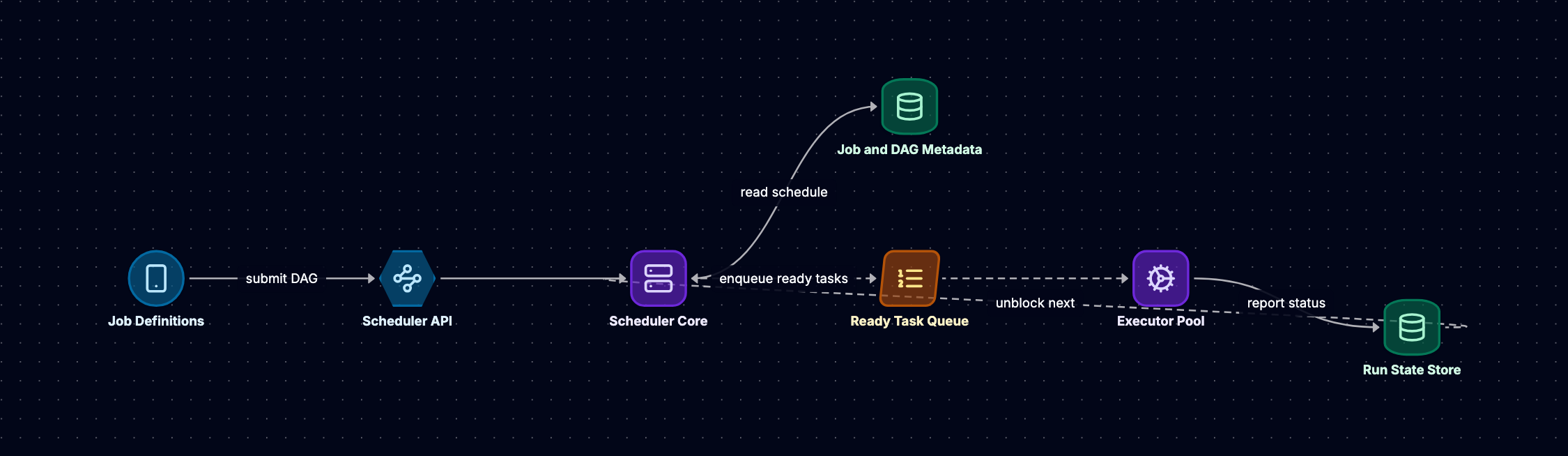
Modern data pipelines process billions of events daily, orchestrating complex workflows that span batch processing, machine learning training, ETL operations, and cross-service dependencies. Behind these systems lies a critical piece of infrastructure: the distributed job scheduler. These schedulers must handle millions of task executions while guaranteeing no missed runs, preventing duplicate executions, and maintaining dependency ordering across distributed worker pools.
This post explores the core design patterns that enable distributed job schedulers to operate reliably at scale, using Apache Airflow's architectural concepts as a reference framework. We'll examine how these systems solve fundamental distributed systems challenges: leader election for coordination, directed acyclic graph (DAG) dependency resolution, delivery guarantees, historical backfills, and dynamic worker scaling.
Disclaimer: This post explores distributed scheduler design patterns using Airflow's architecture as a reference framework. Specific implementation details should be verified against current Airflow documentation and source code. The patterns discussed represent common approaches in distributed scheduling systems, though implementations vary across platforms and versions.
Whether you're building a scheduler from scratch, evaluating existing solutions, or optimizing your current deployment, understanding these patterns reveals the engineering tradeoffs that determine system reliability, throughput, and operational complexity.
Leader Election and Coordination
The Coordination Challenge
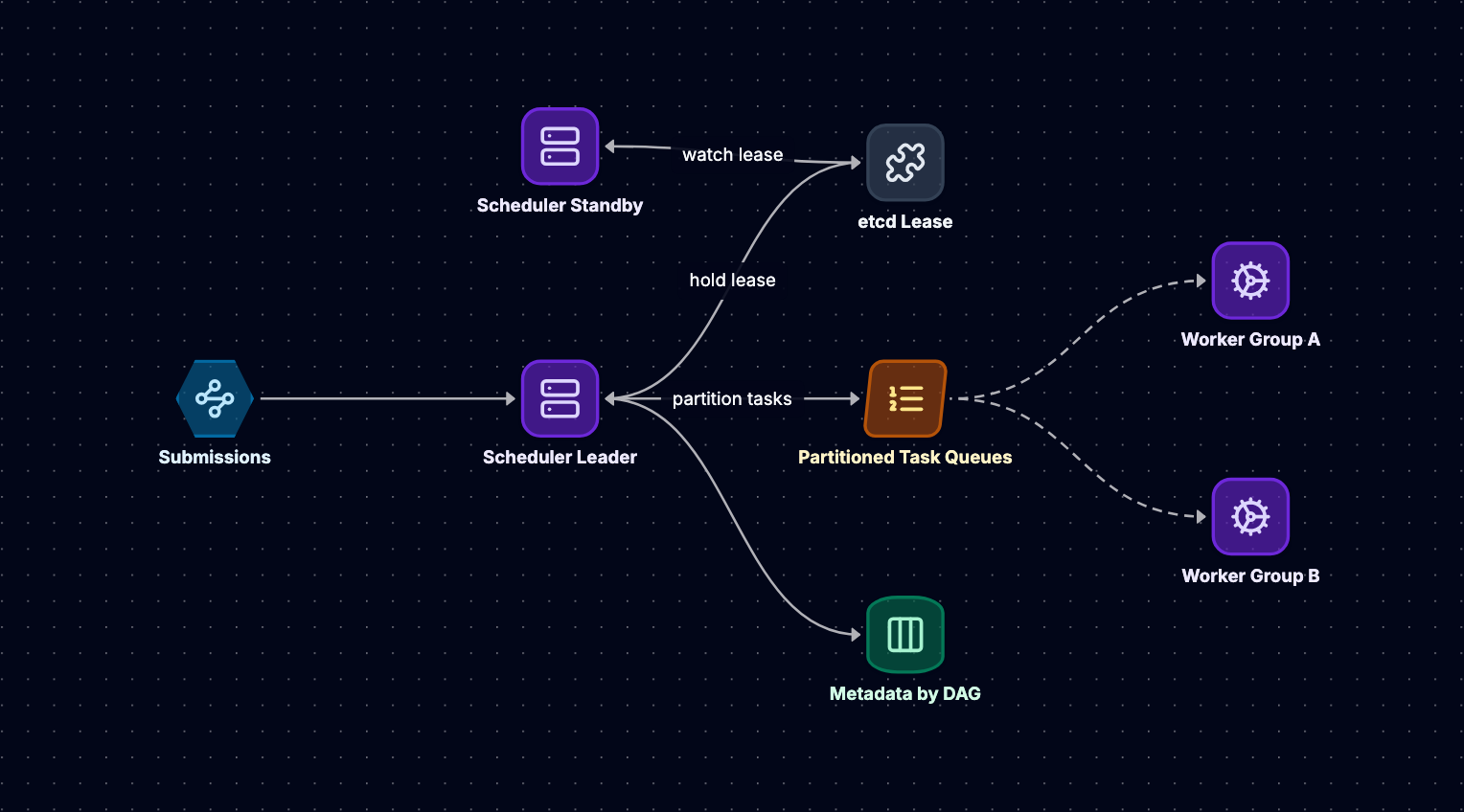
In a distributed job scheduler, multiple scheduler processes may run simultaneously for high availability. However, only one should actively schedule tasks at any given moment to prevent duplicate task submissions. This requires solving the leader election problem: ensuring exactly one process assumes the scheduling role while others remain on standby.
The naive approach of running a single scheduler creates a single point of failure. If that process crashes, no tasks get scheduled until manual intervention. Multi-active schedulers without coordination create worse problems: duplicate task executions, race conditions in state updates, and database contention.
Coordination Mechanisms
Schedulers typically implement leader election through one of several coordination patterns:
Database-based locking uses the scheduler's metadata store itself for coordination. A scheduler process attempts to acquire an exclusive row-level lock or updates a timestamp in a designated coordination table. The process that successfully updates the row with the most recent heartbeat becomes the leader.
-- Conceptual Example: Database-based leader election pattern
UPDATE scheduler_lock
SET hostname = 'scheduler-pod-3',
    last_heartbeat = NOW()
WHERE last_heartbeat < NOW() - INTERVAL '30 seconds'
RETURNING hostname;
This pattern requires careful tuning of heartbeat intervals and timeout thresholds. Too short, and transient network issues cause leadership thrashing. Too long, and failover takes excessive time during actual failures.
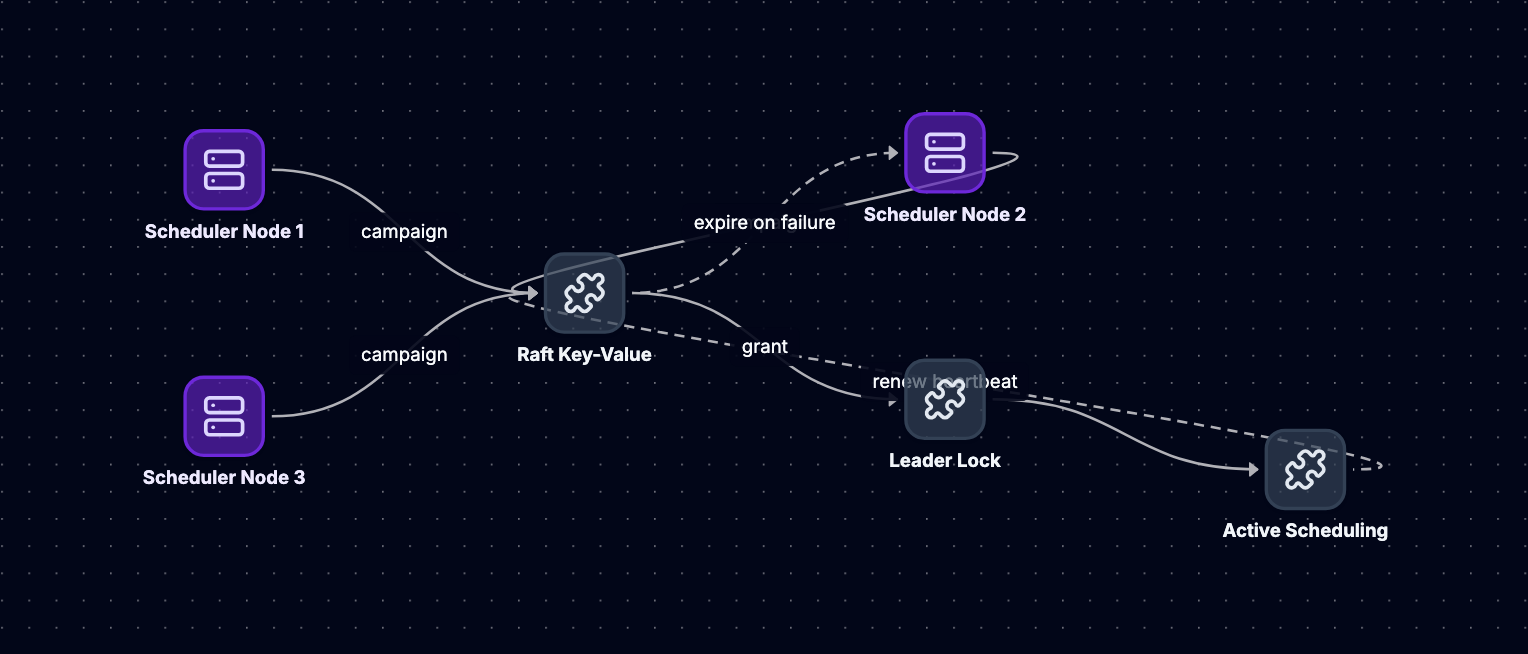
Distributed consensus systems like ZooKeeper, etcd, or Consul provide stronger coordination guarantees through algorithms like Raft or Paxos. These systems handle the complexity of distributed consensus, offering ephemeral nodes that automatically expire when a process fails.
# Pseudocode Pattern: ZooKeeper-based leader election
def attempt_leadership(zk_client, election_path):
    ephemeral_node = zk_client.create(
        f"{election_path}/candidate-",
        value=hostname,
        ephemeral=True,
        sequence=True
    )

    candidates = zk_client.get_children(election_path)
    candidates.sort()

    if ephemeral_node == candidates[0]:
        return True  # This process is leader
    else:
        # Watch the next-lowest candidate
        watch_candidate(candidates[candidates.index(ephemeral_node) - 1])
        return False
The tradeoff: external dependencies increase operational complexity but provide more robust failover semantics. Consensus systems detect failures through configurable session timeouts, typically triggering leadership transitions within seconds rather than relying on application-level heartbeat logic.
Split-Brain Prevention
A critical failure mode occurs when network partitions create split-brain scenarios: two processes both believe they're the leader. This violates the fundamental requirement of single-active scheduling.
Schedulers prevent split-brain through several mechanisms:
Fencing tokens ensure that even if two processes believe they're leaders, only one can successfully execute scheduling operations. Each leadership term receives a monotonically increasing token. The metadata database rejects operations with stale tokens.
# Conceptual Example: Fencing token validation pattern
class SchedulerDatabase:
    def schedule_task(self, task_id, leadership_token):
        current_token = self.get_current_leadership_token()

        if leadership_token < current_token:
            raise StaleLeadershipException(
                f"Token {leadership_token} < current {current_token}"
            )

        # Proceed with scheduling in transaction
        with self.transaction():
            self.insert_task_instance(task_id)
            self.update_leadership_token(leadership_token)
Lease-based coordination grants leadership for a fixed duration. The leader must continuously renew its lease before expiration. If renewal fails, the leader immediately stops scheduling operations, even if it hasn't detected its own failure. This "fail-stop" behavior prevents split-brain during network partitions.
High Availability Architecture
Production deployments typically run multiple scheduler processes in active-standby configuration:
- Active scheduler: Holds leadership, performs DAG parsing, triggers task instances
- Standby schedulers: Monitor leadership status, ready to assume control
- Shared metadata database: Single source of truth for all state
- Coordination service: Mediates leadership election
When the active scheduler fails, standbys detect the failure through missed heartbeats or expired leases. The fastest standby to acquire the lock becomes the new leader, typically completing failover within the configured timeout period.
This architecture assumes the metadata database remains available. Database failures represent a separate failure domain requiring replication, automated failover, and potentially cross-region disaster recovery strategies.
DAG Dependency Resolution and Execution
Representing Workflow Dependencies
Job schedulers model workflows as Directed Acyclic Graphs (DAGs), where nodes represent tasks and edges represent dependencies. The acyclic constraint prevents circular dependencies that would create unresolvable execution orders.
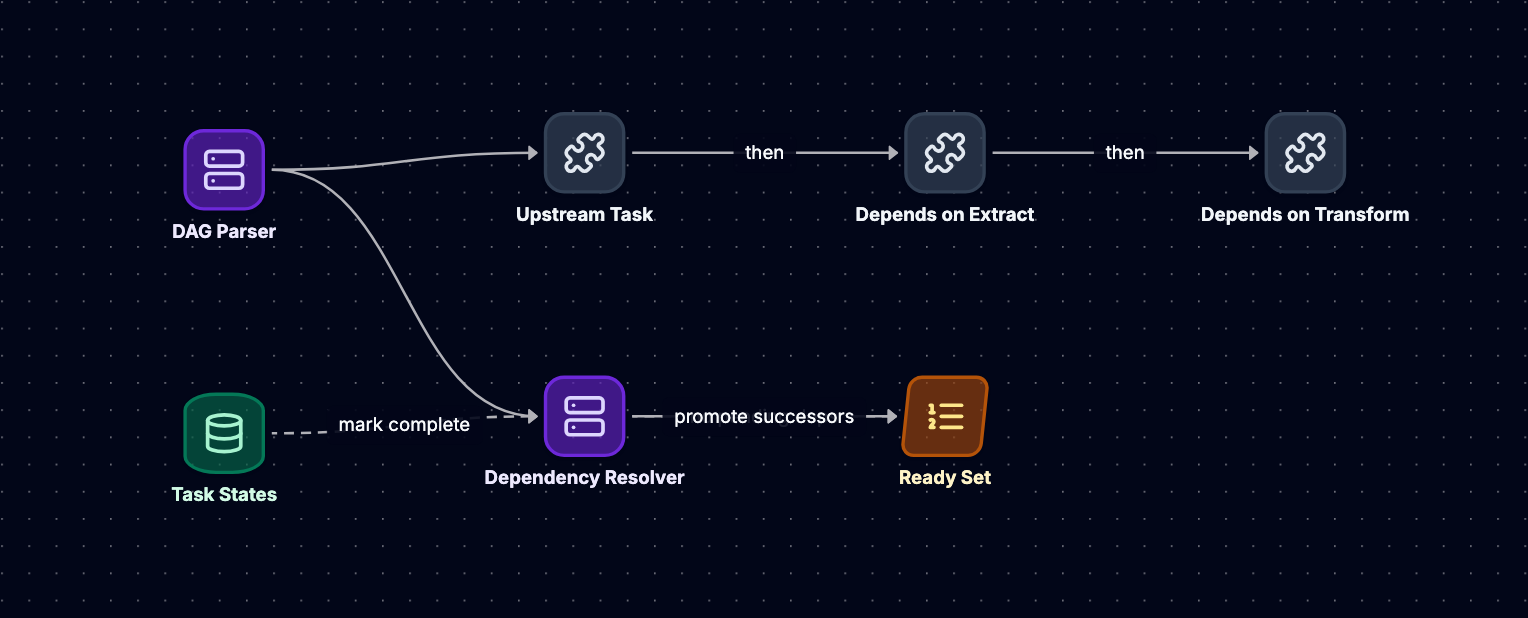
A typical data pipeline DAG might look like:
# Conceptual Example: DAG structure pattern
extract_users = Task(id="extract_users")
extract_orders = Task(id="extract_orders")
join_data = Task(id="join_data",
                 upstream=[extract_users, extract_orders])
aggregate = Task(id="aggregate",
                upstream=[join_data])
load_warehouse = Task(id="load_warehouse",
                     upstream=[aggregate])
This creates a dependency graph where join_data cannot execute until both extraction tasks complete, and the pipeline flows through aggregation to final loading.
Scheduling Algorithm
The scheduler's core responsibility is determining which tasks are ready to execute. This requires tracking task state and evaluating dependency satisfaction.
State transitions follow a well-defined lifecycle:
- None/Scheduled: Task is queued but not yet running
- Queued: Task submitted to executor, awaiting worker assignment
- Running: Worker actively executing task
- Success: Task completed successfully
- Failed: Task execution failed
- Skipped: Task skipped due to branching logic
- Upstream Failed: Task cannot run due to upstream failure
The scheduling loop continuously:
# Pseudocode Pattern: Core scheduling loop
def scheduling_loop(dag_bag, executor, metadata_db):
    while is_leader():
        for dag in dag_bag.get_active_dags():
            for dag_run in metadata_db.get_active_runs(dag.id):
                schedulable_tasks = find_schedulable_tasks(
                    dag,
                    dag_run,
                    metadata_db
                )

                for task in schedulable_tasks:
                    task_instance = create_task_instance(
                        dag_run,
                        task
                    )
                    executor.queue_task(task_instance)

        executor.heartbeat()  # Process task state updates
        sleep(scheduling_interval)

def find_schedulable_tasks(dag, dag_run, db):
    schedulable = []
    for task in dag.tasks:
        if task_already_scheduled(task, dag_run, db):
            continue

        upstream_states = db.get_task_states(
            dag_run,
            task.upstream_task_ids
        )

        if all(state == 'success' for state in upstream_states):
            schedulable.append(task)

    return schedulable
This pattern ensures tasks execute only when dependencies are satisfied, preventing premature execution while maximizing parallelism.
Execution Strategies
Different executor implementations provide different execution semantics:
Sequential Executor runs tasks one at a time in the scheduler process itself. This provides simplicity for development and testing but offers no parallelism or fault isolation. A single task failure can crash the entire scheduler.
Local Executor spawns worker processes on the scheduler machine using multiprocessing. Tasks execute in parallel up to a configured concurrency limit. This provides basic parallelism but doesn't scale beyond a single machine's resources.
Distributed Executors (like Celery or Kubernetes executors) submit tasks to a separate worker pool:
# Conceptual Example: Distributed executor pattern
class DistributedExecutor:
    def queue_task(self, task_instance):
        task_message = {
            'task_id': task_instance.task_id,
            'dag_id': task_instance.dag_id,
            'execution_date': task_instance.execution_date,
            'try_number': task_instance.try_number
        }

        # Submit to message queue for worker consumption
        self.message_queue.publish(
            queue='task_queue',
            message=task_message,
            routing_key=task_instance.queue
        )

        # Update task state to 'queued'
        self.metadata_db.set_task_state(
            task_instance,
            state='queued'
        )
Workers consume messages from the queue, execute tasks, and report results back to the metadata database. This decouples scheduling from execution, enabling horizontal scaling of worker capacity independently from scheduler capacity.
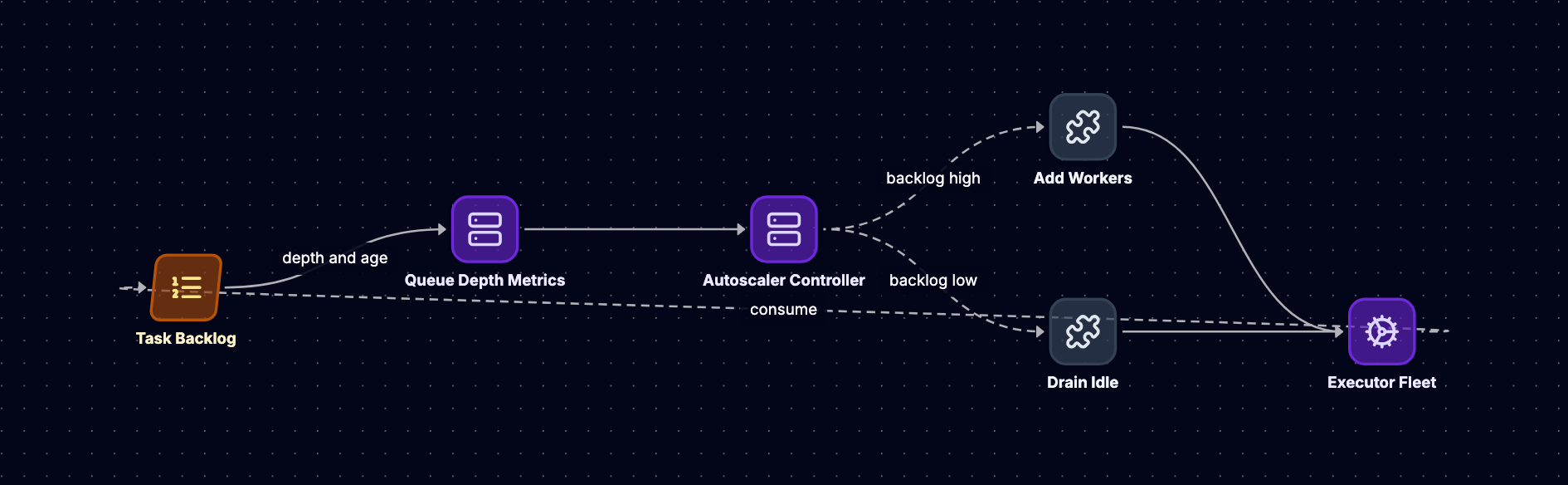
Task Prioritization and Queueing
When worker capacity is limited, schedulers must prioritize which tasks execute first. Common prioritization strategies include:
Priority weights assigned to tasks or DAGs. Critical business pipelines receive higher weights, ensuring they get worker resources before lower-priority workloads.
FIFO by execution date ensures older DAG runs complete before newer ones, preventing starvation when new runs continuously arrive.
Pool-based resource allocation divides workers into logical pools (e.g., "cpu-intensive", "memory-intensive", "gpu"). Tasks declare their pool requirements, and the scheduler only assigns tasks to appropriate workers.
# Conceptual Example: Pool-based task assignment pattern
class TaskPool:
    def __init__(self, name, slot_count):
        self.name = name
        self.total_slots = slot_count
        self.occupied_slots = 0

    def has_capacity(self):
        return self.occupied_slots < self.total_slots

    def acquire_slot(self):
        if self.has_capacity():
            self.occupied_slots += 1
            return True
        return False

def schedule_with_pools(tasks, pools):
    for task in sorted(tasks, key=lambda t: t.priority, reverse=True):
        pool = pools[task.pool_name]
        if pool.acquire_slot():
            submit_to_executor(task)
This prevents resource-intensive tasks from monopolizing all workers, ensuring diverse workloads can execute concurrently.
Handling Task Failures
Dependency resolution must account for task failures. Schedulers typically support several failure handling modes:
Retry with exponential backoff: Failed tasks automatically retry up to a configured limit, with increasing delays between attempts. This handles transient failures (network timeouts, temporary service unavailability) without manual intervention.
Upstream failure propagation: When a task fails, downstream tasks transition to "upstream_failed" state rather than executing with incomplete data. This prevents cascading failures and data corruption.
Failure callbacks: Tasks can register callback functions that execute on failure, enabling custom alerting, cleanup, or remediation logic.
The scheduler tracks retry attempts and failure states in the metadata database, providing visibility into which tasks require attention versus which are handling transient issues automatically.
Delivery Guarantees: At-Least-Once vs Exactly-Once
The Delivery Guarantee Spectrum
Distributed job schedulers face a fundamental challenge: ensuring tasks execute the correct number of times despite failures, network partitions, and process crashes. The industry recognizes three delivery guarantee levels:
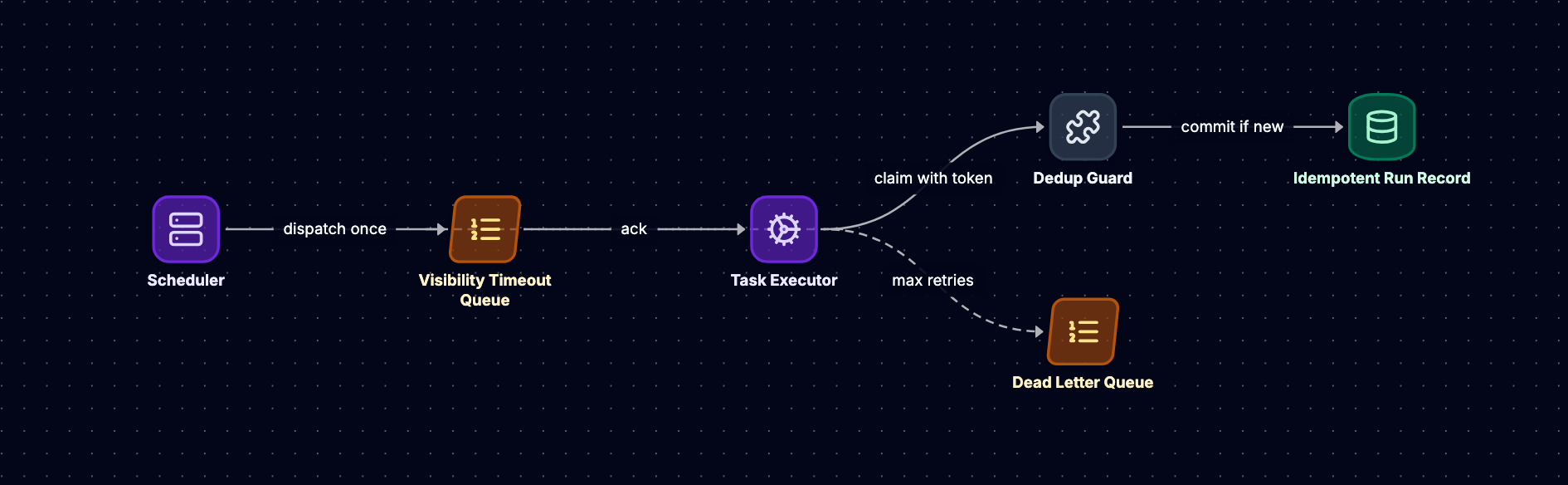
At-most-once: Tasks may execute zero or one time. Failures result in skipped executions. This is the simplest to implement but unacceptable for most data pipelines where missed runs cause data gaps.
At-least-once: Tasks execute one or more times. The scheduler guarantees no missed executions but may produce duplicates during failure scenarios. This is the most common guarantee in production systems.
Exactly-once: Tasks execute precisely once. This is the ideal but hardest to achieve in distributed systems, often requiring application-level idempotency rather than infrastructure guarantees.
At-Least-Once Implementation
Schedulers typically provide at-least-once semantics through persistent task queuing and state tracking. Consider the execution flow:
- Scheduler marks task as "queued" in database (durable write)
- Scheduler submits task to message queue
- Worker picks up task from queue
- Worker marks task as "running" in database
- Worker executes task logic
- Worker marks task as "success" in database
- Worker acknowledges message to queue
Failures at different points create different scenarios:
Failure after step 1: Task remains "queued" in database. Scheduler's periodic reconciliation loop detects the task never transitioned to "running" and resubmits it to the queue.
Failure during step 4: Worker crashes before updating state. The task remains "queued" and gets resubmitted. The message queue may also redeliver the message if the worker never acknowledged it.
Failure during step 5: Worker crashes during execution. The task remains "running" in the database. A timeout mechanism eventually marks it "failed", triggering retry logic.
Failure after step 6: Worker crashes after marking success but before acknowledging the message. The database shows "success", but the message queue redelivers. The scheduler detects the task already succeeded and ignores the duplicate message.
This pattern ensures no task is lost but may execute tasks multiple times:
# Conceptual Example: At-least-once task execution pattern
class Worker:
    def execute_task(self, task_message):
        task_id = task_message['task_id']

        # Check if task already completed (idempotency check)
        current_state = self.db.get_task_state(task_id)
        if current_state == 'success':
            self.message_queue.ack(task_message)
            return  # Already completed, skip execution

        # Mark running
        self.db.set_task_state(task_id, 'running')

        try:
            # Execute actual task logic
            result = self.run_task_logic(task_id)

            # Mark success
            self.db.set_task_state(task_id, 'success', result=result)

            # Acknowledge message (may fail before reaching here)
            self.message_queue.ack(task_message)

        except Exception as e:
            self.db.set_task_state(task_id, 'failed', error=str(e))
            self.message_queue.nack(task_message)
Achieving Exactly-Once Semantics
True exactly-once execution requires eliminating duplicate executions, which is fundamentally challenging in distributed systems. The scheduler can approach this through several patterns:
Idempotent task design: Tasks are written such that executing them multiple times produces the same result as executing once. For example, a task that writes to a database using INSERT ... ON CONFLICT UPDATE or MERGE statements can safely execute multiple times.
Deduplication tokens: Each task execution receives a unique token. Workers and downstream systems track processed tokens, rejecting duplicate executions:
# Conceptual Example: Token-based deduplication pattern
class IdempotentTaskExecutor:
    def execute_with_token(self, task_id, execution_token):
        # Check if this token was already processed
        if self.token_store.exists(execution_token):
            return self.token_store.get_result(execution_token)

        # Execute task
        result = self.execute_task(task_id)

        # Store result with token atomically
        self.token_store.set(execution_token, result)

        return result
Transactional outbox pattern: Task execution and state update occur in a single database transaction. If the task writes to the same database as the scheduler's metadata, both the task's data changes and the "success" state update commit atomically:
# Conceptual Example: Transactional outbox pattern
def execute_task_transactionally(task_id, db_connection):
    with db_connection.transaction():
        # Execute task logic (database writes)
        process_data(db_connection)

        # Update task state in same transaction
        db_connection.execute(
            "UPDATE task_instances SET state = 'success' WHERE id = %s",
            (task_id,)
        )

        # Both commit together or both roll back
This ensures the task state accurately reflects whether the work completed, preventing duplicate executions from the scheduler's perspective.
Handling Zombie Tasks
A subtle challenge emerges with long-running tasks: zombie detection. A worker may appear to hang but is actually still processing. If the scheduler marks it failed and retries, two instances execute concurrently.
Schedulers address this through heartbeat mechanisms:
# Conceptual Example: Task heartbeat pattern
class LongRunningTask:
    def execute(self, task_id):
        heartbeat_thread = threading.Thread(
            target=self.send_heartbeats,
            args=(task_id,)
        )
        heartbeat_thread.start()

        try:
            self.do_work()
        finally:
            heartbeat_thread.stop()

    def send_heartbeats(self, task_id):
        while not self.stopped:
            self.db.update_task_heartbeat(task_id, timestamp=now())
            time.sleep(30)
The scheduler monitors heartbeat timestamps. Only tasks with stale heartbeats (beyond a configured threshold) are marked as failed and retried. This distinguishes truly hung tasks from slow but progressing ones.
Practical Tradeoffs
Most production schedulers operate with at-least-once guarantees combined with application-level idempotency. This balances implementation complexity against reliability:
- At-least-once: Simpler scheduler implementation, requires idempotent tasks
- Exactly-once: Complex scheduler implementation, still requires careful task design
The key insight: exactly-once is often a property of the entire system (scheduler + tasks + data stores) rather than the scheduler alone. Designing tasks to be naturally idempotent is often more practical than attempting to guarantee exactly-once at the infrastructure level.
Backfills and Catch-up Runs
The Backfill Problem
Data pipelines frequently need to reprocess historical data: fixing bugs in transformation logic, ingesting newly available historical data, or recovering from extended outages. This requires executing tasks for past time periods, potentially spanning months or years of historical intervals.
Naive approaches create operational challenges. Running thousands of historical DAG runs simultaneously overwhelms worker capacity, starves current production runs, and makes monitoring difficult. Schedulers need sophisticated backfill mechanisms that balance historical processing with ongoing operations.
Execution Date vs Logical Date
Schedulers distinguish between when a task runs (execution time) and what time period it processes (logical date or data interval):
# Conceptual Example: Logical date concept
class DAGRun:
    def __init__(self, dag_id, logical_date, execution_date):
        self.dag_id = dag_id
        self.logical_date = logical_date  # What data to process
        self.execution_date = execution_date  # When it actually runs

# A DAG scheduled for 2024-01-15 might run on 2024-01-16
# but processes data from 2024-01-15
dag_run = DAGRun(
    dag_id='daily_pipeline',
    logical_date='2024-01-15',
    execution_date='2024-01-16 00:05:00'
)
This separation enables backfills: creating DAG runs with historical logical dates while executing them at the current time. Tasks use the logical date to determine which data to process, ensuring correct historical data selection.
Backfill Strategies
Schedulers implement several backfill patterns:
Sequential backfill executes historical runs one at a time, in chronological order. This ensures each run completes before the next begins, maintaining strict ordering when later runs depend on earlier ones:
# Conceptual Example: Sequential backfill pattern
def sequential_backfill(dag_id, start_date, end_date):
    current_date = start_date

    while current_date <= end_date:
        dag_run = create_dag_run(
            dag_id=dag_id,
            logical_date=current_date,
            execution_date=now()
        )

        # Wait for completion before proceeding
        while not is_complete(dag_run):
            sleep(polling_interval)

        if dag_run.state == 'failed':
            raise BackfillFailedException(
                f"Run for {current_date} failed"
            )

        current_date += dag_schedule_interval
This approach is safest but slowest, processing one interval at a time.
Parallel backfill executes multiple historical runs concurrently, up to a configured limit. This accelerates backfills when runs are independent:
# Conceptual Example: Parallel backfill pattern
def parallel_backfill(dag_id, start_date, end_date, max_parallel):
    dates = generate_date_range(start_date, end_date, interval)

    with ThreadPoolExecutor(max_workers=max_parallel) as executor:
        futures = []
        for date in dates:
            future = executor.submit(
                execute_dag_run,
                dag_id=dag_id,
                logical_date=date
            )
            futures.append(future)

        # Wait for all to complete
        for future in futures:
            result = future.result()
            if result.state == 'failed':
                handle_failure(result)
This maximizes throughput but requires careful tuning of parallelism to avoid overwhelming workers.
Chunked backfill divides the date range into chunks, executing each chunk sequentially but running tasks within each chunk in parallel. This balances ordering requirements with performance:
# Conceptual Example: Chunked backfill pattern
def chunked_backfill(dag_id, start_date, end_date, chunk_size):
    date_chunks = chunk_date_range(
        start_date,
        end_date,
        chunk_size
    )

    for chunk in date_chunks:
        # Execute chunk in parallel
        chunk_runs = [
            create_dag_run(dag_id, date)
            for date in chunk
        ]

        # Wait for chunk completion
        wait_for_completion(chunk_runs)

        # Verify all succeeded before next chunk
        if any(run.state == 'failed' for run in chunk_runs):
            raise BackfillFailedException()
Catch-up Mode
Related to backfills, catch-up mode determines whether a DAG automatically creates runs for missed intervals. Consider a daily DAG that was paused for a week. When resumed, should it:
- Create seven DAG runs for the missed days (catch-up enabled)
- Resume with only the current day (catch-up disabled)
Schedulers typically make this configurable per DAG:
# Conceptual Example: Catch-up configuration pattern
class DAG:
    def __init__(self, dag_id, schedule_interval, catchup=True):
        self.dag_id = dag_id
        self.schedule_interval = schedule_interval
        self.catchup = catchup

def create_missed_runs(dag, last_run_date):
    if not dag.catchup:
        # Only create run for current interval
        return [create_run_for_current_interval(dag)]

    # Create runs for all missed intervals
    missed_runs = []
    current_date = last_run_date + dag.schedule_interval

    while current_date <= now():
        missed_