Why Small Language Models Are About to Change Everything
Look, I get it. Everyone's talking about GPT-4, Claude, and these massive models with hundreds of billions of parameters. But here's the thing that's got me excited: the real revolution isn't happening in the cloud with these giant models. It's happening right on your device with Small Language Models (SLMs).
And before you roll your eyes thinking "small = worse," let me blow your mind with some numbers. Microsoft's Phi-2 model has just 2 billion parameters but rivals models with 30 billion parameters in reasoning tasks. Oh, and it runs 15 times faster. Yeah, you read that right.
What Exactly Are Small Language Models?
Think of SLMs as the Swiss Army knives of AI. Instead of being massive, do-everything models that need a data center to run, SLMs are compact, specialized tools designed to run efficiently on your laptop, phone, or even a Raspberry Pi.
We're talking about models that can operate on devices with as little as 8GB of RAM while delivering 60-80% lower power consumption and 2-5x faster inference speeds compared to their larger cousins.

The "But Wait, There's More" Moment
Here's where it gets interesting. SLMs aren't just smaller versions of big models, they're fundamentally different beasts. They're like having a team of specialists instead of one generalist.
Privacy That Actually Means Something
Remember when everyone freaked out about ChatGPT potentially storing their conversations? With SLMs, your data never leaves your device. Ever. It's processed locally, which means:
- Healthcare apps can analyze patient data without HIPAA nightmares
- Financial institutions can run AI without regulatory panic attacks
- Your personal assistant actually stays personal
The Offline Superpower
This one's huge. SLMs work without internet. Think about it, when was the last time you had a reliable connection everywhere you went? SLMs don't care if you're in a basement, on a plane, or in the middle of nowhere. They just work.
The Agentic AI Revolution (This Is Where It Gets Wild)
Okay, here's where my brain starts buzzing with possibilities. Instead of having one massive AI trying to do everything, imagine having a team of specialized AI agents, each powered by their own SLM.
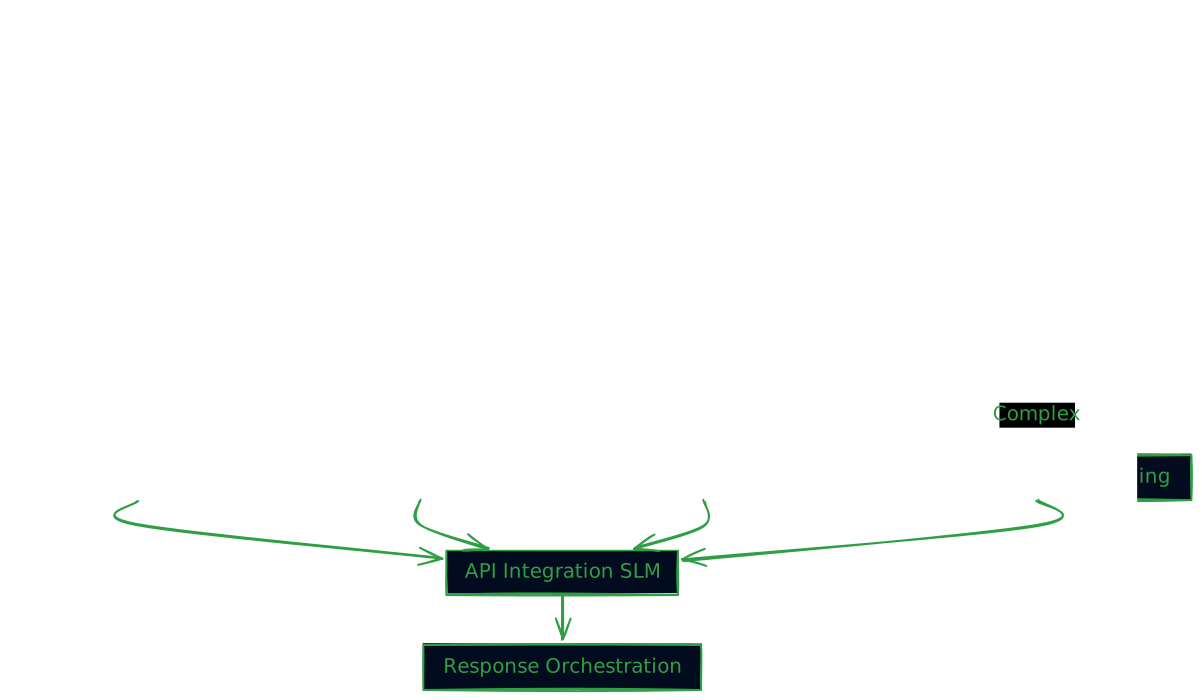
This modular approach is brilliant because:
- Each SLM becomes really good at one thing (like that friend who's amazing at parallel parking but terrible at everything else)
- You only use the compute power you need (no need to fire up a massive model to classify an email)
- The system becomes more reliable (if one agent fails, the others keep working)
The Technical Deep Dive (For the Nerds Among Us)
Let's talk about how these little powerhouses actually work under the hood.
Model Compression Magic
The secret sauce behind SLMs involves some seriously clever techniques:
Quantization: Instead of using 32-bit floating-point numbers for everything, SLMs use 8-bit or even 4-bit integers. It's like switching from 4K video to 1080p, you lose some detail but gain massive efficiency.
Pruning: This is basically Marie Kondo for neural networks. If a connection doesn't spark joy (contribute meaningfully to the output), it gets removed.
# Simplified example of quantization
def quantize_weights(weights, bits=8):
    """Convert 32-bit weights to 8-bit integers"""
    scale = (weights.max() - weights.min()) / (2**bits - 1)
    quantized = ((weights - weights.min()) / scale).round()
    return quantized.astype(f'int{bits}'), scale
Hardware Acceleration Tricks
Modern SLMs are designed to play nice with specialized hardware:
- GPU Tensor Cores: These are like turbo boosters for matrix operations
- AI Accelerators: Purpose-built chips that eat neural network computations for breakfast
- Edge TPUs: Google's tiny processors that can run inference at lightning speed
Real-World Examples That'll Make You Go "Whoa"
Let me introduce you to some SLMs that are already changing the game:
Qwen 2.5-0.5B-Instruct
With just 500 million parameters, this little beast handles multiple languages and follows instructions like a champ. It's like having a polyglot assistant that fits in your pocket.
StableLM-Zephyr 3B
Stability AI's contribution to the SLM world. Three billion parameters of pure efficiency, perfect for when you need reliable NLP without the overhead.
TinyLLaMA
Meta's answer to "what if we made LLaMA really, really small?" Spoiler alert: it still works amazingly well.
The "Yeah, But What About..." Questions
"Don't Small Models Suck at Complex Reasoning?"
Fair question. Here's the thing, they're not trying to replace GPT-4 for writing your PhD thesis. They're designed for specific tasks where they can actually outperform larger models.
Think of it like this: you wouldn't use a sledgehammer to hang a picture frame, right? SLMs are the precision tools in your AI toolkit.
"How Do They Handle Edge Cases?"
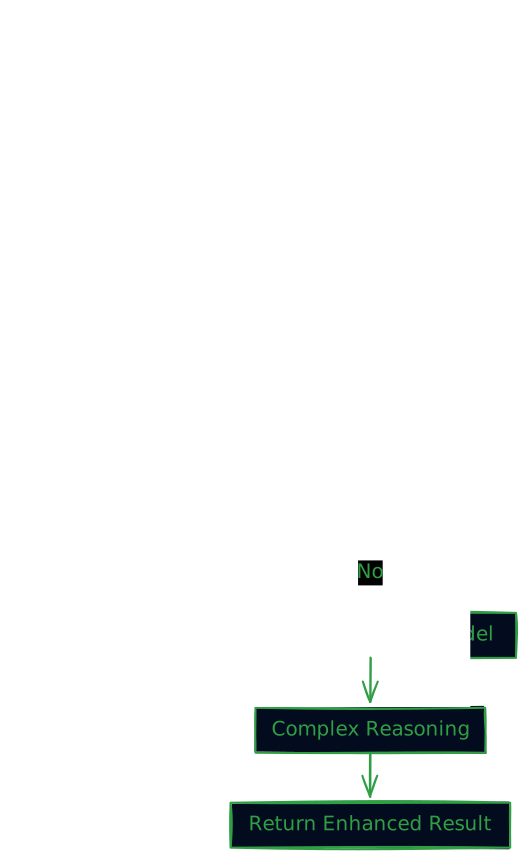
This is where the modular approach shines. When an SLM hits something it can't handle, it can hand off to a larger model or another specialist. It's like having a general practitioner who knows when to refer you to a specialist.
"What About Training Data and Bias?"
Great question. SLMs can actually be more transparent about their training data because they're often open-source. Plus, you can fine-tune them on your specific domain data, which means less bias from irrelevant training examples.
The Optimization Game (Getting Every Ounce of Performance)
If you're thinking about deploying SLMs, here are the tricks that separate the pros from the amateurs:
Early Exit Strategies
Instead of running through the entire model, smart SLMs can "exit early" when they're confident about an answer. It's like knowing the answer to a multiple-choice question after reading option A.
Collaborative Inference
This is where things get really cool. Multiple edge devices can work together to run inference, sharing the computational load. Imagine your phone, laptop, and smart speaker all chipping in to process a complex query.
Efficient Attention Mechanisms
Traditional attention mechanisms are computational hogs. SLMs use sparse attention and other tricks to focus only on what matters, like having selective hearing but in a good way.
The Open Source Revolution
Here's something that gets me really excited: the open-source SLM community is absolutely crushing it. Models like Deepseek-R1-Distill-Qwen-7B are matching or beating proprietary models while being completely transparent about their architecture and training.
This means:
- No vendor lock-in (you own your AI stack)
- Community-driven improvements (thousands of developers making it better)
- Customization freedom (fine-tune for your specific needs)
What This Means for Developers (The Practical Stuff)
If you're building AI applications, SLMs open up possibilities that were impossible before:
- Real-time applications: No more waiting for API calls to complete
- Privacy-first products: Build apps that never send data to the cloud
- Cost-effective scaling: No per-token pricing eating your profits
- Offline-first experiences: Apps that work everywhere, always
# Example: Local SLM integration
from transformers import AutoTokenizer, AutoModelForCausalLM

class LocalSLM:
    def __init__(self, model_name="microsoft/DialoGPT-small"):
        self.tokenizer = AutoTokenizer.from_pretrained(model_name)
        self.model = AutoModelForCausalLM.from_pretrained(model_name)

    def generate_response(self, prompt, max_length=100):
        inputs = self.tokenizer.encode(prompt, return_tensors='pt')
        outputs = self.model.generate(inputs, max_length=max_length)
        return self.tokenizer.decode(outputs[0], skip_special_tokens=True)

# No API keys, no internet required, no data leaving your device
assistant = LocalSLM()
response = assistant.generate_response("How can I optimize my code?")
The Future Is Distributed (And It's Awesome)
Here's my prediction: the future of AI isn't going to be dominated by a few massive models in the cloud. It's going to be thousands of specialized SLMs working together, each optimized for specific tasks and running where they're needed most.
Think about it:
- Your phone's SLM handles quick queries and personal tasks
- Your car's SLM manages navigation and safety systems
- Your home's SLM coordinates smart devices and security
- Your work laptop's SLM assists with coding and documentation
All working together, all private, all fast, all reliable.
The Bottom Line
Small Language Models aren't just a cute alternative to big models, they're a fundamental shift in how we think about AI deployment. They're bringing AI closer to where it's actually needed, making it more private, more reliable, and more accessible.
The best part? We're just getting started. As hardware gets better and optimization techniques improve, SLMs are going to become even more capable while staying small and efficient.
So next time someone tells you bigger is always better in AI, remind them that sometimes the most powerful solutions come in the smallest packages. After all, your smartphone has more computing power than the computers that put humans on the moon, and it fits in your pocket.
The SLM revolution is here, and it's happening right on your device. The question isn't whether you should pay attention, it's whether you can afford not to.
Want to dive deeper into SLMs? Start experimenting with models like Qwen 2.5-0.5B or TinyLLaMA. Trust me, once you experience the speed and privacy of local AI, you'll never want to go back to waiting for cloud APIs.
References
- Why Use Small Language Models for Edge Deployment? A Complete Guide, 2023, Zen van Riel https://zenvanriel.nl/ai-engineer-blog/why-use-small-language-models-for-edge-deployment-complete-guide/
- Edge LLMs vs Cloud LLMs: Pros, Cons, and Use Cases, 2023, Premio Inc. https://premioinc.com/blogs/blog/edge-llms-vs-cloud-llms-pros-cons-and-use-cases
- Small Language Model Agents: The Future of AI, 2023, Aisera https://aisera.com/blog/small-language-model-agents/
- Nvidia Researchers Urge the AI Industry to Rethink Agentic AI in Favor of Smaller, More Efficient LLMs, 2023, The Decoder https://the-decoder.com/nvidia-researchers-urge-the-ai-industry-to-rethink-agentic-ai-in-favor-of-smaller-more-efficient-llms/
- The Future of Agentic AI Will Be Open Source, Data-Driven Small Language Models, 2023, Cobus Greyling https://cobusgreyling.medium.com/the-future-of-agentic-ai-will-be-open-source-data-driven-small-language-models-e798b458d7dc