The Real Talk on Vertical vs Horizontal Scaling
When Your Server Hits the Wall: The Real Talk on Vertical vs Horizontal Scaling
So your app is getting popular. Users are flooding in, your database is sweating, and your server is basically screaming "help me" at 3 AM. Sound familiar?
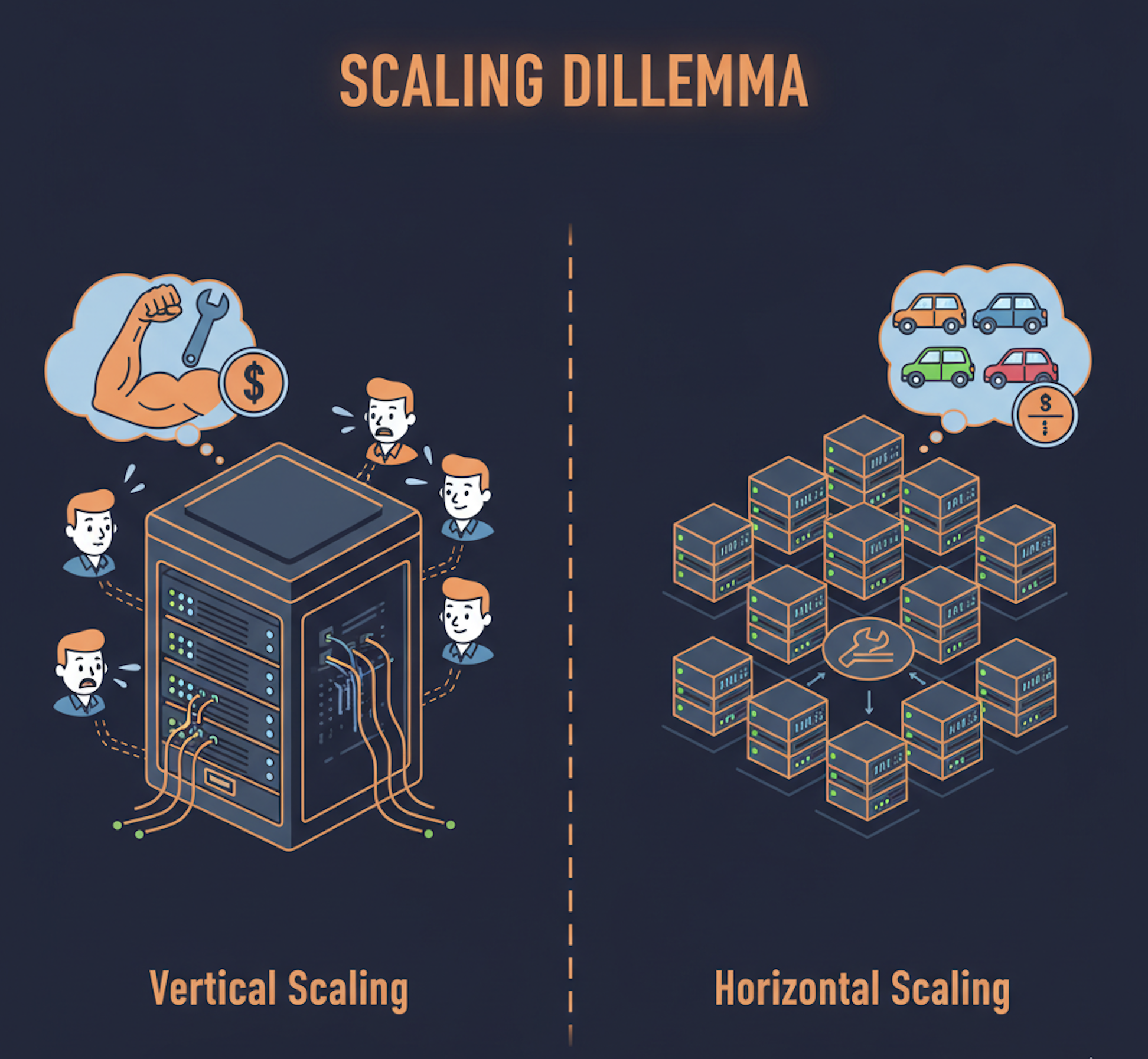
You're at that crossroads every developer faces: do you throw more RAM at your existing server (vertical scaling) or spin up a bunch of new servers (horizontal scaling)? It's like choosing between upgrading your car's engine or buying a whole fleet of cars.
Let me break this down without the corporate fluff.
The Scaling Dilemma: Why This Actually Matters
Here's the thing, scaling isn't just about handling more users. It's about staying sane when your app goes viral, keeping your costs reasonable, and not getting fired when everything crashes during peak hours.
I've seen teams make the wrong scaling choice and pay for it big time. One startup I know spent $50K on a monster server that could barely handle Black Friday traffic, while another company scaled horizontally from day one and handled 10x the load for half the cost.
Vertical Scaling: The "Bigger Hammer" Approach
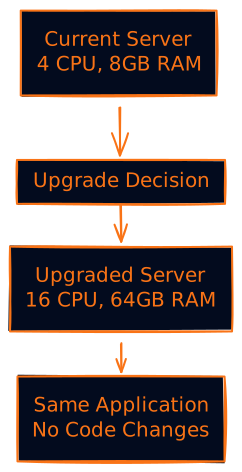
Vertical scaling is basically the brute force method. Got performance issues? Throw more CPU cores at it. Database slow? Add more RAM. It's like solving problems by buying a bigger hammer.
When Vertical Scaling Actually Works
Small to medium apps with predictable growth: If you're running a SaaS with steady growth, vertical scaling can be your best friend. No architectural headaches, no distributed system complexity.
Legacy applications: Got a 10-year-old monolith that would take months to refactor? Vertical scaling might be your only realistic option.
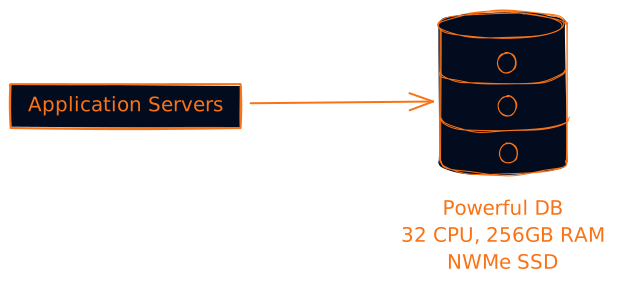
Database-heavy workloads: Some databases just perform better on a single powerful machine. PostgreSQL with tons of RAM can be incredibly fast.
Quick fixes: When you need to buy time while planning a proper horizontal architecture, vertical scaling is like putting a band-aid on the problem.
The Brutal Reality of Vertical Scaling
But here's where it gets ugly. Vertical scaling has a ceiling, and it's lower than you think.
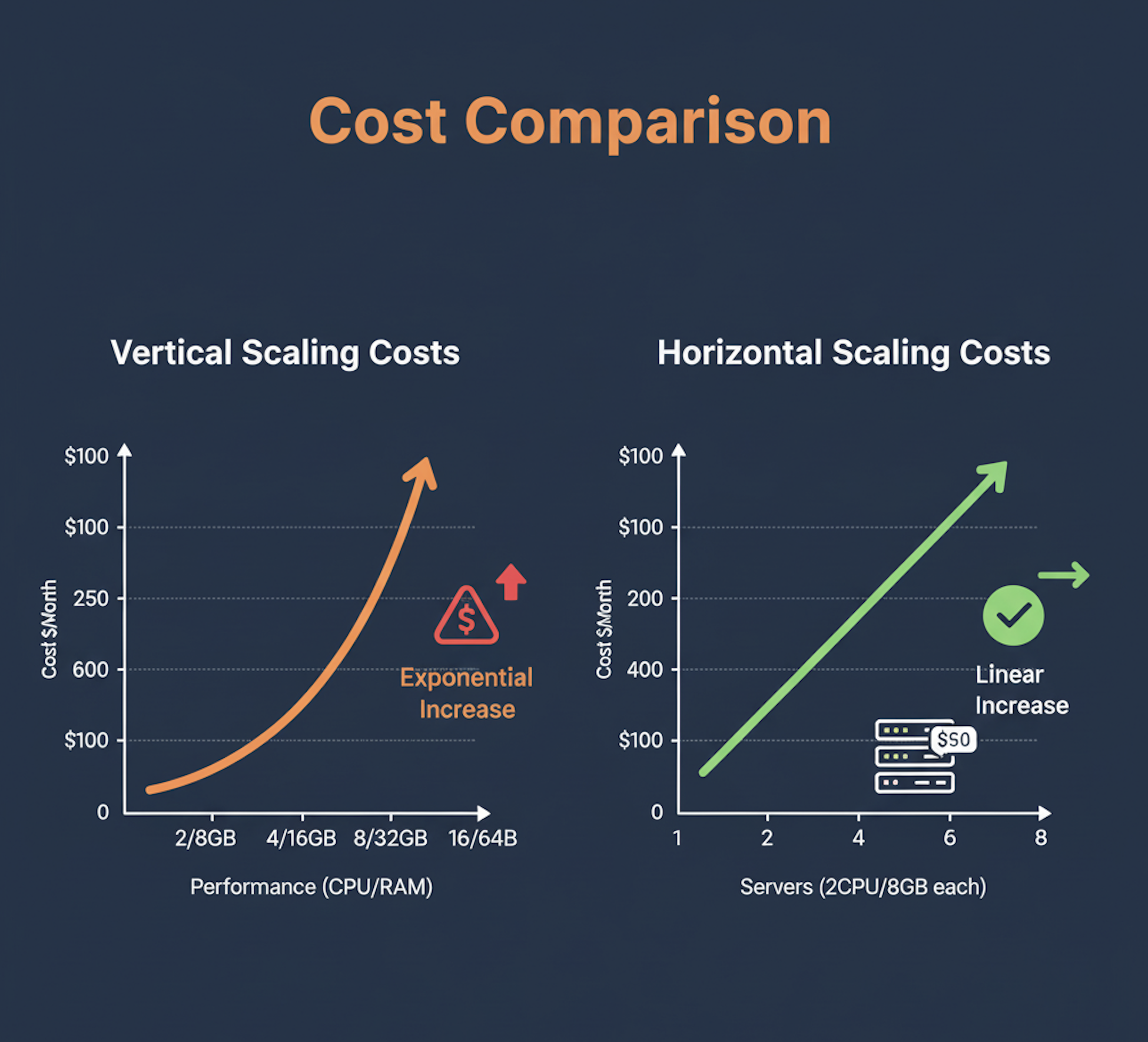
The cost curve is insane: Going from 8GB to 16GB RAM might cost 2x, but going from 64GB to 128GB could cost 4x. The math stops making sense real quick.
Single point of failure: Your entire business runs on one machine. When it goes down (and it will), everything stops. I've seen companies lose thousands of dollars per minute because their "super server" decided to take a nap.
Downtime for upgrades: Want to add more RAM? Hope you planned a maintenance window, because your users are going offline.

Horizontal Scaling: The "Army of Ants" Strategy
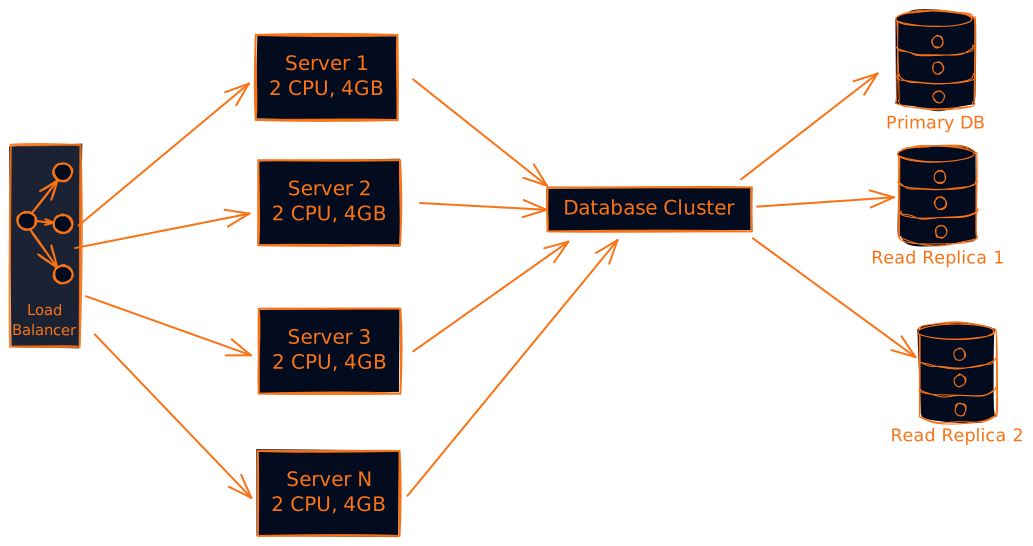
Horizontal scaling is like having an army of worker ants instead of one giant ant. Each server is smaller and cheaper, but together they can move mountains.
Why Horizontal Scaling is the Future
Linear cost scaling: Need 2x performance? Add 2x servers. The math actually makes sense.
Fault tolerance: One server dies? The others keep running. Your users might not even notice.
Geographic distribution: Put servers closer to your users. A server in Tokyo serves Japanese users, one in Frankfurt serves Europeans.
Auto-scaling: Cloud providers can automatically add/remove servers based on demand. It's like having a smart assistant that manages your infrastructure.
But Wait, There's a Catch (There Always Is)
Horizontal scaling isn't free lunch. It comes with its own set of headaches:
Stateless applications required: Your app can't store user sessions on the server. Everything needs to go to a database or cache.
Network latency: Servers talking to each other over the network is slower than components talking within the same machine.
Distributed system complexity: Ever heard of the CAP theorem? Welcome to the world of eventual consistency and network partitions.
Data synchronization: Keeping data consistent across multiple servers is hard. Really hard.
The Database Scaling Nightmare
Let's talk about the elephant in the room: databases. They're usually the first thing to break when you scale.
Vertical Database Scaling: The Easy Button
Pros:
- ACID transactions work perfectly
- No data consistency issues
- Simple to manage
Cons:
- Expensive as hell at scale
- Single point of failure
- Limited by hardware
Horizontal Database Scaling: Choose Your Pain
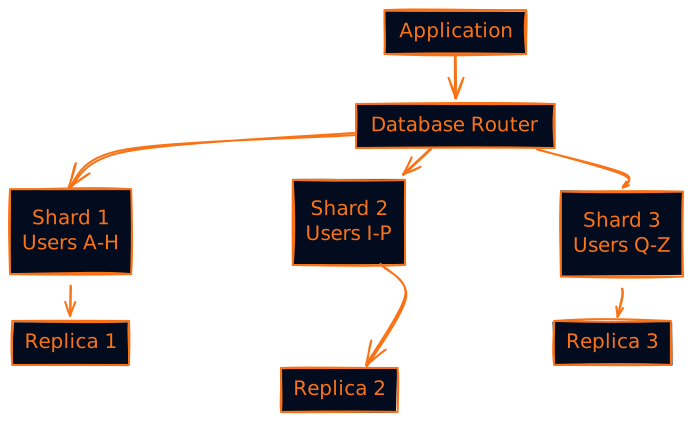
Read scaling: Easy. Just add read replicas. Most apps are read-heavy anyway.
Write scaling: This is where things get spicy. You'll need to shard your data, and cross-shard queries become a nightmare.
Real-World Examples: Who Does What
Vertical Scaling Champions
Stack Overflow (early days): They famously ran on a single powerful database server for years. Worked great until it didn't.
Financial trading systems: When you need microsecond latency, a single powerful machine beats distributed systems every time.
Horizontal Scaling Masters
Netflix: Thousands of microservices, auto-scaling based on demand. They can lose entire data centers and keep streaming.
Google: Everything is distributed. They assume hardware will fail and design around it.
Facebook: Billions of users, distributed across the globe. Horizontal scaling is the only way this works.
The Hybrid Approach: Best of Both Worlds?
Here's what most successful companies actually do: they use both strategies.
Phase 1: Start with vertical scaling. It's simpler and gets you to market faster.
Phase 2: When you hit the cost/performance wall, start planning horizontal scaling.
Phase 3: Gradually migrate to a distributed architecture.
The Decision Framework: What Should You Actually Do?
Choose Vertical Scaling If:
- You're a small team with limited DevOps expertise
- Your app has predictable, moderate growth
- You need strong data consistency
- You're working with legacy systems
- You need to ship fast and optimize later
Choose Horizontal Scaling If:
- You expect rapid, unpredictable growth
- High availability is critical
- You have the team to manage distributed systems
- Cost efficiency at scale matters
- You're building for global users
Red Flags for Each Approach
Vertical scaling red flags:
- Your server costs are doubling every few months
- You're hitting hardware limits
- Downtime for upgrades is becoming unacceptable
- You need geographic distribution
Horizontal scaling red flags:
- Your team is spending more time on infrastructure than features
- Network issues are causing cascading failures
- Data consistency bugs are appearing
- Operational complexity is overwhelming your team
The Cost Reality Check
Let's talk numbers because that's what your boss cares about.
Vertical Scaling Costs
Small:    2 CPU,  8GB RAM = $100/month
Medium:   4 CPU, 16GB RAM = $250/month  (2.5x cost, 2x performance)
Large:    8 CPU, 32GB RAM = $600/month  (2.4x cost, 2x performance)
X-Large: 16 CPU, 64GB RAM = $1500/month (2.5x cost, 2x performance)
Notice the pattern? Costs increase faster than performance.
Horizontal Scaling Costs
1 server:  2 CPU,  8GB = $100/month
2 servers: 4 CPU, 16GB = $200/month + $50 load balancer
4 servers: 8 CPU, 32GB = $400/month + $50 load balancer
8 servers:16 CPU, 64GB = $800/month + $50 load balancer
Linear scaling, but you pay for the load balancer and operational complexity.
Common Mistakes (Learn from Others' Pain)
Vertical Scaling Mistakes
- Ignoring the hardware ceiling: That 1TB RAM server sounds cool until you realize it costs $50K/month
- Not planning for downtime: Surprise! Your upgrade requires a 4-hour maintenance window
- Vendor lock-in: You're stuck with one cloud provider's most expensive instances
Horizontal Scaling Mistakes
- Premature optimization: Building for Netflix scale when you have 100 users
- Ignoring network failures: The network is reliable, right? Right?
- Underestimating complexity: "How hard can load balancing be?" (Famous last words)
The Migration Path: From Vertical to Horizontal
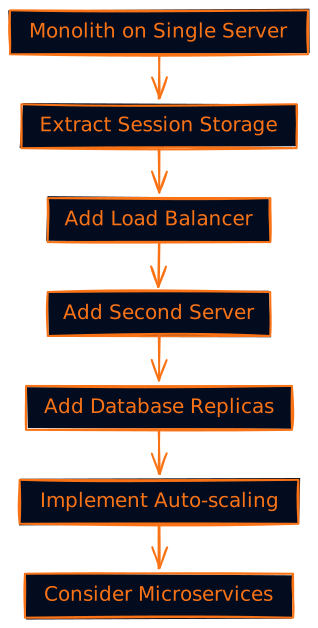
If you're currently vertical and need to go horizontal, here's the playbook:
Step 1: Make Your App Stateless
// Bad: Storing session in memory
app.use(session({
  store: new MemoryStore()
}));

// Good: External session store
app.use(session({
  store: new RedisStore({
    host: 'redis-cluster.example.com'
  })
}));
Step 2: Add a Load Balancer
Start with two identical servers behind a load balancer. Test everything twice.
Step 3: Database Scaling
Add read replicas first. Sharding comes later when you really need it.
Step 4: Monitor Everything
Distributed systems fail in creative ways. You need visibility into every component.
Modern Tools That Make This Easier
For Vertical Scaling
- Cloud auto-scaling: AWS, GCP, and Azure can automatically resize your instances
- Monitoring tools: New Relic, DataDog help you understand when to scale up
For Horizontal Scaling
- Kubernetes: Container orchestration that handles a lot of the complexity
- Service meshes: Istio, Linkerd manage service-to-service communication
- Managed databases: RDS, Cloud SQL handle read replicas automatically
The Future: Serverless and Edge Computing
Plot twist: the future might make this whole debate irrelevant.
Serverless functions: AWS Lambda, Vercel Functions scale automatically. You write code, they handle the servers.
Edge computing: Cloudflare Workers, AWS Lambda@Edge run your code closer to users globally.
Database-as-a-Service: PlanetScale, Supabase, FaunaDB handle scaling for you.
These technologies abstract away the scaling decisions, but understanding the fundamentals still matters.
What About AI and Machine Learning Workloads?
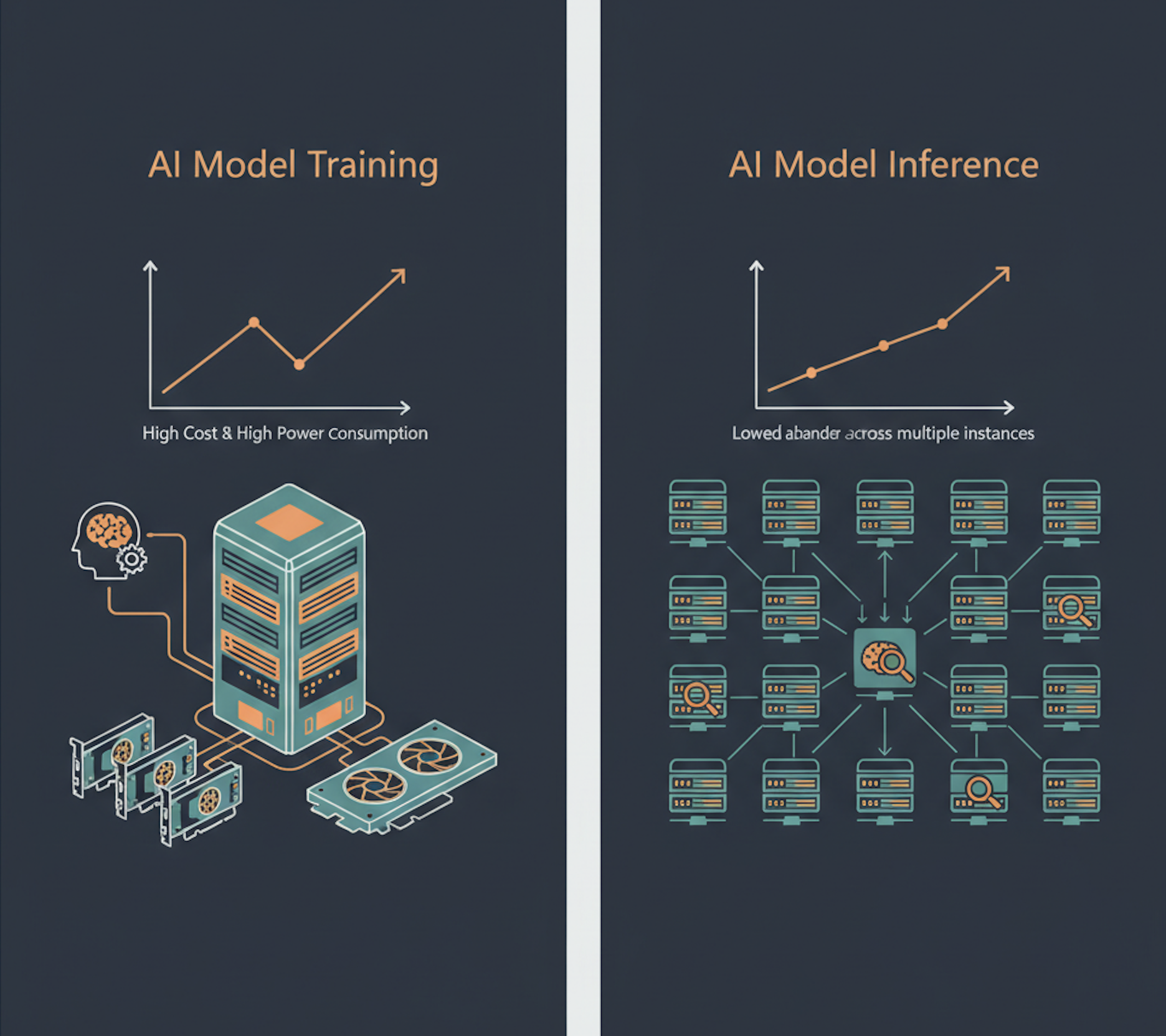
AI changes the game completely:
Training models: Usually requires vertical scaling with powerful GPUs Inference: Can be horizontally scaled across many smaller instances Real-time AI: Often needs edge computing for low latency
The Bottom Line: What Should You Actually Do?
Here's my honest advice after seeing companies succeed and fail with both approaches:
- Start vertical if you're small: Get to market fast, optimize later
- Plan for horizontal from day one: Design stateless applications even if you start with one server
- Monitor your costs and performance: Know when you're hitting limits before they hit you
- Don't over-engineer: Netflix's architecture won't help your 1000-user SaaS
- Consider managed services: Let cloud providers handle the complexity when possible
The best scaling strategy is the one that lets you focus on building features your users love, not fighting infrastructure fires at 2 AM.
Remember: premature optimization is the root of all evil, but so is ignoring scalability until your servers are melting. Find the balance that works for your team, your users, and your budget.
Your future self (and your on-call schedule) will thank you.
What's your scaling horror story? Have you been burned by choosing the wrong approach? Let me know in the comments, I love hearing about other people's infrastructure disasters.