The Four Pillars of Modern System Design
The Four Pillars of Modern System Design
Ever wondered why some systems scale effortlessly while others crumble under pressure? After diving deep into the architecture patterns that power today's most resilient systems, I've discovered it all comes down to four fundamental building blocks. Let me walk you through what I learned.
Why These Building Blocks Matter (And Why You Should Care)
Picture this: you're building a house. You could slap together some walls and call it done, but without a solid foundation, proper plumbing, electrical systems, and good ventilation, you'll be dealing with problems for years. Modern systems work the same way.
The four pillars I'm talking about are:
- Communication Infrastructure
- Data Storage and Management
- Processing and Computation
- Monitoring and Observability
But here's the thing, these aren't just buzzwords. They're the difference between a system that works and one that works reliably at scale.
Communication Infrastructure: The Nervous System of Your Architecture
Why Traditional Networks Fall Short
Remember the old days when network architecture was basically "throw more hardware at it"? Yeah, that doesn't work anymore. Modern applications need networks that can adapt, heal themselves, and route around problems without human intervention.

Software-Defined Networking: The Game Changer
SDN isn't just a fancy acronym. It's what happens when you separate the brain (control plane) from the muscle (data plane). Think of it like having a smart traffic controller that can instantly reroute cars when there's an accident, instead of waiting for someone to manually change the traffic lights.
The real magic happens with Network Function Virtualization (NFV). Instead of buying expensive hardware boxes for every network function, you run everything as software on commodity servers. Need a new firewall? Spin up a virtual one. Load balancer crashed? Deploy another instance in seconds.
Real-Time Monitoring: Your Early Warning System
But what if I told you that most network problems could be prevented before they happen? That's where real-time monitoring comes in. We're not talking about checking CPU usage every 5 minutes. We're talking about analyzing traffic patterns, detecting anomalies, and predicting failures before they occur.
# Example: Simple anomaly detection for network traffic
def detect_traffic_anomaly(current_traffic, historical_average, threshold=2.0):
    deviation = abs(current_traffic - historical_average) / historical_average
    return deviation > threshold

# This kind of logic, scaled up with ML, prevents outages
Data Storage and Management: Beyond "Just Use a Database"
The Data Lake Revolution
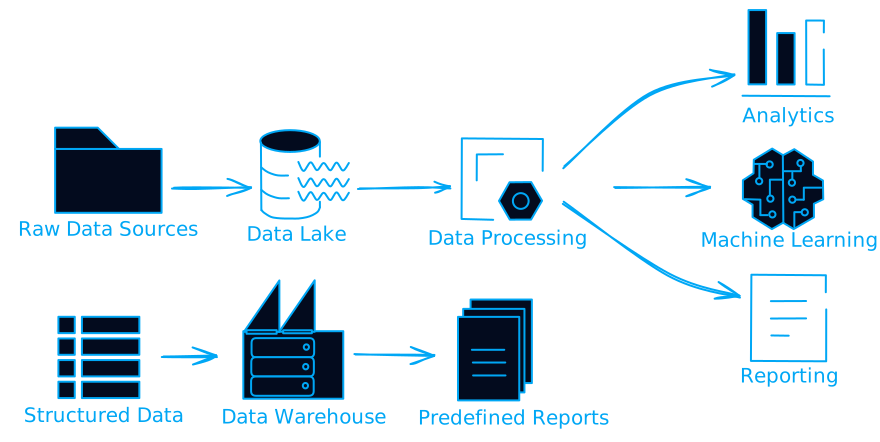
Here's something that might surprise you: traditional data warehouses are becoming obsolete for many use cases. Why? Because they force you to decide what your data looks like before you even know what questions you want to ask.
Data lakes flip this on its head. They store everything in its raw form, letting you figure out the structure later. It's like having a massive warehouse where you can throw everything in boxes and organize it when you actually need it.
Cloud Storage: Not Just "Someone Else's Computer"
Cloud storage gets a bad rap from the "it's just someone else's computer" crowd. But here's what they're missing: built-in redundancy, automatic backups, version control, and global distribution. Try building that yourself and see how much it costs.
The real advantage isn't just storage, it's the ecosystem. When your data is in the cloud, you can spin up processing power on demand, run analytics without moving data around, and scale storage independently from compute.
Data Governance: The Unsexy Hero
Nobody talks about data governance at parties, but it's what keeps you out of legal trouble. GDPR, HIPAA, PCI DSS, these aren't just acronyms, they're regulations that can shut down your business if you mess up.
Modern data management tools build compliance in from the ground up. Encryption at rest and in transit, access controls, audit trails, data lineage tracking. It's not exciting, but it's essential.
Processing and Computation: Beyond Single-Threaded Thinking
Parallel Processing: Why One Core Isn't Enough
Single-threaded processing is like trying to paint a house with one brush. Sure, you'll get it done eventually, but why not use multiple brushes and finish faster?
# Sequential processing - slow
def process_data_sequential(data_list):
    results = []
    for item in data_list:
        results.append(expensive_operation(item))
    return results

# Parallel processing - fast
from multiprocessing import Pool

def process_data_parallel(data_list):
    with Pool() as pool:
        results = pool.map(expensive_operation, data_list)
    return results
The key insight is that most real-world problems can be broken down into smaller, independent pieces. Image processing, data analysis, web scraping, you name it. The trick is identifying where the parallelization boundaries are.
Distributed Computing: When One Machine Isn't Enough
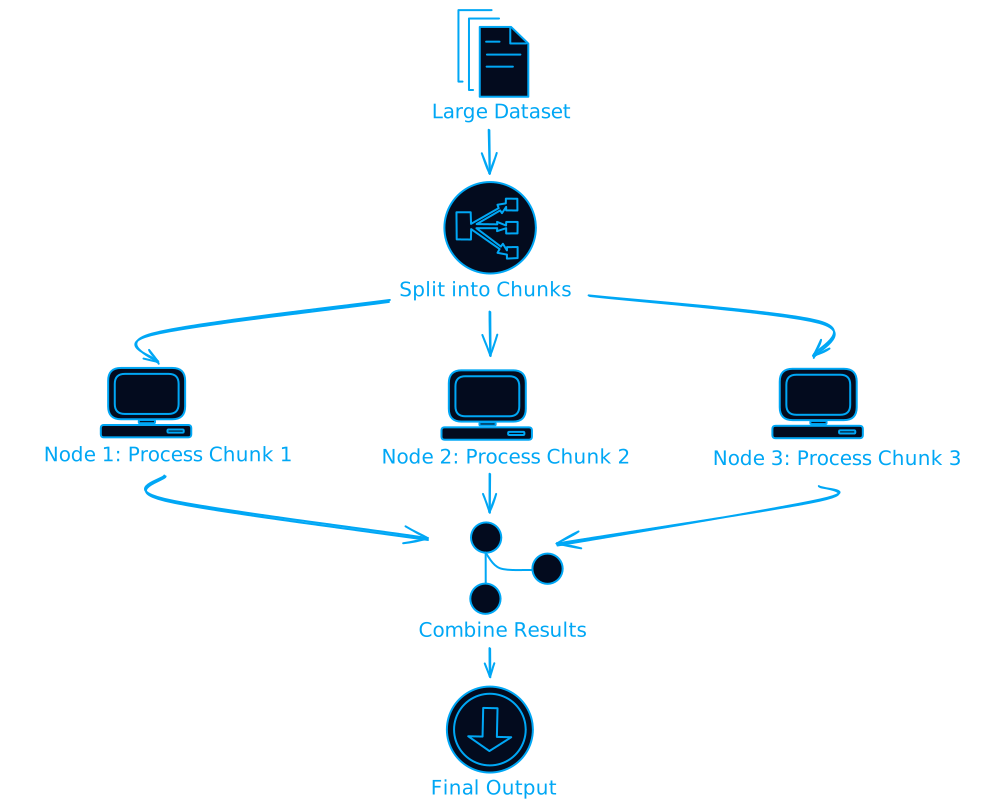
Sometimes even parallel processing on one machine isn't enough. That's where distributed computing comes in. Apache Hadoop was one of the first frameworks to make this accessible, but the principles apply everywhere.
The Quantum Computing Wild Card
Quantum computing is still mostly theoretical for practical applications, but it's worth understanding the basics. While classical computers use bits (0 or 1), quantum computers use qubits that can be in superposition (both 0 and 1 simultaneously).
This isn't just "faster computing." It's fundamentally different computing that could solve certain problems exponentially faster. Cryptography, optimization, drug discovery, these are the areas where quantum computing could be game-changing.
Edge Computing: Bringing Processing to the Data
Here's a counterintuitive idea: instead of sending all your data to the cloud for processing, what if you processed it where it's generated? That's edge computing in a nutshell.
Think about autonomous vehicles. You can't send camera data to the cloud, wait for processing, and then get a response. The car needs to make decisions in milliseconds. Edge computing makes this possible.
Monitoring vs Observability: The Difference That Matters
Why Traditional Monitoring Falls Short
Traditional monitoring is like having a smoke detector. It tells you there's a fire, but not where it started or why. You get alerts like "CPU usage high" or "Response time slow," but good luck figuring out the root cause.
Observability: The Three Pillars
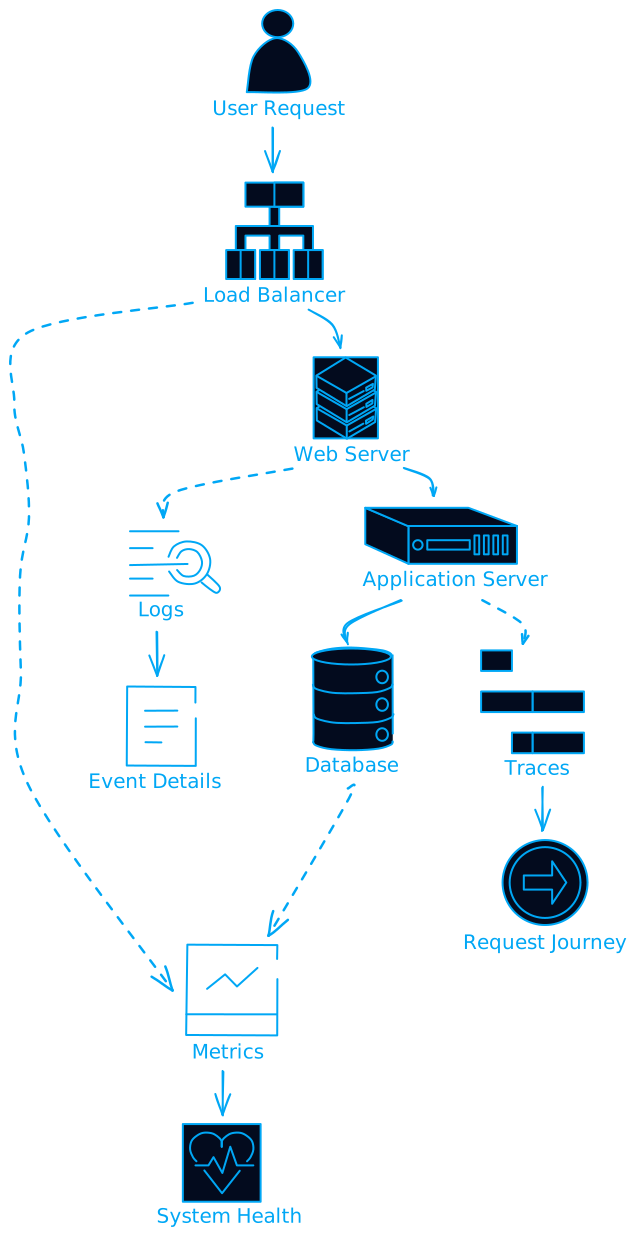
Observability is different. It's built on three pillars:
- Metrics: The numbers (CPU, memory, response times)
- Logs: The stories (what happened, when, and where)
- Traces: The journeys (how requests flow through your system)
The Power of Correlation
The real magic happens when you correlate data from all three pillars. A spike in response time (metric) correlates with error messages in the logs (logs) and shows that requests are getting stuck at the database layer (traces).
This isn't just about fixing problems faster. It's about understanding your system well enough to prevent problems in the first place.
Cloud-Native Observability
Cloud environments are different. Resources come and go, containers spin up and down, services scale automatically. Traditional monitoring tools weren't built for this level of dynamism.
Cloud-native observability tools understand that your infrastructure is ephemeral. They track resources that might only exist for minutes, correlate data across constantly changing topologies, and provide insights into systems that are never the same twice.
Putting It All Together: The Integration Challenge
Here's the thing nobody talks about: these building blocks are only as good as how well they work together. You can have the best networking, storage, processing, and monitoring in the world, but if they don't integrate seamlessly, you're still going to have problems.
The API-First Approach
Everything needs to talk to everything else through well-defined APIs. Your monitoring system needs to understand your network topology. Your data processing needs to integrate with your storage. Your networking needs to adapt based on processing demands.
Automation Is Key
Manual integration doesn't scale. You need automation that can:
- Provision resources based on demand
- Route traffic around failures
- Scale processing based on data volume
- Adjust monitoring thresholds based on system behavior
# Example: Infrastructure as Code
apiVersion: v1
kind: Service
metadata:
  name: data-processor
spec:
  selector:
    app: data-processor
  ports:
  - port: 80
    targetPort: 8080
  type: LoadBalancer
---
apiVersion: apps/v1
kind: Deployment
metadata:
  name: data-processor
spec:
  replicas: 3
  selector:
    matchLabels:
      app: data-processor
  template:
    metadata:
      labels:
        app: data-processor
    spec:
      containers:
      - name: processor
        image: data-processor:latest
        resources:
          requests:
            memory: "256Mi"
            cpu: "250m"
          limits:
            memory: "512Mi"
            cpu: "500m"
What This Means for You
If you're building systems today, you can't afford to ignore these building blocks. But you also can't implement everything at once. Here's my advice:
Start with Observability
You can't improve what you can't measure. Implement comprehensive observability first. It'll help you understand where your current bottlenecks are and guide your other investments.
Modernize Your Data Strategy
If you're still thinking in terms of traditional databases and batch processing, you're already behind. Start experimenting with data lakes, stream processing, and real-time analytics.
Embrace the Cloud (But Do It Right)
Cloud isn't just about cost savings. It's about accessing capabilities that would be impossible to build yourself. But don't just "lift and shift." Redesign your architecture to take advantage of cloud-native capabilities.
Invest in Automation
Manual processes don't scale. Everything that can be automated should be automated. Infrastructure provisioning, deployment, scaling, monitoring, even incident response.
The Future Is Already Here
These aren't emerging technologies. They're the foundation of every major system built in the last five years. Companies like Netflix, Uber, and Airbnb didn't become successful despite their technical architecture, they became successful because of it.
The question isn't whether you should adopt these building blocks. The question is how quickly you can implement them before your competitors do.
What's your experience with these building blocks? Have you implemented any of them in your systems? What challenges did you face? Let me know in the comments.
Want to dive deeper into any of these topics? I'm planning follow-up posts on each building block with practical implementation guides. Follow me for updates.