The Consistency Spectrum: Why Your Distributed System Doesn't Need to Be Perfect
The Consistency Spectrum: Why Your Distributed System Doesn't Need to Be Perfect
Picture this: you're building the next big social media app. Users are posting, liking, commenting, and sharing at lightning speed across the globe. But here's the thing - do you really need every single user to see the exact same data at the exact same millisecond? Or is it okay if Sarah's like on your vacation photo takes a few seconds to show up for everyone else?
This is the heart of distributed systems design, and it's way more nuanced than most people think. Today we're diving deep into the consistency spectrum - from rock-solid guarantees that would make a bank happy, to the "eh, close enough" approach that keeps your Instagram feed flowing smoothly.
What Even Is Consistency? (And Why Should You Care?)
Before we jump into the technical deep end, let's get our bearings. In distributed systems, consistency is basically about one question: when you update data, how quickly and reliably does that change show up everywhere else?
Think of it like this - imagine you have three notebooks, and whenever you write something in one, you want the same thing to appear in the other two. Strong consistency is like having magical notebooks that update instantly and perfectly. Eventual consistency is more like having friends who promise to copy your notes... eventually... when they get around to it.
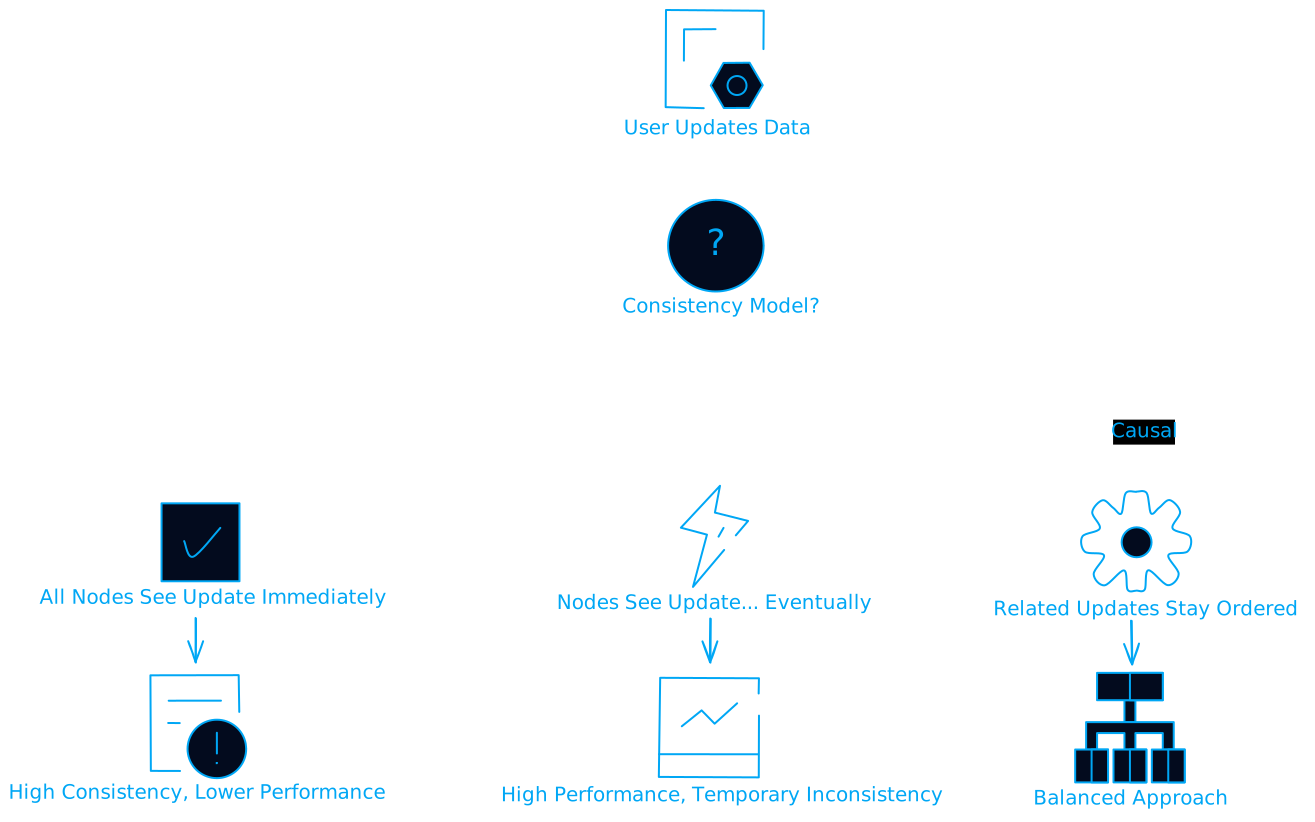
The choice between these approaches isn't just academic - it literally shapes how your users experience your application. Get it wrong, and you might end up with angry customers seeing their bank account charged twice, or frustrated users wondering why their posts aren't showing up.
Strong Consistency: The Perfectionist's Dream (And Nightmare)
Let's start with the gold standard - strong consistency. This is the "measure twice, cut once" approach to distributed systems.
What Makes It "Strong"?
Strong consistency gives you three rock-solid guarantees:
Linearizability: Every operation appears to happen instantly and in a globally agreed-upon order. It's like having a universal timestamp that everyone agrees on.
Atomic Visibility: Once an update completes, boom - everyone sees it immediately. No "well, some people might see the old version for a bit."
Strict Serializability: All concurrent operations behave as if they happened one after another in some order. No weird race conditions or half-updated states.
When You Actually Need This Level of Paranoia
Strong consistency isn't just showing off - there are real scenarios where anything less is unacceptable:
Financial Systems: You absolutely cannot have someone's bank account showing different balances on different servers. That's how you get lawsuits and regulatory nightmares.
E-commerce Inventory: Overselling products because your inventory count was "eventually consistent" is a great way to create angry customers and logistical headaches.
Healthcare Records: Patient data needs to be accurate everywhere, immediately. Lives literally depend on it.
Critical Infrastructure: Power grids, traffic systems, anything where inconsistency could cause real-world harm.
The Price of Perfection
But here's the catch - strong consistency is expensive. Really expensive.
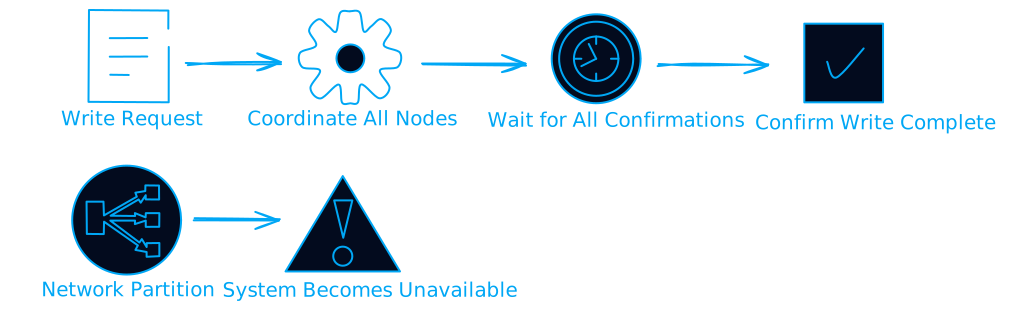
Performance Hit: Every write operation has to coordinate with all replicas. That means waiting for the slowest node, dealing with network latency, and handling failures gracefully.
Availability Trade-offs: When network partitions happen (and they will), strongly consistent systems often have to choose between staying consistent or staying available. Usually, they choose consistency, which means downtime.
Complexity: Implementing protocols like Two-Phase Commit or Paxos isn't exactly weekend project material. These are complex, subtle algorithms that are easy to get wrong.
The Algorithms That Make It Work
The heavy lifting of strong consistency is done by some pretty sophisticated algorithms:
Two-Phase Commit (2PC): The classic "are we all ready? okay, everyone commit now!" protocol. Works great until a coordinator fails at the worst possible moment.
Paxos: The theoretical foundation that's so complex, even its creator admits it's hard to understand. But it works, even when nodes fail.
Raft: The "Paxos for humans" algorithm that's actually implementable without a PhD in distributed systems.
But what if you don't need this level of perfection? What if "good enough" is actually... good enough?
Eventual Consistency: Embracing the Chaos (Productively)
Welcome to the wild west of distributed systems, where updates propagate when they feel like it, and temporary inconsistencies are just part of life.
The CAP Theorem Reality Check
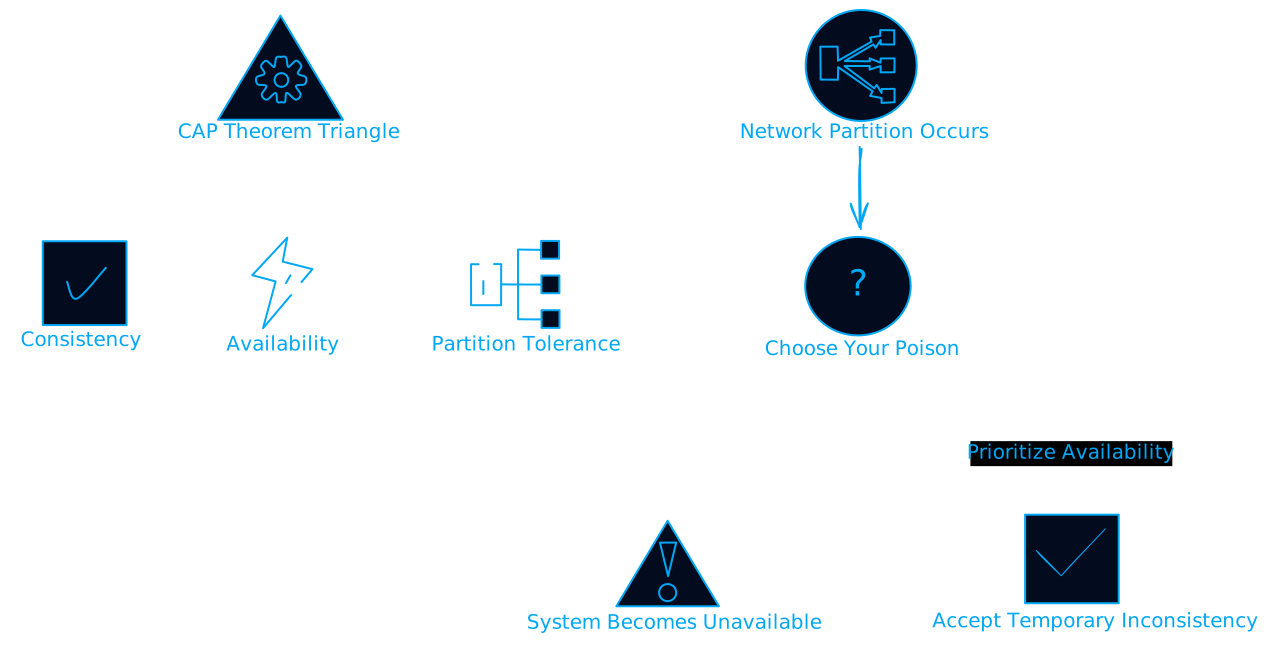
Here's where we need to talk about the CAP theorem - one of those fundamental truths that shapes everything in distributed systems. You can pick two out of three:
- Consistency: Everyone sees the same data
- Availability: The system keeps working
- Partition Tolerance: The system survives network failures
Since network partitions are basically inevitable in any real distributed system, you're really choosing between consistency and availability. Eventual consistency says "let's choose availability and figure out the consistency part later."
Why "Eventually" Isn't a Dirty Word
Eventual consistency gets a bad rap, but it's actually incredibly powerful when used correctly:
Blazing Fast Performance: No waiting for consensus, no coordinating across continents. Write locally, sync later.
Bulletproof Availability: One server goes down? No problem. Half your data centers lose power? Still serving requests.
Infinite Scalability: Adding more nodes doesn't slow things down - it actually makes the system more resilient.
Real-World Resilience: Networks are messy, servers fail, and users don't wait. Eventual consistency embraces this reality.
The Art of Controlled Chaos
The trick with eventual consistency isn't avoiding conflicts - it's handling them gracefully:
Conflict-Free Replicated Data Types (CRDTs): These are data structures that automatically resolve conflicts in mathematically provable ways. It's like having a referee that never makes bad calls.
Last-Writer-Wins: Simple but effective for many use cases. The most recent update wins, and we move on.
Application-Level Resolution: Sometimes you need business logic to decide what "correct" means. Maybe the user gets to choose, or maybe you merge the changes intelligently.
Where Eventual Consistency Shines
Social Media: Does it really matter if your like count is off by a few for a couple seconds? Users care more about the app being fast and responsive.
Content Delivery: Netflix doesn't need every server to have the exact same catalog at the exact same moment. Close enough is perfect.
IoT and Sensor Data: When you're dealing with thousands of sensors with spotty connections, eventual consistency is often the only practical choice.
Collaborative Editing: Google Docs works because it embraces eventual consistency with smart conflict resolution.
But what if you want something in between? What if you need more than "eventually" but less than "immediately"?
Causal Consistency: The Goldilocks Zone
Enter causal consistency - the "just right" option that many people don't know exists.
The Big Idea: Cause and Effect Matter
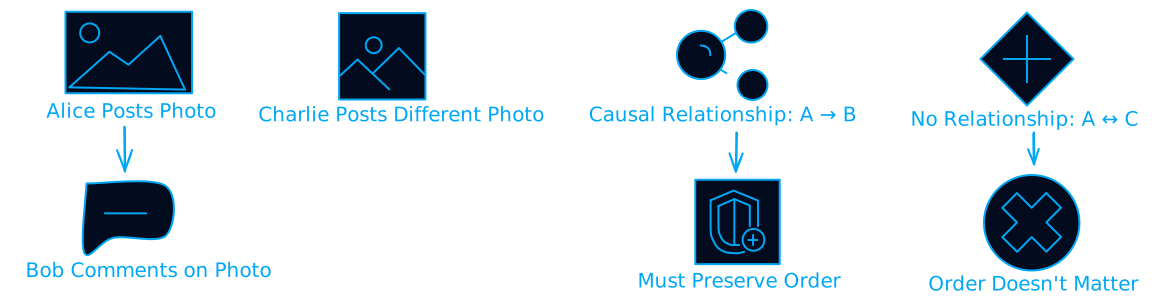
Causal consistency has one key insight: not all operations are created equal. Some things have cause-and-effect relationships that matter, while others are completely independent.
If Alice posts a photo and then Bob comments on it, everyone should see the photo before the comment. But if Alice posts a photo and Charlie posts a completely different photo at the same time? Who cares which one people see first?
The Sweet Spot Benefits
Better Performance Than Strong Consistency: You only coordinate when you actually need to, not for every single operation.
More Guarantees Than Eventual Consistency: Users won't see weird ordering issues that break the logical flow of events.
Improved Scalability: Independent operations can happen in parallel without any coordination overhead.
Maintained Availability: The system can keep working even when some nodes are unreachable.
The Implementation Challenge
Here's where things get tricky. Implementing causal consistency requires tracking which operations depend on which other operations. This usually means:
Vector Clocks: Each node maintains a logical timestamp that tracks causal relationships. It's like having a family tree for your data operations.
Dependency Tracking: The system needs to remember "this update can't be applied until that other update has been seen."
Careful Ordering: Operations need to be applied in an order that respects causal dependencies, even if they arrive out of order.
When Causal Consistency Makes Sense
Chat Applications: Messages in a conversation thread need to stay in order, but conversations in different channels can be completely independent.
Version Control Systems: Changes to a file need to be applied in the right order, but changes to different files can happen independently.
Collaborative Platforms: User actions that build on each other need ordering, but independent actions don't.
Gaming Systems: Player actions that affect each other need coordination, but actions in different game instances don't.
Choosing Your Consistency Adventure
So how do you actually decide which consistency model to use? It's not just about technical capabilities - it's about understanding your users, your business requirements, and your operational constraints.
Know Your Requirements (Really Know Them)
Start by asking the hard questions:
What happens if users see stale data? Is it a minor annoyance or a major problem?
How much latency can you tolerate? Are users willing to wait 100ms for perfect consistency, or do they want instant responses?
What's your failure tolerance? Is it better to be unavailable or inconsistent during network problems?
How complex can your conflict resolution be? Do you have the engineering resources to handle sophisticated merging logic?
The Hybrid Approach: Best of All Worlds?
Here's a secret that many distributed systems architects use: you don't have to pick just one consistency model for your entire system.
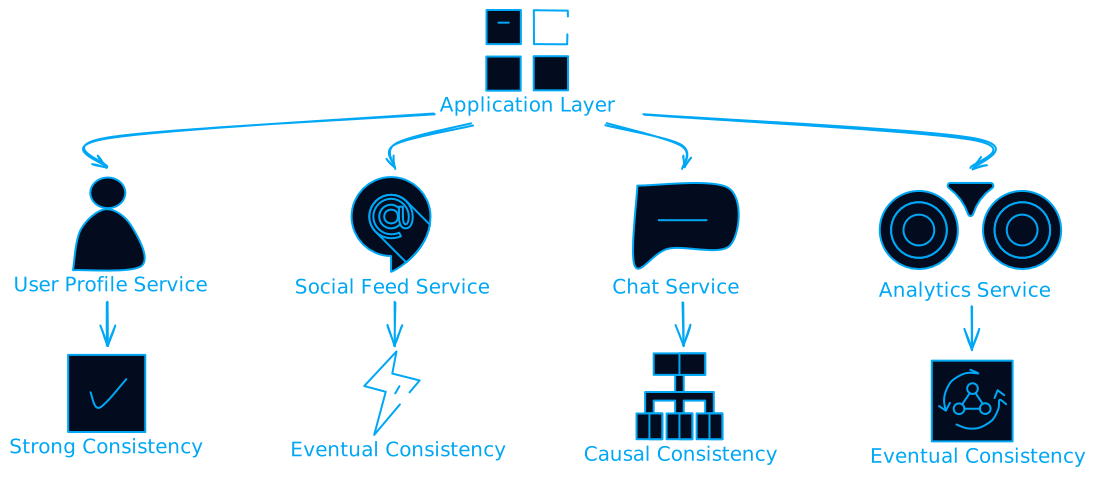
Critical Data: Use strong consistency for things like user accounts, payment information, and security credentials.
User-Generated Content: Use eventual consistency for posts, comments, and other social features where speed matters more than perfect ordering.
Interactive Features: Use causal consistency for things like chat, collaborative editing, or gaming where some ordering matters but not everything needs to be perfectly synchronized.
Analytics and Reporting: Use eventual consistency for data that's inherently historical and doesn't need real-time accuracy.
Monitoring and Adaptation
The consistency model you choose today might not be the right one tomorrow. As your system grows and evolves, you need to keep an eye on:
Performance Metrics: Are users experiencing unacceptable latency? Are you hitting scalability limits?
Consistency Violations: How often are users seeing stale or conflicting data? Is it causing real problems?
Operational Complexity: Is your chosen consistency model creating operational headaches that outweigh its benefits?
Business Requirements: Have your business needs changed in ways that affect your consistency requirements?
The Real-World Reality Check
Let's be honest about something: most of the time, you're not building the next global financial system or life-critical medical device. You're probably building something where eventual consistency is not just acceptable, but actually preferable.
The Performance vs. Consistency Trade-off
Users are incredibly sensitive to latency. Studies show that even 100ms of additional delay can significantly impact user engagement. If your strong consistency requirements are making your app feel sluggish, you might be optimizing for the wrong thing.
The Complexity Cost
Strong consistency protocols are complex to implement correctly and even more complex to operate reliably. Unless you absolutely need those guarantees, you might be better off with a simpler approach that your team can actually understand and maintain.
The Scale Reality
As your system grows, strong consistency becomes exponentially more expensive. What works fine with three servers in one data center becomes a nightmare with hundreds of servers across multiple continents.
Practical Implementation Tips
If you've made it this far, you're probably wondering about the practical side of implementing these consistency models. Here are some battle-tested approaches:
Start Simple, Evolve Gradually
Begin with eventual consistency for most of your system. It's easier to implement, easier to scale, and easier to operate.
Identify the critical paths where you actually need stronger guarantees. These are usually a small fraction of your total operations.
Implement stronger consistency incrementally for those critical paths, rather than trying to build a perfectly consistent system from day one.
Embrace Idempotency
Make your operations idempotent whenever possible. If applying the same operation multiple times has the same effect as applying it once, a lot of consistency problems just disappear.
// Bad: Not idempotent
function incrementCounter(userId) {
    user.counter += 1;
}

// Good: Idempotent
function setCounterValue(userId, newValue) {
    user.counter = newValue;
}
Design for Conflict Resolution
When you're using eventual consistency, conflicts will happen. Design your data structures and operations to make conflicts easy to resolve:
Use CRDTs when possible: They automatically resolve conflicts in mathematically sound ways.
Implement application-level merging: For complex business logic, you might need custom conflict resolution.
Provide user-facing conflict resolution: Sometimes the best approach is to let users decide how to resolve conflicts.
Monitor Everything
Consistency issues are often subtle and hard to detect. Implement comprehensive monitoring:
Lag metrics: How far behind are your replicas?
Conflict rates: How often are you seeing conflicting updates?
Consistency violations: Are users reporting seeing stale or inconsistent data?
Performance impact: How much is your consistency model affecting response times?
The Future of Consistency
The distributed systems landscape is constantly evolving, and new approaches to consistency are emerging:
Programmable Consistency
Some systems are starting to offer "programmable consistency" where you can define custom consistency semantics for different parts of your application.
Machine Learning-Assisted Conflict Resolution
AI is starting to be used for intelligent conflict resolution, learning from user behavior to make better decisions about how to merge conflicting updates.
Edge Computing Challenges
As more computation moves to the edge, we're seeing new consistency challenges and solutions designed for highly distributed, sometimes-connected environments.
Wrapping Up: It's All About Trade-offs
Here's the thing about consistency models - there's no universally "right" answer. It's all about understanding your specific requirements and making informed trade-offs.
Strong consistency gives you the strongest guarantees but at the cost of performance, availability, and complexity. Use it when correctness is absolutely critical.
Eventual consistency gives you the best performance and availability but requires careful design to handle conflicts gracefully. Use it when speed and availability matter more than perfect consistency.
Causal consistency gives you a middle ground that preserves important ordering relationships while allowing independent operations to proceed in parallel. Use it when you need some ordering guarantees but not perfect consistency.
The most successful distributed systems often use a mix of all three, applying the right consistency model to each part of the system based on its specific requirements.
Remember, your users don't care about your consistency model - they care about whether your application works well for them. Sometimes that means perfect consistency, sometimes it means blazing fast performance, and sometimes it means finding the right balance between the two.
The key is to understand the trade-offs, measure what matters, and be willing to evolve your approach as your system and requirements change. After all, the best consistency model is the one that helps you build something your users actually want to use.
What consistency challenges are you facing in your distributed systems? Have you found creative solutions that balance performance and correctness? The distributed systems community thrives on sharing these real-world experiences - your approach might be exactly what someone else needs to hear.