
Building Correct Payment Systems: Five Technical Pillars for Financial Integrity
Introduction
A payment fails silently in production. Your customer's card is declined, but your inventory system already reserved the item. Meanwhile, your ledger shows a pending charge, your fraud service logged a successful check, and three microservices hold inconsistent state. By the time your on-call engineer wakes up to investigate, you've oversold your inventory and have no audit trail to explain what happened.
This scenario plays out daily in payment systems that treat transactions as simple API calls rather than distributed system problems. Unlike social media posts or search queries, financial transactions demand correctness guarantees that most web architectures aren't built to provide. A payment must succeed exactly once or fail completely, with every state change recorded in an immutable audit log that survives any failure.
This article examines five technical pillars that payment processors use to maintain correctness under failure: idempotency keys that prevent duplicate charges, double-entry ledgers that ensure financial consistency, distributed transaction patterns that coordinate across services, reconciliation systems that detect and repair inconsistencies, and security boundaries that isolate sensitive data. Each pillar addresses a specific failure mode, and together they form a coherent approach to building payment systems that maintain correctness at scale.
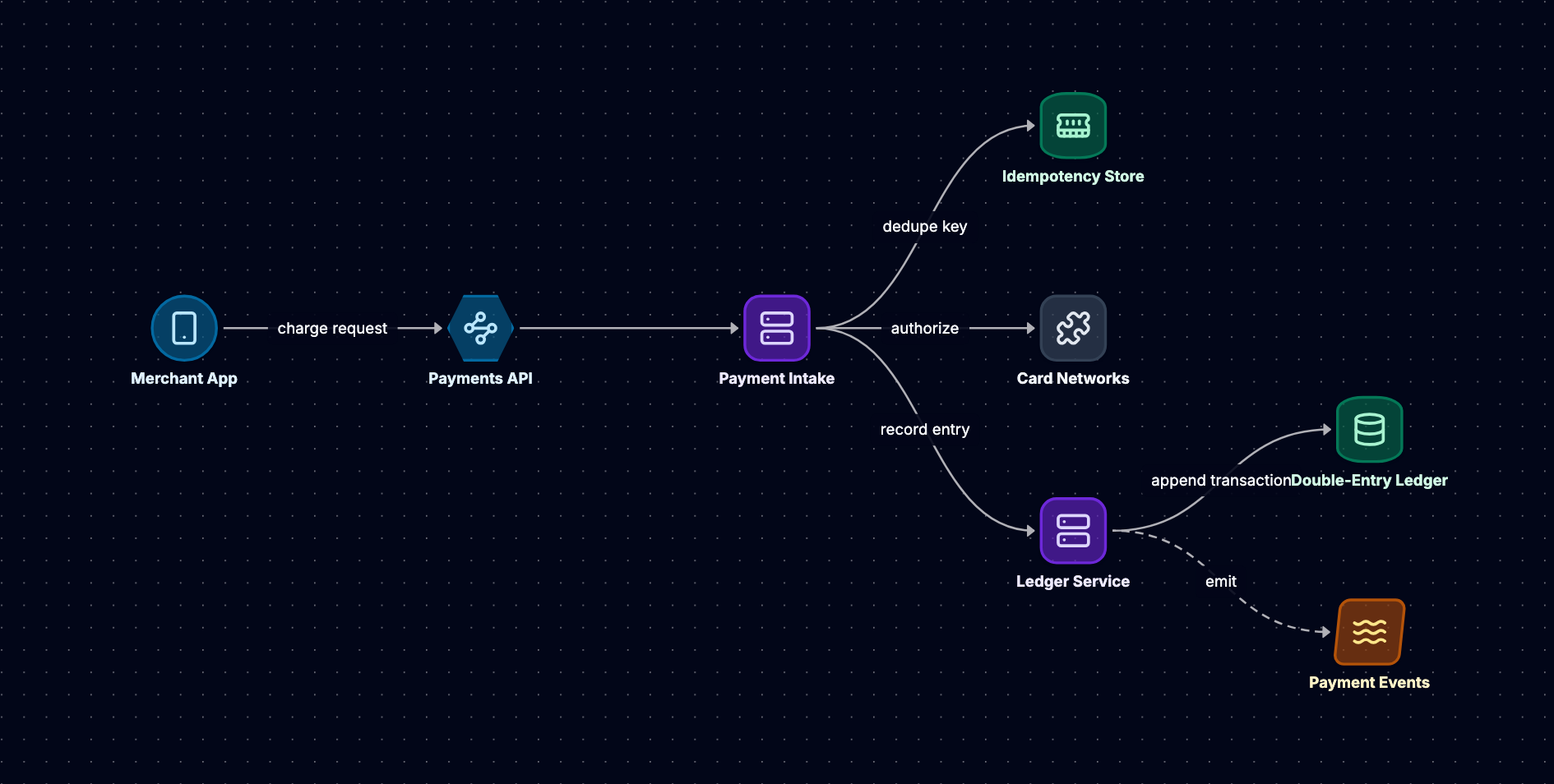
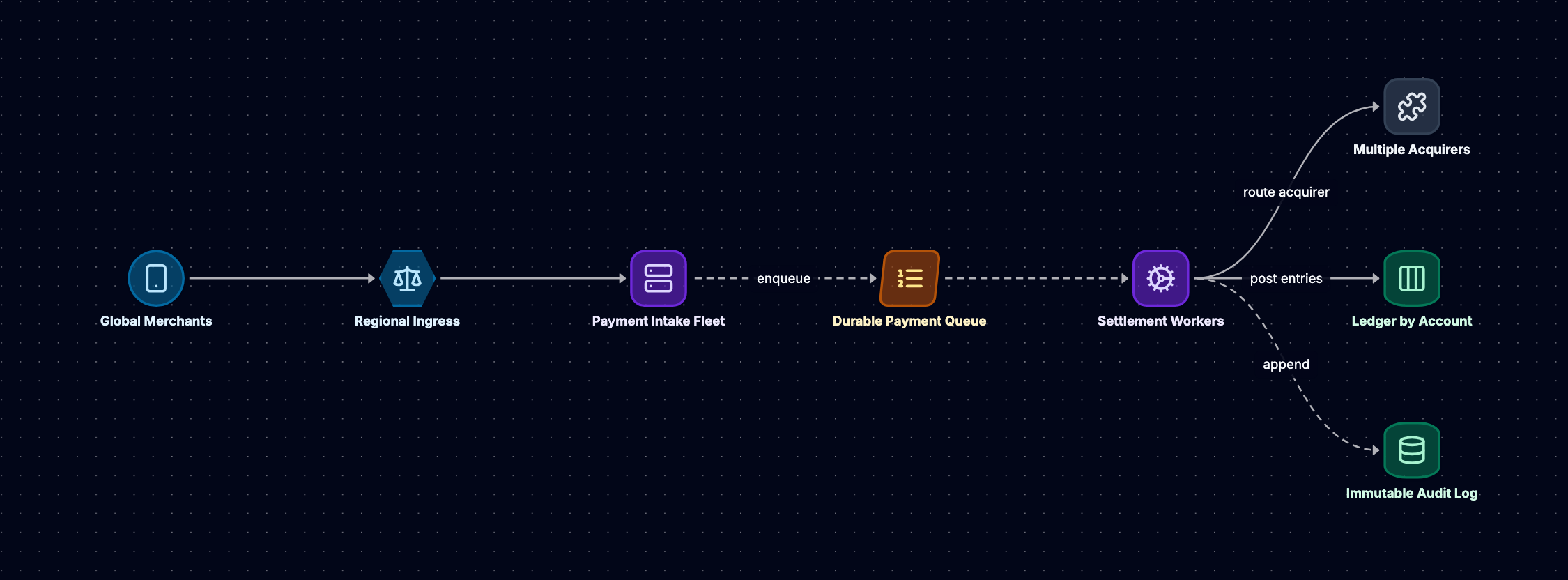
Before diving into each pillar, it's useful to understand how they connect in a typical payment flow. When a customer submits payment, the idempotency key ensures the request processes exactly once even if retried. The system then executes a distributed transaction (using sagas or two-phase commit) to coordinate the payment provider, ledger, and business logic services. Each state change writes double-entry records to the ledger, creating an immutable audit trail. The reconciliation system continuously compares internal ledger state against external payment provider records to detect discrepancies. Throughout this flow, PCI compliance boundaries determine which services can access raw card data versus tokens. This end-to-end flow demonstrates why all five pillars are necessary: removing any one creates a failure mode that compromises correctness.
Idempotency Keys and Exactly-Once Processing
Network failures, client retries, and timeout ambiguity make it impossible to know whether a request succeeded without checking state. A client submits a payment, the request times out, and the client doesn't know if the charge went through. If they retry, they might double-charge the customer. If they don't retry, they might lose a legitimate transaction.
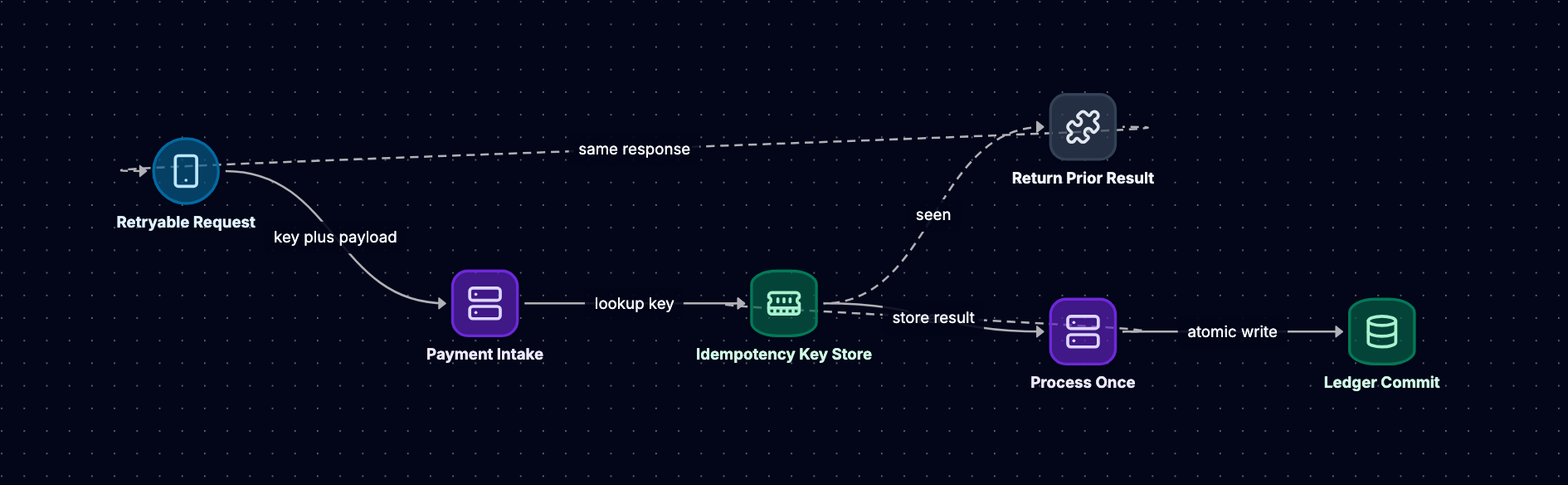
Idempotency keys solve this by making requests safely retryable. The client generates a unique key (typically a UUID) and includes it with every request. The server stores this key alongside the operation's result, and if it receives the same key again, it returns the stored result instead of executing the operation twice.
# Simplified example showing core idempotency pattern
def create_payment(amount, currency, idempotency_key):
    # Check if we've seen this key before
    existing = db.query(
        "SELECT * FROM payments WHERE idempotency_key = ?",
        idempotency_key
    )

    if existing:
        return existing  # Return cached result

    # First time seeing this key - execute payment
    with db.transaction():
        payment = charge_card(amount, currency)
        db.execute(
            """INSERT INTO payments
               (id, amount, status, idempotency_key)
               VALUES (?, ?, ?, ?)""",
            payment.id, amount, payment.status, idempotency_key
        )
        return payment
This simplified implementation demonstrates the core pattern but omits critical details. Production systems must handle concurrent requests with the same key. If two requests arrive simultaneously, both will see no existing record and attempt to execute. The solution is to make the idempotency key insertion atomic and use database constraints to enforce uniqueness:
CREATE TABLE payments (
    id UUID PRIMARY KEY,
    amount INTEGER NOT NULL,
    currency TEXT NOT NULL,
    status TEXT NOT NULL,
    idempotency_key TEXT UNIQUE NOT NULL,
    created_at TIMESTAMP NOT NULL DEFAULT NOW()
);

CREATE INDEX idx_idempotency_key ON payments(idempotency_key);
The UNIQUE constraint ensures only one payment succeeds per key. The second request receives a constraint violation error, backs off, and retries. On retry, it finds the existing payment and returns it.
Idempotency keys introduce several operational considerations. Keys must be scoped per account to prevent collisions across customers. They should expire after a reasonable window (one pattern is to expire keys after they succeed, while keeping failed attempts retryable). The server must distinguish between requests that are in-flight versus completed. One approach is to write a pending record immediately when receiving a request, then update it to completed or failed when the operation finishes.
The interaction between idempotency and distributed transactions requires careful design. If a payment involves multiple services (charging the card, updating inventory, recording in the ledger), the idempotency key must protect the entire operation. Storing the key in the same database transaction that commits the final state ensures atomicity. If any step fails, the entire operation rolls back, including the idempotency record, making the request retryable.
Key Takeaway: Idempotency keys transform unreliable networks into reliable payment operations by making requests safely retryable. The key must be stored atomically with the operation's result, typically using database uniqueness constraints to handle concurrent requests.
Double-Entry Ledger Design
Payment systems are fundamentally accounting systems. Every dollar that leaves one account must enter another. Double-entry bookkeeping, invented in medieval Italy, provides the mathematical framework for this: every transaction records equal and opposite entries in two accounts, ensuring the system always balances.
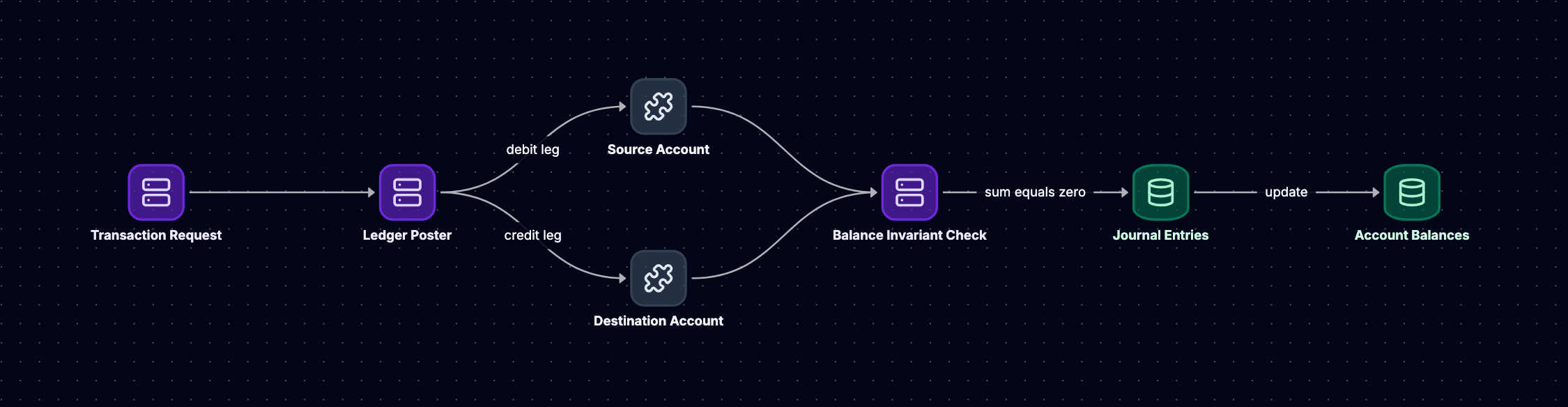
In double-entry accounting, accounts have types (asset, liability, equity, revenue, expense) that determine their normal balance direction. Assets and expenses increase with debits and decrease with credits. Liabilities, equity, and revenue increase with credits and decrease with debits. A customer payment involves debiting (increasing) your cash asset account and crediting (increasing) your revenue account. Both entries record the same amount, keeping the system balanced.
A ledger table captures these entries:
CREATE TABLE ledger_entries (
    id UUID PRIMARY KEY,
    transaction_id UUID NOT NULL,
    account_id UUID NOT NULL,
    amount INTEGER NOT NULL,
    currency TEXT NOT NULL,
    entry_type TEXT NOT NULL CHECK (entry_type IN ('debit', 'credit')),
    created_at TIMESTAMP NOT NULL DEFAULT NOW()
);

CREATE TABLE accounts (
    id UUID PRIMARY KEY,
    account_type TEXT NOT NULL,
    normal_balance TEXT NOT NULL CHECK (normal_balance IN ('debit', 'credit')),
    currency TEXT NOT NULL
);
Every financial transaction creates at least two entries with the same transaction_id. A payment of 100. The transaction_id groups these entries, making the transaction atomic: either both entries commit or neither does.
This design makes several guarantees impossible to violate at the database level. The system cannot record a one-sided transaction because application code must insert both entries in the same database transaction. The ledger becomes an immutable audit log: entries are never updated or deleted, only inserted. To reverse a transaction, you insert new entries with opposite signs.
Double-entry ledgers enable powerful queries. To find an account's balance, sum all debits and subtract all credits (or vice versa, depending on the account's normal balance):
SELECT
    SUM(CASE WHEN entry_type = 'debit' THEN amount ELSE -amount END) as balance
FROM ledger_entries
WHERE account_id = ?;
To verify the entire system balances, check that total debits equal total credits. If they don't, the data is corrupt, and you have a serious problem. This query should always return zero:
SELECT
    SUM(CASE WHEN entry_type = 'debit' THEN amount ELSE -amount END)
FROM ledger_entries;
Performance becomes a concern as ledgers grow. Every balance query scans all entries for an account. One pattern is to maintain materialized account balances that update with each transaction. Another is to use periodic snapshots: store the balance at the end of each day, then sum only entries since the last snapshot. These optimizations trade query performance for write complexity and must maintain consistency with the underlying ledger.
Ledger immutability provides forensic capabilities. You can reconstruct the system's state at any point in history by replaying entries up to that timestamp. If a bug corrupts balances, you can identify exactly when the corruption occurred by comparing expected versus actual balances across time. This time-travel capability is impossible with systems that update balances in place.
The double-entry model extends beyond simple payments. Refunds, chargebacks, fees, and currency conversions all map to ledger entries. A refund reverses the original payment by debiting revenue and crediting cash. A chargeback creates similar entries plus additional entries for chargeback fees. Multi-currency transactions use multiple account pairs, one per currency, with exchange rates recorded in the transaction metadata.
Key Takeaway: Double-entry ledgers provide mathematical guarantees that the system balances by requiring equal and opposite entries for every transaction. Immutability creates an audit trail that enables time-travel queries and forensic analysis, while the structure makes certain corruption patterns impossible at the database level.
Distributed Transactions: Sagas vs Two-Phase Commit
Payment processing involves multiple independent systems: the payment provider that charges cards, the ledger that records transactions, the inventory system that reserves products, and the notification service that emails receipts. Each system must update atomically with the others, but they don't share a database. How do you maintain consistency across these boundaries?
Two patterns dominate: sagas and two-phase commit (2PC). They make different tradeoffs between consistency, availability, and complexity.
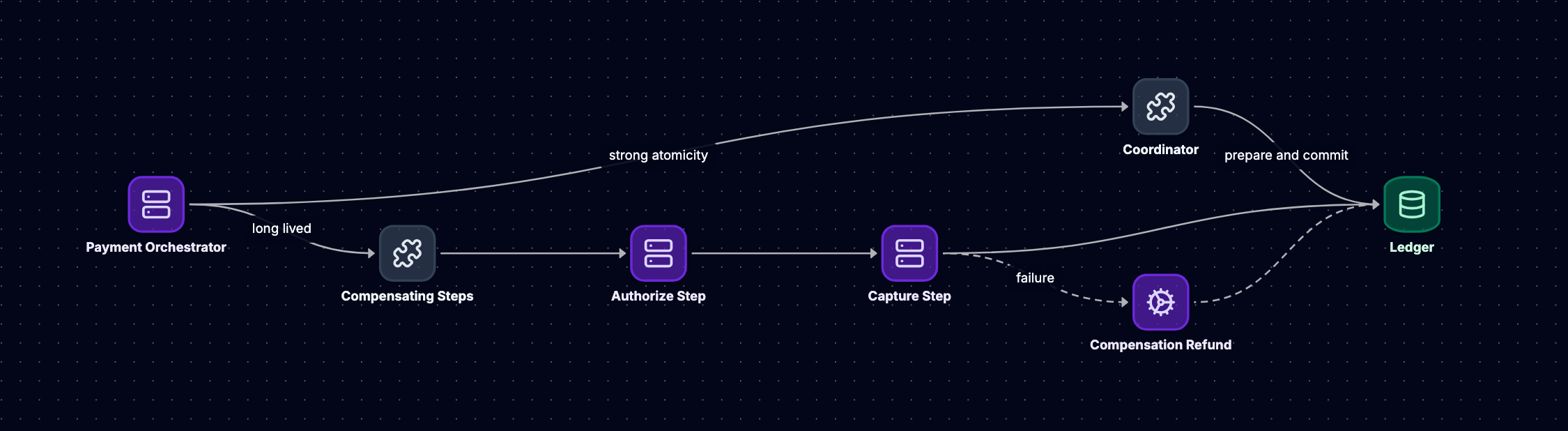
Two-Phase Commit
Two-phase commit provides atomic commitment across multiple databases through a coordinator that manages a two-phase protocol. In the prepare phase, the coordinator asks each participant to prepare the transaction and guarantee they can commit. Participants write redo and undo logs but don't commit. In the commit phase, if all participants prepared successfully, the coordinator tells them to commit. If any participant fails to prepare, the coordinator tells all participants to abort.
Note that 2PC is typically used within a single organization's infrastructure where all participants are controlled databases or services, not for coordinating with external third-party APIs. Payment providers like Stripe don't participate in 2PC protocols with their customers.
Coordinator → Participant A: Prepare transaction
Coordinator → Participant B: Prepare transaction
Participant A → Coordinator: Prepared (logged, can commit)
Participant B → Coordinator: Prepared (logged, can commit)
Coordinator → Participant A: Commit
Coordinator → Participant B: Commit
Two-phase commit guarantees atomicity: either all participants commit or all abort. This makes it attractive for financial systems where partial failures are unacceptable. The cost is availability. If any participant becomes unavailable during the prepare phase, the entire transaction blocks until it recovers. If the coordinator crashes after some participants commit but before others receive the commit message, those participants must wait for the coordinator to recover before they know whether to commit or abort.
The blocking behavior makes 2PC unsuitable for many distributed systems, especially those involving external services with unpredictable latency. A payment that waits indefinitely for inventory service recovery provides poor user experience. However, for tightly coupled internal systems with strong consistency requirements, 2PC remains a viable pattern.
Sagas
Sagas take a different approach: they break a distributed transaction into a sequence of local transactions, each with a compensating transaction that undoes its effects. If any step fails, the saga executes compensating transactions in reverse order to roll back completed steps.
Consider a payment saga:
1. Reserve inventory (compensate: release inventory)
2. Charge payment provider (compensate: refund)
3. Record in ledger (compensate: record reversal)
4. Send confirmation email (compensate: send cancellation email)
If step 3 fails, the saga executes compensations for steps 2 and 1: refund the charge and release the inventory. The system returns to a consistent state, though not the same state as before the saga started (the customer sees a charge and refund rather than no charge at all).
A simplified saga implementation might look like:
saga = [
    (reserve_inventory, release_inventory),
    (charge_card, refund_card),
    (record_ledger, reverse_ledger),
]

completed_steps = []
try:
    for (action, compensation) in saga:
        result = action()
        completed_steps.append((compensation, result))
except Exception as e:
    for (compensation, result) in reversed(completed_steps):
        compensation(result)
    raise
This example simplifies error handling and assumes compensations always succeed. Production implementations must handle compensation failures, which is one of the saga pattern's fundamental challenges. If the refund API is down when you try to compensate, you're left in an inconsistent state. One approach is to retry compensations indefinitely with exponential backoff, storing the compensation state durably so it survives service restarts.
Sagas provide better availability than 2PC because each step commits immediately rather than blocking. But they sacrifice atomicity: there's a window where some steps have committed and others haven't. Other transactions might see this intermediate state. If you reserve inventory, charge the card, and then fail to record in the ledger, another transaction might see the inventory as reserved even though the payment is being rolled back.
This visibility of intermediate state requires careful design. One pattern is to mark saga steps as pending until the entire saga completes, then atomically mark them as committed. Queries ignore pending steps, maintaining isolation. Another pattern is to use semantic locks: reserve inventory with a saga_id that indicates it's part of an in-progress saga, and only consider it truly reserved once the saga commits.
The choice between sagas and 2PC depends on your consistency and availability requirements. For internal systems where you control all participants and can tolerate brief unavailability, 2PC provides stronger guarantees. For systems involving external services or where availability is critical, sagas provide better fault tolerance at the cost of more complex error handling and weaker consistency guarantees.
Key Takeaway: Distributed transactions require choosing between two-phase commit's strong consistency with blocking behavior (suitable for controlled internal systems) and sagas' better availability with eventual consistency (suitable for external integrations). Both patterns require careful error handling, and neither eliminates the fundamental difficulty of maintaining consistency across service boundaries.
Reconciliation and Auditing
Despite idempotency keys, double-entry ledgers, and distributed transaction patterns, payment systems still diverge from reality. Software bugs, network partitions, operator errors, and external system failures create discrepancies between your internal ledger and the outside world. Reconciliation detects and repairs these discrepancies.
Reconciliation compares two sources of truth: your internal ledger and external records from payment providers, banks, or other systems. The comparison happens in batches (nightly reconciliation of the previous day's transactions is a common pattern) or continuously (streaming reconciliation that checks transactions shortly after they complete).
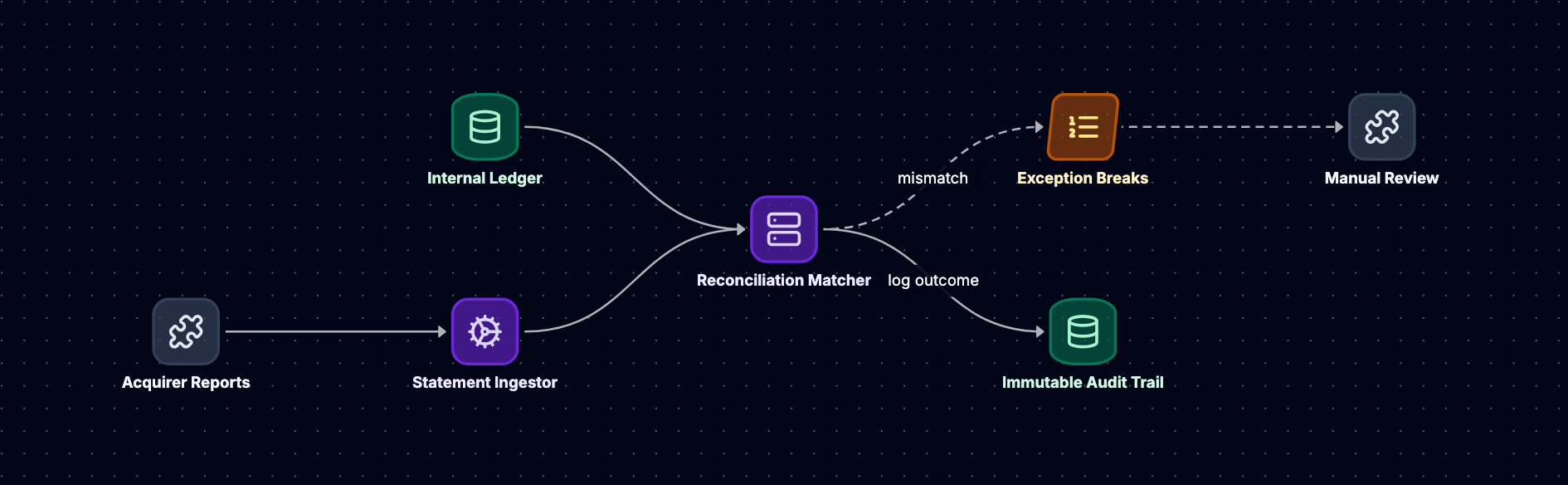
A basic reconciliation process:
- Export all transactions from your ledger for a time period
- Download a settlement report from the payment provider for the same period
- Match transactions between the two datasets
- Flag unmatched transactions for investigation
Matching is harder than it appears. Payment providers use different identifiers than your internal system. Timestamps may differ due to timezone handling or when the provider processes versus when you record. Amounts might differ due to currency conversion or fees. A robust matching algorithm tries multiple strategies: exact ID match, fuzzy timestamp and amount match, and pattern-based matching for known discrepancy types.
def reconcile_transactions(internal_txns, provider_txns):
    matched = []
    unmatched_internal = []
    unmatched_provider = []

    # Try exact ID matching first
    provider_by_id = {txn.external_id: txn for txn in provider_txns}

    for internal_txn in internal_txns:
        provider_txn = provider_by_id.get(internal_txn.external_id)
        if provider_txn and amounts_match(internal_txn, provider_txn):
            matched.append((internal_txn, provider_txn))
        else:
            unmatched_internal.append(internal_txn)

    # Fuzzy matching for unmatched transactions would go here

    return matched, unmatched_internal, unmatched_provider
This simplified example shows the core pattern but omits fuzzy matching, amount tolerance, and the complex logic for handling fees and currency conversion.
Unmatched transactions fall into categories:
- Timing differences: Your system recorded the transaction but the provider hasn't processed it yet (or vice versa). These resolve automatically in the next reconciliation run.
- Missing transactions: Your system shows a charge but the provider doesn't, or the provider shows a charge but your system doesn't. These indicate serious bugs.
- Amount mismatches: Both systems show the transaction but with different amounts, often due to currency conversion or fee calculation errors.
Each category requires different remediation. Timing differences need no action. Missing transactions require investigation: did the payment actually succeed? Should you retry or refund? Amount mismatches need root cause analysis: is your fee calculation wrong? Did the provider apply unexpected charges?
Automated remediation handles simple cases. If your system shows a pending charge but the provider shows it failed, automatically mark it failed in your system. If amounts differ by exactly the provider's fee structure, automatically record the fee. Complex cases require human investigation, and the reconciliation system should provide tools for this: showing the full transaction history, linking to logs and traces, and providing a workflow for tracking investigation status.
Audit logs complement reconciliation by recording every action in the system. While the ledger records financial state, audit logs record operations: who initiated a payment, when it was retried, which services were called, and what responses they returned. The combination of ledger entries (what happened financially) and audit logs (how it happened operationally) enables forensic analysis.
Audit logs must be immutable and tamper-evident. Write them to append-only storage, and consider cryptographic techniques like hash chains where each log entry includes a hash of the previous entry, making it impossible to modify history without detection. Regulatory requirements often mandate specific retention periods and access controls for audit logs.
The reconciliation system itself needs monitoring. Track the reconciliation success rate (percentage of transactions that match), the time to reconcile (how long after a transaction occurs does it get reconciled), and the backlog of unmatched transactions. Alerting should trigger when these metrics degrade, indicating a systemic issue rather than isolated failures.
Key Takeaway: Reconciliation and auditing provide defense in depth by continuously verifying that your internal state matches external reality and recording every action for forensic analysis. Automated matching with manual investigation workflows handles the spectrum from simple timing differences to complex discrepancies requiring human judgment.
PCI Boundaries and Security
Payment systems handle sensitive cardholder data that must be protected to prevent fraud and comply with the Payment Card Industry Data Security Standard (PCI DSS). PCI compliance divides your infrastructure into scopes: systems that store, process, or transmit cardholder data (in-scope) versus systems that don't (out-of-scope). Minimizing in-scope systems reduces compliance burden and attack surface.
Tokenization is the primary technique for minimizing scope. Instead of storing raw card numbers, you send them directly to a payment provider that returns a token: an opaque identifier that represents the card but has no value if stolen. Your systems store and process tokens, never raw card data, moving most of your infrastructure out of PCI scope.
The payment flow with tokenization:
- Customer enters card details in a form hosted by the payment provider (or embedded via iframe)
- Provider validates the card and returns a token to your frontend
- Your frontend sends the token to your backend
- Your backend sends the token to the provider to charge the card
- Your backend stores the token for future charges
Your backend never sees the raw card number, keeping it out of PCI scope. The provider handles PCI compliance for the systems that do see card data.
Even with tokenization, your systems must implement security controls. PCI DSS requires encryption in transit (TLS for all network communication) and at rest (encrypted databases and backups). It requires access controls (authentication, authorization, audit logs of who accessed what). It requires network segmentation (firewalls between components) and monitoring (intrusion detection, log analysis).
For systems that do handle raw card data, PCI DSS mandates specific controls. Stored card numbers must be encrypted or truncated (showing only the last four digits). Primary account numbers (PANs) must never appear in logs or error messages. Systems must be patched regularly, and security configurations must follow industry standards.
The boundary between in-scope and out-of-scope systems requires careful design. If an out-of-scope system can access an in-scope database, it becomes in-scope. If an in-scope system shares a network with out-of-scope systems without proper segmentation, the entire network becomes in-scope. One approach is to isolate in-scope systems in a separate network zone with strict firewall rules allowing only necessary traffic.
Compliance verification happens through annual assessments. Level 1 merchants (processing the highest volume) require an on-site audit by a Qualified Security Assessor (QSA). Lower-level merchants can self-assess using a Self-Assessment Questionnaire (SAQ). The assessment scope depends on how you handle card data: if you use tokenization and never see raw cards, you qualify for a simpler SAQ with fewer requirements.
Beyond PCI DSS, payment systems must consider other security requirements. Strong Customer Authentication (SCA) regulations in Europe require two-factor authentication for online payments. Anti-money laundering (AML) regulations require monitoring for suspicious transaction patterns. Data residency requirements in some jurisdictions mandate storing data in specific geographic regions.
The security architecture must balance protection with operability. Overly restrictive controls make the system difficult to operate and debug. One pattern is to provide different access levels: production systems have strict controls, but development and staging environments have relaxed controls for easier debugging. Another pattern is to use data masking: logs and monitoring tools show masked card numbers (e.g., "411111******1111") that allow debugging without exposing sensitive data.
Key Takeaway: PCI compliance and security architecture focus on minimizing the systems that handle raw card data through tokenization, then applying defense-in-depth controls to protect what remains. The boundary between in-scope and out-of-scope systems determines compliance burden and must be carefully designed and maintained.
Conclusion
Building a payment processing system requires addressing five interconnected failure modes, each solved by a specific technical pillar. Idempotency keys prevent duplicate charges when networks fail or clients retry. Double-entry ledgers provide mathematical guarantees that the system balances and create an immutable audit trail. Distributed transaction patterns (sagas or two-phase commit) coordinate state changes across multiple services while managing the tradeoff between consistency and availability. Reconciliation systems detect and repair inevitable discrepancies between internal state and external reality. Security boundaries and tokenization minimize the systems that handle sensitive card data, reducing both attack surface and compliance burden.
These pillars form a coherent architecture because each addresses a specific failure mode that the others don't prevent. Idempotency prevents duplicate requests, but can't ensure a distributed transaction commits atomically across services. Distributed transactions coordinate services, but can't detect when a bug causes divergence from external systems. Reconciliation detects divergence, but can't prevent unauthorized access to sensitive data. Security boundaries protect data, but can't ensure financial consistency. Only the combination provides correctness guarantees under the full spectrum of failures.
When designing a payment system, choose patterns based on your consistency and availability requirements. Use two-phase commit when you control all participants and can tolerate brief unavailability for stronger consistency guarantees. Use sagas when coordinating with external services or when availability is critical, accepting the complexity of compensation logic and eventual consistency. Implement reconciliation regardless of your transaction pattern, as it provides the safety net that catches failures your other systems miss. Minimize PCI scope through tokenization unless you have specific requirements that demand handling raw card data.
The correctness-first approach described here prioritizes data integrity over performance. This is appropriate for payment systems where financial errors have regulatory and reputational consequences. As you scale, you'll face pressure to optimize, but maintain the invariants these patterns provide. Cache aggressively, but ensure caches can't cause double-charges. Shard databases for performance, but ensure transactions within a shard remain atomic. Add eventual consistency where appropriate, but maintain strong consistency for financial state. The patterns in this article provide the foundation for building systems that remain correct as they grow.