Software Maintainability: The Hidden Cost That's Crushing Your Development Team
Software Maintainability
You know that feeling when you open a codebase you wrote six months ago and think "What the hell was I thinking?" Now imagine that feeling, but it's costing your company thousands of dollars every month. Welcome to the world of software maintainability – the non-functional requirement that everyone talks about but few actually prioritize until it's too late.
The Real Cost of Unmaintainable Code
Let's start with some uncomfortable truths. Studies show that maintenance accounts for 60-80% of total software costs over a system's lifetime. That means for every dollar you spend building software, you'll spend three to four dollars maintaining it. But here's the kicker – poorly maintainable code can increase those costs exponentially.
I've seen teams spend weeks implementing features that should take days, not because the feature was complex, but because the existing codebase was a tangled mess of dependencies and unclear logic. It's like trying to renovate a house where the previous owner decided walls were optional and electrical wiring was more of a "suggestion."
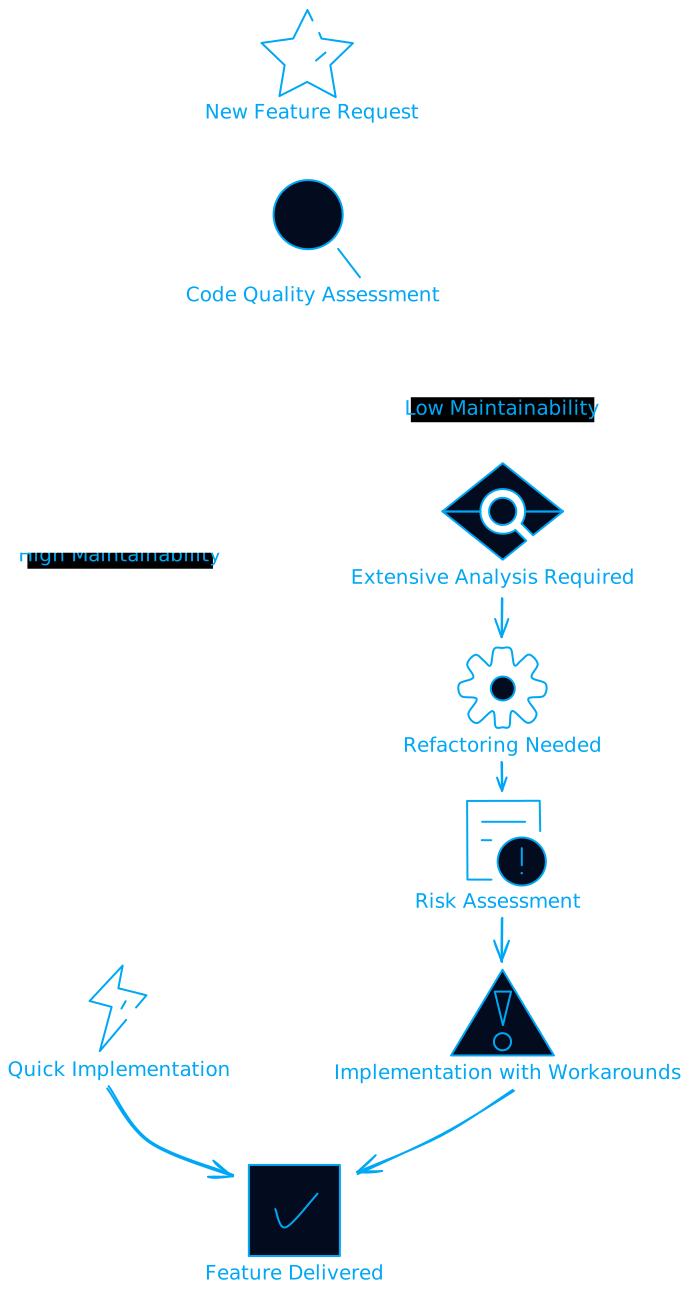
What Makes Code Maintainable? The Five Pillars
1. Modular Design: Building with LEGO Blocks
Think of maintainable code like LEGO blocks. Each piece has a specific purpose, clear connection points, and can be combined with other pieces to create something larger. When you need to change something, you swap out individual blocks rather than rebuilding the entire structure.
// Unmaintainable: Everything in one giant function
function processUserData(userData) {
    // 200 lines of mixed validation, transformation,
    // database operations, and email sending
}

// Maintainable: Separated concerns
class UserProcessor {
    validate(userData) { /* validation logic */ }
    transform(userData) { /* transformation logic */ }
    save(userData) { /* database operations */ }
    notify(userData) { /* notification logic */ }

    process(userData) {
        const validated = this.validate(userData);
        const transformed = this.transform(validated);
        const saved = this.save(transformed);
        this.notify(saved);
        return saved;
    }
}
The modular approach means when the validation rules change, you only touch the validation module. When the database schema changes, you only modify the save method. It's surgical precision instead of sledgehammer solutions.
2. Code Readability: Writing for Humans, Not Just Machines
Code is read far more often than it's written. Yet many developers write code like they're trying to win a "most cryptic variable names" contest. Maintainable code tells a story that any developer can follow.
# Cryptic
def calc(x, y, z):
    return (x * y * z * 0.1) if z > 10 else (x * y * 0.05)

# Readable
def calculate_shipping_cost(weight_kg, distance_km, is_express_delivery):
    EXPRESS_RATE = 0.1
    STANDARD_RATE = 0.05

    base_cost = weight_kg * distance_km

    if is_express_delivery:
        return base_cost * EXPRESS_RATE
    else:
        return base_cost * STANDARD_RATE
The second version takes more lines, but it's self-documenting. Six months later, any developer can understand what's happening without deciphering cryptic abbreviations.
3. Automated Testing: Your Safety Net
Automated tests are like having a safety net when you're walking a tightrope. They give you confidence to make changes without fear of breaking everything. But not all tests are created equal.
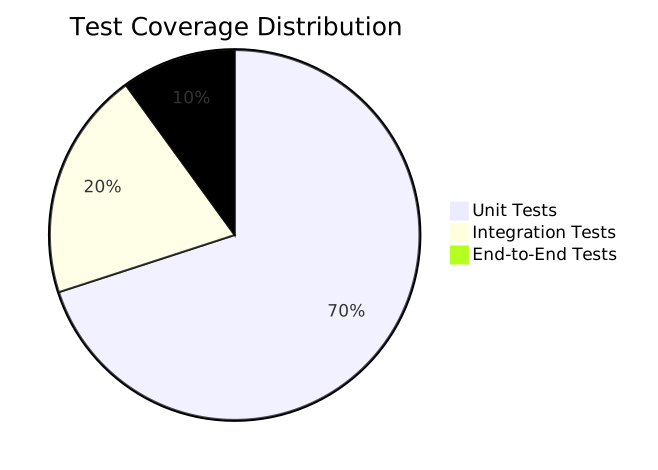
This testing distribution shows the intended balance across test types. Unit tests are fast, focused, and catch issues early. Integration tests ensure that components work correctly together. End-to-end tests validate the complete user journey from start to finish. Together, this mix forms a comprehensive safety net that keeps refactoring and new feature development significantly safer.
4. Design Principles: The SOLID Foundation
The SOLID principles aren't just academic concepts – they're practical guidelines that directly impact maintainability:
Single Responsibility Principle: Each class should have one reason to change. If your User class handles authentication, database operations, email sending, and report generation, you're asking for trouble.
Open/Closed Principle: Software should be open for extension but closed for modification. Use interfaces and dependency injection to add new functionality without changing existing code.
// Violates Open/Closed Principle
class PaymentProcessor {
    processPayment(amount: number, type: string) {
        if (type === 'credit_card') {
            // Credit card logic
        } else if (type === 'paypal') {
            // PayPal logic
        } else if (type === 'bitcoin') {
            // Bitcoin logic - requires modifying existing code
        }
    }
}

// Follows Open/Closed Principle
interface PaymentMethod {
    process(amount: number): Promise<PaymentResult>;
}

class PaymentProcessor {
    constructor(private paymentMethod: PaymentMethod) {}

    async processPayment(amount: number): Promise<PaymentResult> {
        return await this.paymentMethod.process(amount);
    }
}
5. Version Control and Change Management: The Time Machine
Good version control isn't just about backing up code – it's about creating a historical narrative of your project. Every commit should tell a story, and every branch should have a purpose.
# Bad commit messages
git commit -m "fix stuff"
git commit -m "updates"
git commit -m "asdf"

# Good commit messages
git commit -m "feat: add user authentication with JWT tokens"
git commit -m "fix: resolve memory leak in image processing pipeline"
git commit -m "refactor: extract payment logic into separate service"
Measuring Maintainability: Metrics That Matter
You can't improve what you don't measure. Here are the key metrics that actually predict maintainability problems:
Cyclomatic Complexity: The Branching Nightmare
Cyclomatic complexity measures how many different paths your code can take. High complexity means more potential bugs and harder testing.
// High complexity (complexity = 8)
function processOrder(order) {
    if (order.type === 'express') {
        if (order.weight > 10) {
            if (order.destination === 'international') {
                if (order.insurance) {
                    // Path 1
                } else {
                    // Path 2
                }
            } else {
                // Path 3
            }
        } else {
            // Path 4
        }
    } else {
        // Paths 5-8...
    }
}

// Lower complexity using strategy pattern
class OrderProcessor {
    constructor() {
        this.strategies = new Map([
            ['express_heavy_international_insured', new ExpressHeavyIntlInsuredStrategy()],
            ['express_heavy_international', new ExpressHeavyIntlStrategy()],
            // ... other strategies
        ]);
    }

    process(order) {
        const key = this.buildStrategyKey(order);
        const strategy = this.strategies.get(key);
        return strategy.process(order);
    }
}
Technical Debt Ratio: The Interest You're Paying
Technical debt is like financial debt – a little bit can be useful, but too much will crush you. The technical debt ratio measures how much of your codebase needs refactoring.

Code Coverage: The Safety Metric
Code coverage tells you how much of your code is tested. While 100% coverage doesn't guarantee bug-free code, low coverage almost guarantees maintenance nightmares.
The Refactoring Dilemma: When and How to Pay Down Debt
Refactoring is like cleaning your house – it's never urgent until it becomes critical. The key is finding the right balance between new features and code health.
The Boy Scout Rule
Leave the code cleaner than you found it. Every time you touch a piece of code, make one small improvement. Fix a variable name, extract a method, add a test. These micro-improvements compound over time.
Strategic Refactoring
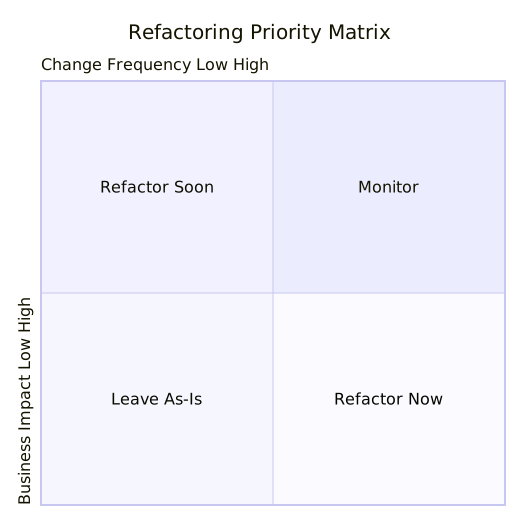
Not all technical debt is worth paying down immediately. Focus on:
- High-traffic code paths – Code that's executed frequently
- Change-prone areas – Parts of the system that need frequent modifications
- Critical business logic – Code that directly impacts revenue or user experience
Modern Tools and Techniques
Continuous Integration: The Quality Gate
Modern CI/CD pipelines can automatically check code quality, run tests, and even block deployments if maintainability metrics fall below thresholds.
# Example GitHub Actions workflow
name: Code Quality Check
on: [pull_request]

jobs:
  quality:
    runs-on: ubuntu-latest
    steps:
      - uses: actions/checkout@v2
      - name: Run tests
        run: npm test
      - name: Check coverage
        run: npm run coverage
      - name: Lint code
        run: npm run lint
      - name: Check complexity
        run: npm run complexity-check
Static Analysis Tools
Tools like SonarQube, ESLint, and Pylint can catch maintainability issues before they reach production. They're like spell-check for code quality.
Documentation as Code
Keep documentation close to the code it describes. Use tools like JSDoc, Sphinx, or GitBook to generate documentation from code comments.
The Human Factor: Building a Maintainability Culture
Technology alone won't solve maintainability problems. You need to build a culture that values code quality.
Code Reviews: The Knowledge Transfer Mechanism
Code reviews aren't just about catching bugs – they're about sharing knowledge and maintaining standards. Good code reviews focus on:
- Readability: Can other developers understand this code?
- Design: Does this fit well with the existing architecture?
- Testing: Are there adequate tests for this change?
- Documentation: Is complex logic explained?
Pair Programming: Real-time Quality Assurance
Pair programming naturally improves code quality because you're constantly explaining your thinking to another person. It's harder to write cryptic code when someone is watching over your shoulder.
Common Pitfalls and How to Avoid Them
The "We'll Fix It Later" Trap
Technical debt has a way of compounding. That quick hack you implemented to meet a deadline becomes the foundation for the next feature, which becomes the foundation for the next one. Before you know it, your entire system is built on quicksand.
Solution: Set aside dedicated time for technical debt reduction. Many teams use the 80/20 rule – 80% new features, 20% technical debt.
The Over-Engineering Trap
Some developers swing too far in the other direction, creating elaborate abstractions for simple problems. Remember: the best code is often the simplest code that solves the problem.
The Documentation Debt
Code without documentation is like a car without a manual. You might figure out how to drive it, but good luck fixing it when something breaks.
Ethical Considerations: The Responsibility Factor
Maintainable code isn't just about business efficiency – it's about responsibility to your users and colleagues.
Privacy and Security
Unmaintainable code often leads to security vulnerabilities. When developers can't understand how data flows through a system, they can't properly secure it.
Accessibility
Complex, unmaintainable code makes it harder to implement accessibility features. Clean, modular code makes it easier to ensure your software works for everyone.
Environmental Impact
Inefficient, unmaintainable code often leads to resource waste. Clean, optimized code runs more efficiently, reducing energy consumption.
The Business Case: Selling Maintainability to Stakeholders
Here's how to make the business case for maintainability:
Speed of Delivery
Maintainable codebases enable faster feature development. Teams working with clean code can implement features 2-3x faster than teams dealing with technical debt.
Risk Reduction
Maintainable systems are more predictable. You can estimate development time more accurately and have fewer production surprises.
Talent Retention
Developers hate working with unmaintainable code. Good maintainability practices help attract and retain top talent.
Competitive Advantage
Companies with maintainable codebases can respond to market changes faster than their competitors.
Real-World Success Stories
Netflix: The Microservices Evolution
Netflix transformed from a monolithic DVD-by-mail service to a streaming giant partly by prioritizing maintainability. Their microservices architecture allows teams to independently develop, test, and deploy services without affecting the entire system.
Shopify: The Modular Monolith
Shopify manages one of the world's largest e-commerce platforms by maintaining a modular monolith with strict boundaries between components. This approach gives them the benefits of modularity without the complexity of distributed systems.
Counter-Questions and Challenges
"Isn't focusing on maintainability just perfectionism that slows down delivery?"
This is like asking if wearing a seatbelt slows down your car. Yes, it takes a few seconds to put on, but it can save your life. Maintainable code might take slightly longer to write initially, but it saves enormous amounts of time over the system's lifetime.
"How do you balance maintainability with tight deadlines?"
Start with the Boy Scout Rule – make small improvements as you go. Even under pressure, you can choose better variable names, extract obvious methods, and write basic tests. These small actions compound over time.
"What if the business doesn't understand the value of maintainability?"
Translate technical concepts into business language. Don't talk about cyclomatic complexity – talk about "how quickly we can add new features." Don't mention technical debt – mention "the hidden costs that slow down development."
Getting Started: A Practical Roadmap
Week 1: Assessment
- Run static analysis tools on your codebase
- Measure current technical debt
- Identify the most problematic areas
Week 2-4: Quick Wins
- Implement automated linting
- Add basic tests for critical paths
- Improve documentation for complex algorithms
Month 2-3: Process Changes
- Establish code review guidelines
- Set up CI/CD quality gates
- Begin regular refactoring sessions
Month 4+: Culture Building
- Train team on design principles
- Establish maintainability metrics
- Create a technical debt backlog
The Future of Maintainability
As software systems become more complex, maintainability becomes even more critical. Emerging trends like AI-assisted code generation and automated refactoring tools will help, but the fundamental principles remain the same: write code for humans, not just machines.
The companies that prioritize maintainability today will be the ones that can adapt quickly to tomorrow's challenges. They'll be the ones shipping features while their competitors are still untangling legacy code.
The Bottom Line
Maintainability isn't a luxury – it's a necessity. In a world where software is eating everything, the ability to quickly and safely modify your code is a competitive advantage. The question isn't whether you can afford to prioritize maintainability; it's whether you can afford not to.
Every line of unmaintainable code you write today is a tax on your future self. Every shortcut you take to meet a deadline becomes a roadblock for the next feature. But every investment you make in code quality pays dividends for years to come.
The choice is yours: spend a little extra time now writing maintainable code, or spend a lot of extra time later fighting with the mess you created. Most successful software companies have learned this lesson the hard way. You don't have to.
Remember, maintainable code isn't just about following best practices – it's about respecting the developers who will work with your code in the future. And more often than not, that future developer is you.