ROI of AI Tools
So your company spent a fortune on AI tools, and now the CFO is asking the dreaded question: "What's our return on investment?" If you're sweating bullets trying to answer that, you're not alone. Measuring AI ROI is like trying to measure the value of sleep, you know it's important, but putting a number on it is surprisingly tricky.
The Brutal Truth About AI ROI
Here's what nobody tells you at those fancy AI conferences: most companies have no clue if their AI investments are actually paying off. According to IDC, over 60% of organizations struggle to measure the business value of their AI initiatives. That's not a small problem, that's a "we're flying blind" problem.
The issue isn't that AI doesn't provide value, it's that the value is often invisible, delayed, or so intertwined with other factors that isolating AI's contribution becomes nearly impossible.
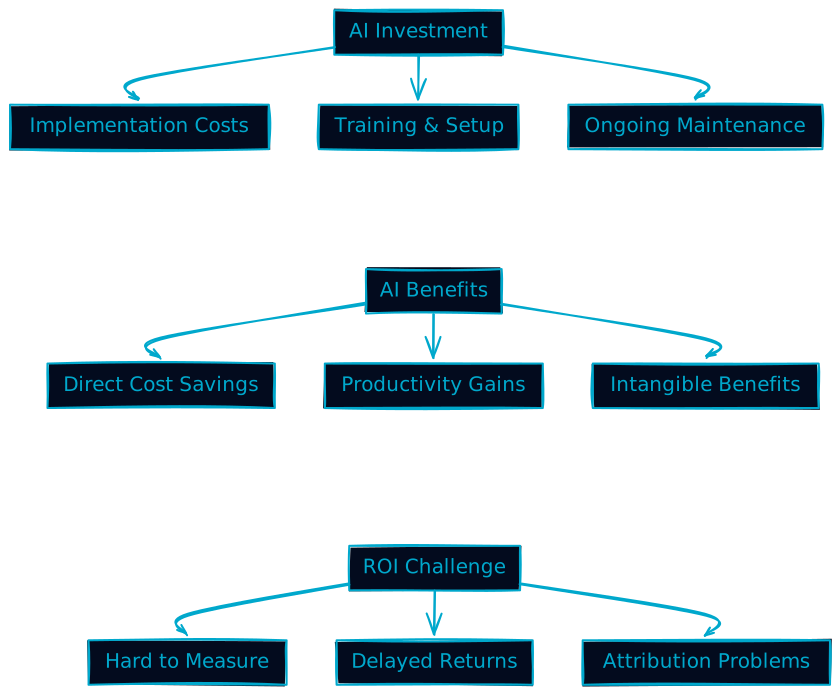
Why Measuring AI ROI Is So Damn Hard
The Intangible Benefits Problem
AI often delivers benefits that are real but hard to quantify. How do you put a dollar value on "better decision-making" or "improved customer satisfaction"? These benefits are like the dark matter of business value, you know they're there, but measuring them directly is nearly impossible.
The Attribution Nightmare
When your sales go up after implementing an AI-powered recommendation system, how much of that increase is due to the AI versus market conditions, seasonal trends, or that new marketing campaign you launched at the same time? Isolating AI's contribution from everything else happening in your business is like trying to figure out which raindrop caused the flood.
The Time Lag Reality
AI investments often have a J-curve effect. You spend a lot upfront (data preparation, model training, infrastructure), see little immediate benefit, and then hopefully see returns later. This delayed gratification doesn't play well with quarterly earnings calls.
[Image suggestion: Graph showing the J-curve effect of AI investments - high initial costs, followed by a dip in ROI, then gradual improvement over time]
The Data Quality Trap
Here's a fun fact: 67% of organizations cite data quality issues as a major barrier to AI success. If your data is garbage, your AI will be garbage, and your ROI will be... well, you get the idea. But cleaning and preparing data is expensive and time-consuming, making it harder to show positive ROI in the short term.
The Metrics That Actually Matter
Direct Financial Metrics (The Easy Ones)
Cost Reduction: This is the low-hanging fruit. If AI automates a process that used to require 10 people and now requires 2, that's a measurable cost saving.
Revenue Increase: If your AI-powered recommendation engine increases average order value by 15%, that's trackable revenue impact.
Efficiency Gains: If AI reduces processing time from 4 hours to 30 minutes, you can calculate the value of that time savings.
Indirect Metrics (The Tricky Ones)
Customer Satisfaction: Use surveys, Net Promoter Scores, and retention rates as proxies for AI's impact on customer experience.
Employee Productivity: Measure output per employee, time-to-completion for tasks, or employee satisfaction scores.
Decision Quality: Track the accuracy of predictions, reduction in errors, or improvement in forecasting accuracy.
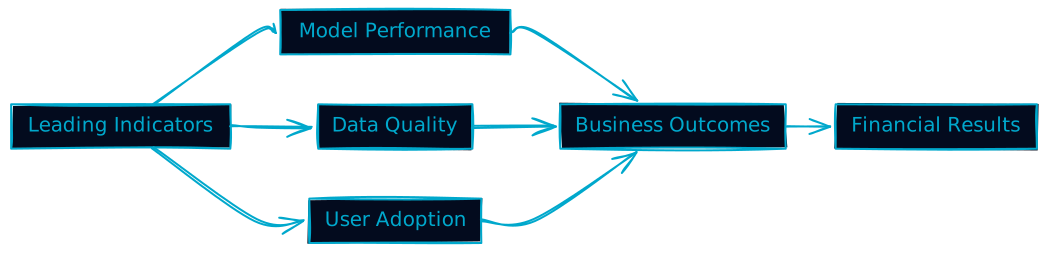
Leading Indicators (The Smart Ones)
Data Quality Improvements: Better data leads to better AI, which leads to better outcomes.
Model Performance: Track accuracy, precision, recall, and other technical metrics that predict business value.
Adoption Rates: If people aren't using your AI tools, they can't deliver value.
Real-World ROI Success Stories
Customer Service Automation
A major telecom company implemented AI chatbots and saw:
- 40% reduction in call center costs
- 25% improvement in first-call resolution
- 15% increase in customer satisfaction scores
ROI Calculation: 800K investment = 288% ROI
Predictive Maintenance
A manufacturing company used AI to predict equipment failures:
- 30% reduction in unplanned downtime
- 25% decrease in maintenance costs
- 20% increase in equipment lifespan
ROI Calculation: 1.2M investment = 425% ROI
Fraud Detection
A financial services firm deployed AI fraud detection:
- 60% reduction in fraud losses
- 50% decrease in false positives
- 35% improvement in detection speed
ROI Calculation: 2M investment = 600% ROI
[Image suggestion: Dashboard showing key AI ROI metrics with before/after comparisons, highlighting the dramatic improvements in each case study]
The Framework That Actually Works
1. Establish Clear Baselines
Before implementing AI, measure everything you can about your current state. You can't calculate ROI without knowing where you started.
Key Baseline Metrics:
- Current process costs and timelines
- Error rates and quality metrics
- Customer satisfaction scores
- Employee productivity measures
2. Define Success Criteria Upfront
Don't wait until after implementation to decide what success looks like. Define specific, measurable goals before you start.
Example Success Criteria:
- Reduce processing time by 50%
- Increase accuracy by 25%
- Improve customer satisfaction by 15%
- Achieve payback within 18 months
3. Track Both Hard and Soft Benefits
Don't ignore intangible benefits just because they're hard to measure. Use proxy metrics and surveys to capture the full value of your AI investment.
4. Use a Phased Approach
Start with pilot projects that have clear, measurable outcomes. Use these wins to build credibility and funding for larger initiatives.
5. Implement Continuous Monitoring
AI performance can degrade over time due to data drift, changing conditions, or model decay. Continuous monitoring ensures you maintain and improve ROI over time.
Common ROI Measurement Mistakes
Mistake #1: Only Measuring Direct Costs
Many organizations only look at obvious costs like software licenses and ignore hidden costs like data preparation, training, and ongoing maintenance.
Mistake #2: Ignoring Opportunity Costs
What else could you have done with that money? If your AI project delivers 10% ROI but you could have gotten 15% from other investments, that's not a win.
Mistake #3: Short-Term Thinking
AI investments often take 12-24 months to show full value. Measuring ROI after 3 months is like judging a marathon runner's performance at the first mile marker.
Mistake #4: Attribution Errors
Giving AI credit for improvements that would have happened anyway, or failing to account for other factors that contributed to success.
Advanced ROI Measurement Techniques
Net Present Value (NPV) Analysis
Calculate the present value of future AI benefits minus the present value of costs. This accounts for the time value of money and provides a more accurate long-term ROI picture.
Sensitivity Analysis
Test how changes in key assumptions affect your ROI calculations. This helps identify which factors have the biggest impact on success and where to focus optimization efforts.
Comparative Analysis
Compare your AI ROI to industry benchmarks or alternative solutions. This provides context for whether your results are good, bad, or average.
Total Economic Impact (TEI)
Consider all costs and benefits, including indirect effects like improved employee morale or reduced regulatory risk.
The Future of AI ROI Measurement
AI-Powered ROI Tracking
Companies are starting to use AI to measure AI ROI. Machine learning algorithms can identify patterns and correlations that humans might miss, providing more accurate attribution and prediction of future value.
Real-Time ROI Dashboards
Advanced analytics platforms are enabling real-time tracking of AI performance and business impact, allowing for faster course corrections and optimization.
Standardized Metrics
Industry groups are working to establish standardized metrics and methodologies for AI ROI measurement, making it easier to compare results and benchmark performance.
Your Action Plan for Better AI ROI
1. Start with the End in Mind
Before implementing any AI solution, clearly define what success looks like and how you'll measure it.
2. Invest in Data Infrastructure
Good data is the foundation of good AI ROI. Invest in data quality, governance, and infrastructure before worrying about fancy algorithms.
3. Choose Your Battles
Start with use cases that have clear, measurable benefits and high probability of success. Build credibility before tackling harder problems.
4. Measure Everything
Track both leading and lagging indicators, both hard and soft benefits, both direct and indirect impacts.
5. Be Patient but Persistent
AI ROI often takes time to materialize, but that doesn't mean you should wait passively. Continuously optimize and improve your implementations.
The Bottom Line
Measuring AI ROI is hard, but it's not impossible. The key is to be systematic, comprehensive, and patient. Don't expect immediate results, but don't accept vague promises of future value either.
The organizations that master AI ROI measurement will have a significant competitive advantage. They'll make better investment decisions, optimize their AI implementations more effectively, and build stronger business cases for future AI initiatives.
Remember: AI is not magic, it's a tool. And like any tool, its value depends on how well you use it and how accurately you measure its impact. The companies that figure this out will be the ones that truly benefit from the AI revolution.
The most successful AI implementations aren't necessarily the most technically sophisticated, they're the ones that deliver measurable business value. Focus on the metrics that matter, and the technology will follow.
References
- International Data Corporation (IDC) report, year not provided, Author not provided https://www.idc.com/getdoc.jsp?containerId=US46286320
- Deloitte survey, year not provided, Author not provided https://www2.deloitte.com/us/en/insights/focus/cognitive-technologies/ai-investment-by-the-numbers.html
- Fiveable.me, year not provided, Author not provided https://fiveable.me/artificial-intelligence-in-business/unit-9/measuring-ai-success-roi/study-guide/zuy2zlx100gvUe0I
- Gartner peer community post, year not provided, Author not provided https://www.gartner.com/peer-community/post/how-organizations-measuring-value-ai-productivity-tools-such-m365-copilot-metrics-kpis-tracking-beyond-time-saved-how-justifying
- Worklytics.co, year not provided, Author not provided https://www.worklytics.co/resources/calculating-roi-generative-ai-tools-worklytics-framework
- AugmentCode.com, year not provided, Author not provided https://www.augmentcode.com/guides/ai-development-tool-roi-5-tech-adoption-frameworks
- CongruentX.com, year not provided, Author not provided https://congruentx.com/measuring-roi-and-business-value-of-ai-agents/
- DeepSet.ai, year not provided, Author not provided https://www.deepset.ai/blog/ai-adoption-framework-outcomes-roi