The Retrospective Implementation Gap
The Retrospective Implementation Gap: Why Two-Thirds of Engineering Teams Fail to Act on Their Own Insights
Many Agile teams gather religiously for retrospectives. They discuss what went well, what didn't, and what should change. Then they return to their desks, and nothing happens.
This isn't anecdotal frustration—it's measured reality. According to a PMI Community Poll, nearly two-thirds of teams implement fewer than 25% of ideas from retrospectives. More striking: zero respondents reported implementing more than 75% of their retrospective action items. Usage data from Easy Agile TeamRhythm confirms this pattern, showing only 40-50% of retrospective action items are completed in practice.
This represents a massive productivity loss. Teams invest hours in reflection but fail to capture value through execution. The problem isn't the retrospective format itself—it's what happens after the meeting ends.
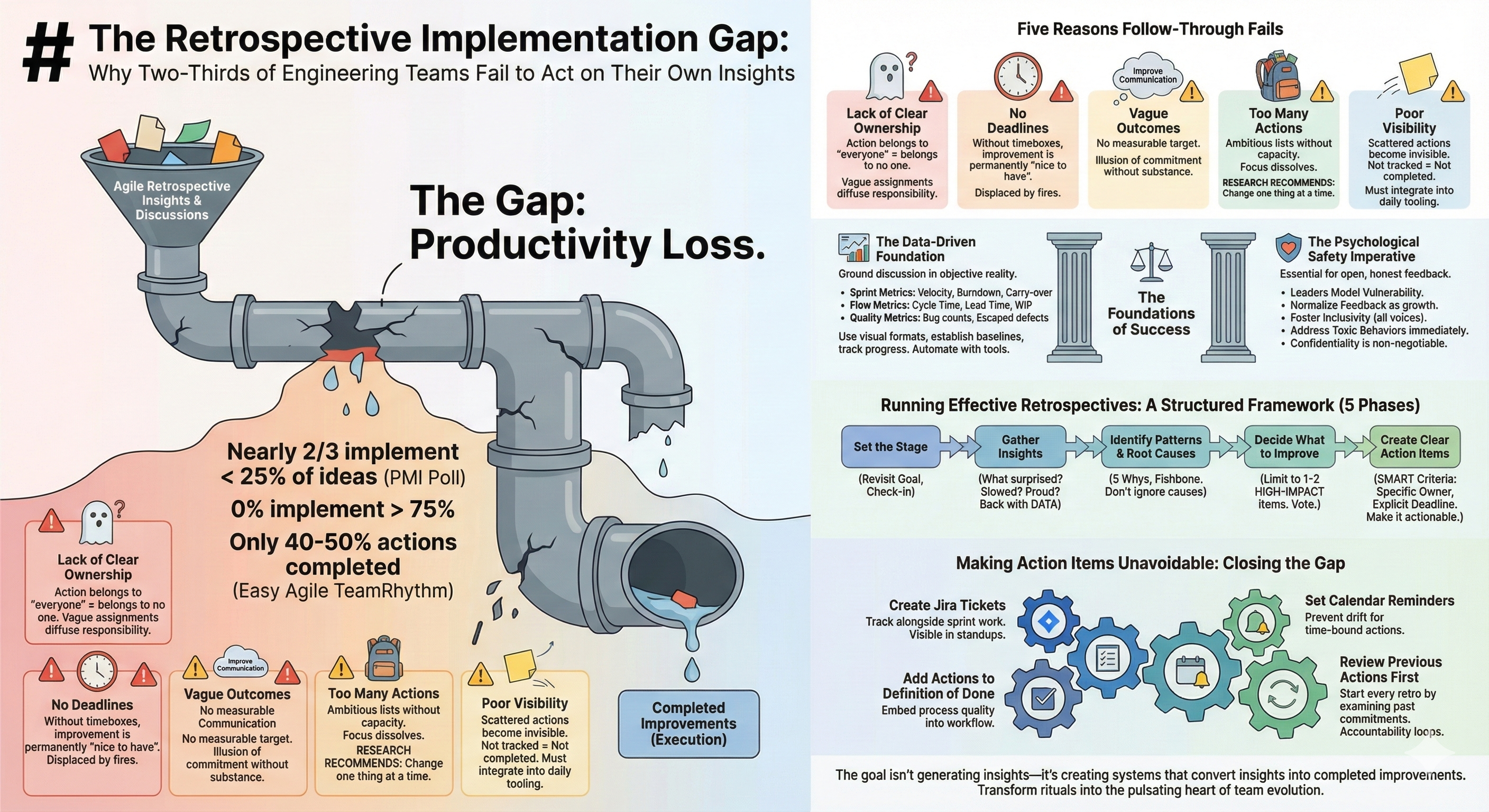
Five Reasons Follow-Through Fails
Before exploring how to conduct effective retrospectives, we need to understand why implementation breaks down. Research identifies five primary failure points:
1. Lack of Clear Ownership
When an action belongs to "everyone," it belongs to no one. Vague assignments like "the team will improve code review turnaround" diffuse responsibility until it evaporates entirely.
2. No Deadlines
Items without timeboxes drift into the background, perpetually displaced by sprint commitments and production fires. Without temporal boundaries, improvement work becomes permanently "nice to have."
3. Vague Outcomes
"Improve communication" sounds reasonable but provides no measurable target. These intentions masquerade as actions, creating the illusion of commitment without the substance.
4. Too Many Actions
Teams commit to ambitious action lists without considering capacity. When everything seems equally important, focus dissolves. The research recommends a counterintuitive approach: change one thing at a time.
5. Poor Visibility
Actions scattered across whiteboards, documents, or memory become invisible. What isn't tracked isn't completed. Without integration into daily tooling, retrospective commitments exist in a parallel universe that never intersects with actual work.
Understanding these failure modes transforms how we approach retrospective design. The goal isn't generating insights—it's creating systems that convert insights into completed improvements.
What Is a Retrospective?
A retrospective is a structured reflection session where software teams examine their recent work to identify improvements. In Agile methodologies, retrospectives typically occur at the end of each sprint—commonly two-week or one-month cycles.
The format is deceptively simple: teams discuss what worked, what didn't, and what to change. The underlying purpose is more profound: retrospectives serve as what research describes as the "pulsating heart" of continuous improvement in Agile teams, providing formal opportunities for alignment that might not occur organically in daily work.
The standard time allocation matters. The Scrum Guide recommends a maximum of three hours for one-month sprints, proportionally less for shorter cycles. Research shows that teams allocating only 5-10 minutes fail to achieve meaningful discussion or buy-in, undermining the entire practice.
The Data-Driven Foundation
Effective retrospectives ground discussion in objective reality, not just subjective experience. Research emphasizes that engineering metrics provide quantitative data alongside qualitative feedback, creating what's described as a 360-degree perspective on performance.
Recommended metrics frameworks include:
Sprint Metrics:
- Velocity trends (evaluating overcommitment versus predictability improvement)
- Burndown charts (visualizing work progression)
- Carry-over stories (assessing planning realism)
Flow Metrics:
- Cycle time (duration from task start to finish)
- Lead time (including backlog time for broader view)
- Work in Progress (revealing multitasking issues)
Quality Metrics:
- Bug counts
- Escaped defects
- Code review turnaround time
The research notes that presenting metrics in visually engaging formats using charts, graphs, and dashboards improves discussion quality. More importantly, teams should establish baselines for each metric before analysis, then track progress continuously by monitoring the impact of implemented improvements.
Modern development tools enable automated metric collection. Integration with Jira, GitHub, or Bitbucket can establish automatic baselines for team performance, providing consistent data without manual compilation overhead. This automation removes friction from data-driven retrospectives while enabling AI-driven insights for context and recommendations.
The Psychological Safety Imperative
Multiple sources identify psychological safety as essential for effective retrospectives. Without it, the entire practice collapses into performative ritual.
The research is explicit about the stakes: when psychological safety is absent, team members hesitate to speak openly, fear judgment prevents honest feedback, and concerns about repercussions diminish retrospective value. Teams avoid discussing "difficult" problems when sessions aren't confidential, turning retrospectives into sanitized theater rather than genuine improvement forums.
Research recommends measuring psychological safety through assessment questions on a Likert scale (1-5):
- "Do you feel safe expressing your thoughts and opinions in the team?"
- "Can you admit mistakes without fear of negative consequences?"
- "Do you feel your contributions are valued by the team?"
- "Are team conflicts addressed constructively?"
Building psychological safety requires deliberate practices:
Leaders Model Vulnerability
When managers and senior engineers share their mistakes first, they set the tone for team openness. This signals that fallibility is expected, not punished.
Normalize Feedback
Framing feedback as a growth tool rather than criticism changes how teams receive it. The research emphasizes this reframing as critical for participation.
Foster Inclusivity
Structured facilitation ensures every member has a voice. Without deliberate inclusion, louder personalities dominate while quieter team members disengage.
Address Toxic Behaviors Immediately
Allowing dismissive comments, interruptions, or blame to persist undermines safe environments. Research indicates that swift, clear responses to these behaviors protect the team's ability to function.
Confidentiality emerges as a non-negotiable element. Recording retrospectives or requiring public sharing of internal discussions creates chilling effects. The research recommends keeping retrospective notes within the team, sharing only action items publicly.
Running Effective Retrospectives: A Structured Framework
Research suggests a five-phase model for outcomes-driven retrospectives:
1. Set the Stage
Begin by revisiting the sprint goal and presenting key sprint data visually. Use brief check-in techniques like "One Word for This Sprint" to gauge team sentiment and create psychological presence.
2. Gather Insights
Use structured prompts to organize discussion:
- What surprised us?
- What slowed us down?
- What are we proud of?
The research emphasizes backing observations with data. Instead of "code reviews felt slow," teams reference actual turnaround time metrics to ground the conversation in measurable reality.
3. Identify Patterns and Root Causes
Apply analytical techniques like the 5 Whys, fishbone diagrams, or cause-and-effect matrices. Surface-level symptoms rarely reveal underlying issues. Proper root cause analysis prevents teams from addressing consequences while ignoring causes.
4. Decide What to Improve
Limit focus to 1-2 high-impact items. Use voting or dot prioritization to build consensus. Ensure actions remain within the team's control—commitments requiring external dependencies often stall indefinitely.
5. Create Clear Action Items
This phase determines whether retrospective insights become implemented improvements or forgotten aspirations. Research recommends SMART criteria (Specific, Measurable, Achievable, Relevant, Time-bound), with particular emphasis on assigning specific owners and setting explicit deadlines.
The difference between "improve code review speed" and "Jordan will establish a 24-hour code review SLA, tracked in GitHub, starting next Monday" determines implementation success.
Facilitation Techniques That Drive Participation
Rotating formats prevents retrospective stagnation. Research recommends several structured techniques:
Start-Stop-Continue
Simple and effective for newer teams. What should we start doing? Stop doing? Continue doing?
4Ls (Liked, Learned, Lacked, Longed For)
Encourages deeper reflection across multiple dimensions of team experience.
Sailboat
A visual metaphor technique where the boat represents the team, wind represents what propels progress, anchors represent what holds back, and rocks represent risks.
Rose, Thorn, Bud
Balances positive (rose), negative (thorn), and potential (bud) perspectives.
Mad, Sad, Glad
Emotion-based categorization that acknowledges feelings as valid data points.
Anonymous feedback tools provide another participation lever. Pre-retrospective surveys using Google Forms or Microsoft Forms gather sentiment before meetings, balancing louder voices with quieter team members. Scaled questions like "How well did we collaborate this sprint?" provide quantitative inputs alongside qualitative discussion.
Making Action Items Unavoidable
The implementation gap closes when retrospective commitments integrate into teams' daily tooling. Research describes this as making accountability unavoidable by embedding improvements in existing workflow.
Practical integration approaches include:
Create Jira Tickets for Action Items
Track retrospective commitments alongside sprint work. Include them in sprint planning. Make them visible in standups.
Add Actions to Definition of Done
When an improvement relates to process quality, embedding it in the Definition of Done ensures consistent application.
Set Calendar Reminders
For time-bound actions, scheduled reminders prevent drift. If the team committed to reviewing deployment frequency metrics in three weeks, calendar that review.
Review Previous Actions First
Start each retrospective by examining last sprint's commitments. This creates accountability loops—teams quickly learn that commitments aren't rhetorical.
The research emphasizes that when action items remain in retrospective notes or on whiteboards, completion rates plummet. Visibility drives completion.
Common Anti-Patterns and How to Avoid Them
Research identifies several failure patterns that undermine retrospective effectiveness:
Attempting to "Change the World"
Teams commit to ambitious action lists without capacity consideration, leading to disappointment when actions don't get completed and growing action item backlogs. The solution: change one thing at a time, using proper root cause analysis to ensure that one thing matters.
No Responsibility Taken
Sessions become complaint forums without action commitment, developing blame cultures where no actual improvements get implemented. Research recommends asking the powerful question: "What are you going to do about the situation?" This shifts teams from passive observation to active ownership.
Wishful Thinking
Vague actions without owners (like "improve communication") result in nothing getting implemented due to lack of specificity. The research consistently emphasizes SMART criteria as the antidote.
Insufficient Time Allocation
As noted earlier, teams allocating only 5-10 minutes for retrospectives cannot achieve meaningful improvement discussion. The recommended standard of 90 minutes for two-week sprints provides adequate space for genuine reflection.
Confidentiality Breaches
Recording sessions or requiring public sharing prevents teams from discussing difficult problems. Keep retrospective discussions private; share only resulting action items.
Measuring Retrospective Effectiveness
How do teams know if their retrospectives are working? Research suggests tracking both leading and lagging indicators:
Leading Indicators:
- Action item completion rate (research suggests targeting improvement from the baseline 40-50%)
- Time to implement improvements
- Participation rate in discussions
- Psychological safety scores (survey-based)
Lagging Indicators:
- Velocity trends over multiple sprints
- Defect rate reduction
- Cycle time improvement
- Team satisfaction scores
These measurements create feedback loops. Teams can retrospect on their retrospectives, applying the same continuous improvement mindset to the practice itself.
Beyond Sprint Retrospectives
While most retrospectives occur at sprint boundaries, research identifies value in broader temporal scopes:
Annual or Quarterly Retrospectives
These provide comprehensive reviews of extended periods, evaluating multiple projects or development cycles and assessing team evolution over time. They offer holistic views versus single-project focus, enabling teams to refine practices based on year-long perspectives.
These longer-cycle retrospectives surface patterns invisible in two-week windows. They're particularly valuable for examining architectural decisions, team composition changes, and strategic direction.
The Path Forward
The retrospective implementation gap isn't inevitable. It results from predictable, addressable failure modes: unclear ownership, missing deadlines, vague outcomes, excessive scope, and poor visibility.
Teams that systematically address these structural issues transform retrospectives from ritual meetings into genuine catalysts for measurable improvement. The research provides clear guidance:
- Ground discussions in objective metrics
- Build and maintain psychological safety
- Limit focus to 1-2 high-impact improvements per cycle
- Assign specific owners to every action
- Set explicit deadlines
- Integrate commitments into daily tooling
- Review previous actions at the start of each retrospective
- Allocate adequate time for meaningful discussion
The data reveals both the problem and the solution. With implementation rates below 25% for most teams, there's enormous untapped potential. Closing this gap doesn't require revolutionary new practices—it requires disciplined execution of known effective patterns.
The question isn't whether retrospectives matter. Multiple sources confirm their role as the foundation of continuous improvement in software engineering. The question is whether teams will implement the systems that convert retrospective insights into completed improvements.
The answer determines whether retrospectives remain empty rituals or become what they're designed to be: the pulsating heart of team evolution.