
Rate Limiters: The Unsung Heroes Keeping Your APIs Alive
Rate Limiters: The Unsung Heroes Keeping Your APIs Alive
Ever wondered why your favorite API doesn't crash when a million users hit it at once? Or why that one developer who wrote a script with an infinite loop didn't bring down the entire service? The answer is rate limiting, and it's way more interesting than it sounds.
Think of rate limiting like a bouncer at a club. Sure, everyone wants to get in, but if you let everyone in at once, the place becomes a disaster. The bouncer controls the flow, keeps things manageable, and makes sure everyone has a good time. That's exactly what rate limiters do for your systems.
Why Rate Limiting Isn't Just Nice to Have (It's Essential)
Let's be real here. In today's world, if your API goes down, you're not just losing requests, you're losing money, users, and probably your sanity. Rate limiting isn't some fancy feature you add when you have extra time. It's the difference between a system that works and one that becomes a very expensive paperweight.
The Attack Defense Squad
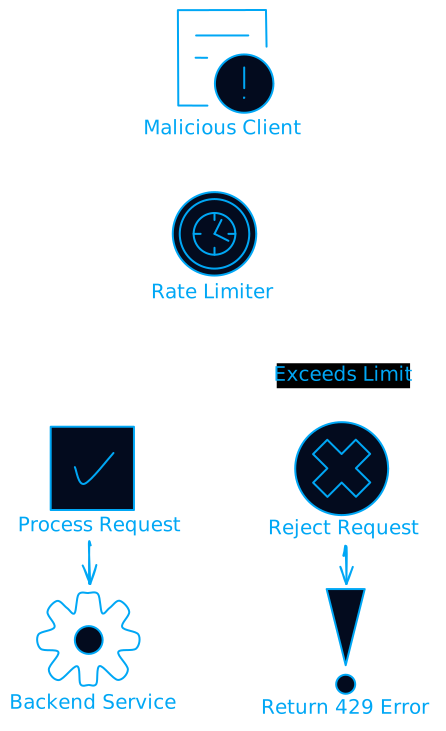
Picture this: some script kiddie decides your API looks like a fun target and starts hammering it with requests. Without rate limiting, your servers would be like "Sure, let me process all 10,000 requests per second!" and then promptly die. With rate limiting? Your system just shrugs and says "Nope, you get 100 requests per minute, deal with it."
Fair Play in the Digital Playground
Here's something that'll make you appreciate rate limiting: imagine you're running a pizza delivery service. One customer orders 1000 pizzas, and now everyone else has to wait 3 hours for their single pizza. That's what happens without rate limiting. One greedy client can monopolize all your resources, leaving everyone else hanging.
Rate limiting ensures everyone gets their fair share. It's like having a really good teacher who makes sure the class participation is distributed evenly, not dominated by that one kid who raises their hand for everything.
The Money Talk
Let's talk about something everyone cares about: money. In cloud environments where you pay for what you use, an uncontrolled API can turn into a financial nightmare faster than you can say "AWS bill." I've seen companies get surprise bills that made their CFOs question their life choices.
Rate limiting is like having a spending limit on your credit card. It prevents those "Oh no, what have I done?" moments when you check your cloud bill.
The Algorithm Showdown: Choosing Your Rate Limiting Champion
Now here's where it gets fun. There are several ways to implement rate limiting, and each has its own personality. It's like choosing a character in a video game, each with different strengths and weaknesses.
Token Bucket: The Flexible Friend
The token bucket algorithm is like having a jar of cookies. Every second, you add a cookie to the jar (up to a maximum). When someone wants to make a request, they need to take a cookie. No cookies? No request.
class TokenBucket:
    def __init__(self, capacity, refill_rate):
        self.capacity = capacity
        self.tokens = capacity
        self.refill_rate = refill_rate
        self.last_refill = time.time()

    def allow_request(self):
        self._refill()
        if self.tokens > 0:
            self.tokens -= 1
            return True
        return False

    def _refill(self):
        now = time.time()
        tokens_to_add = (now - self.last_refill) * self.refill_rate
        self.tokens = min(self.capacity, self.tokens + tokens_to_add)
        self.last_refill = now
The beauty of token bucket? It allows for bursts. If you haven't used your API for a while, you can make several requests quickly because you've accumulated tokens. It's forgiving and flexible, like that friend who lets you borrow their Netflix password.
Leaky Bucket: The Steady Eddie
Leaky bucket is the opposite personality. It's like a very disciplined person who does exactly 10 push-ups every morning, no more, no less. Requests go into the bucket, and they leak out at a constant rate.
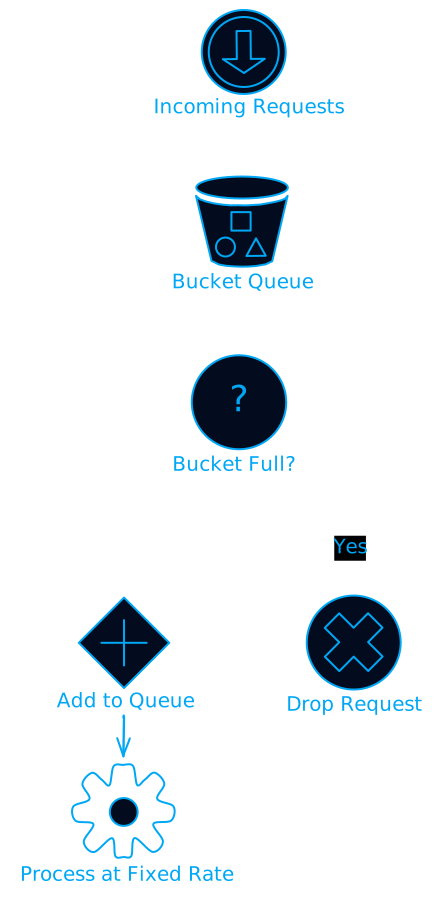
This algorithm is perfect when you want smooth, predictable traffic. It's like having a really good traffic light system that keeps cars flowing at a steady pace.
Sliding Window: The Precise Perfectionist
Sliding window algorithms are the overachievers of rate limiting. They keep track of exactly when each request happened and make decisions based on precise timing. There are two flavors:
Sliding Window Log: Keeps a log of every request timestamp. Super accurate but memory-hungry. It's like keeping a detailed diary of everything that happens.
Sliding Window Counter: Uses two counters and some math to approximate the sliding window. Less memory, slightly less accurate, but still pretty good. It's like estimating your monthly expenses instead of tracking every penny.
Fixed Window: The Simple Simon
Fixed window is the "good enough" solution. Every minute (or hour, or whatever), reset the counter. Simple, fast, but has one big problem: the "thundering herd" at the beginning of each window.
Imagine a store that says "First 100 customers each hour get 50% off." At the start of every hour, there's chaos. That's fixed window for you.
Scaling Rate Limiting: When Things Get Complicated
Here's where rate limiting gets really interesting. When you have multiple servers, how do they all agree on who's used how many requests? It's like trying to coordinate a group project where everyone's working from different locations.
The Distributed Dilemma
You've got three main options for distributed rate limiting:
Centralized Service: One service keeps track of everything. Simple but becomes a bottleneck. It's like having one person manage the entire group project, they know everything but they're also the weak link.
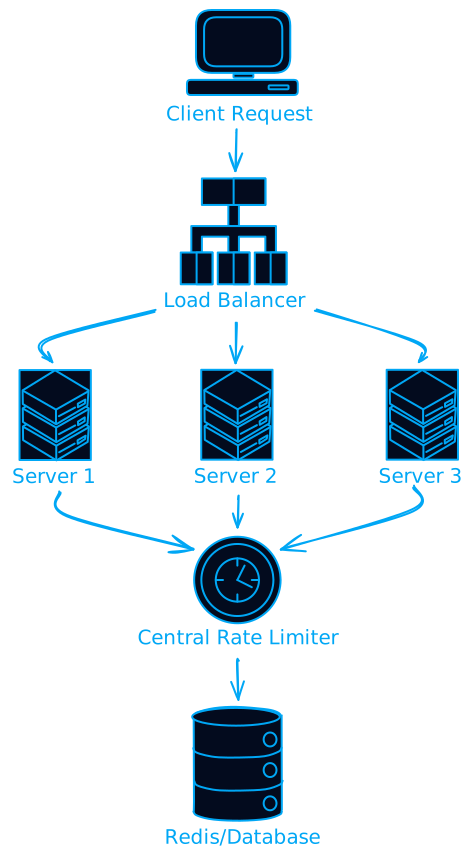
Distributed Cache: Use Redis or similar to share state. Everyone can read and write, but you need to handle the complexity of distributed systems. It's like using a shared Google Doc for the group project.
Eventually Consistent: Each server keeps its own count and occasionally syncs with others. Fast but not perfectly accurate. It's like everyone doing their part and checking in periodically.
Hierarchical Rate Limiting: The Russian Doll Approach
Sometimes you need rate limiting at multiple levels. Think of it like a company structure:
- Global limit: The entire company can't exceed X requests
- Department limit: Each department has its own limit
- Individual limit: Each person has their own limit
class HierarchicalRateLimiter:
    def __init__(self):
        self.global_limiter = TokenBucket(10000, 100)  # 10k capacity, 100/sec
        self.tenant_limiters = {}
        self.user_limiters = {}

    def allow_request(self, tenant_id, user_id):
        # Check global limit first
        if not self.global_limiter.allow_request():
            return False

        # Check tenant limit
        tenant_limiter = self.get_tenant_limiter(tenant_id)
        if not tenant_limiter.allow_request():
            return False

        # Check user limit
        user_limiter = self.get_user_limiter(user_id)
        return user_limiter.allow_request()
This approach lets you have fine-grained control while still protecting your overall system. It's like having multiple layers of security at a building.
Where to Put Your Rate Limiter: Location, Location, Location
Just like real estate, location matters for rate limiters. You've got several options, each with its own trade-offs.
API Gateway: The Front Door Bouncer
Most people put rate limiting at the API gateway. It's the first thing requests hit, so you can stop bad traffic before it even gets to your servers. It's efficient and centralized.
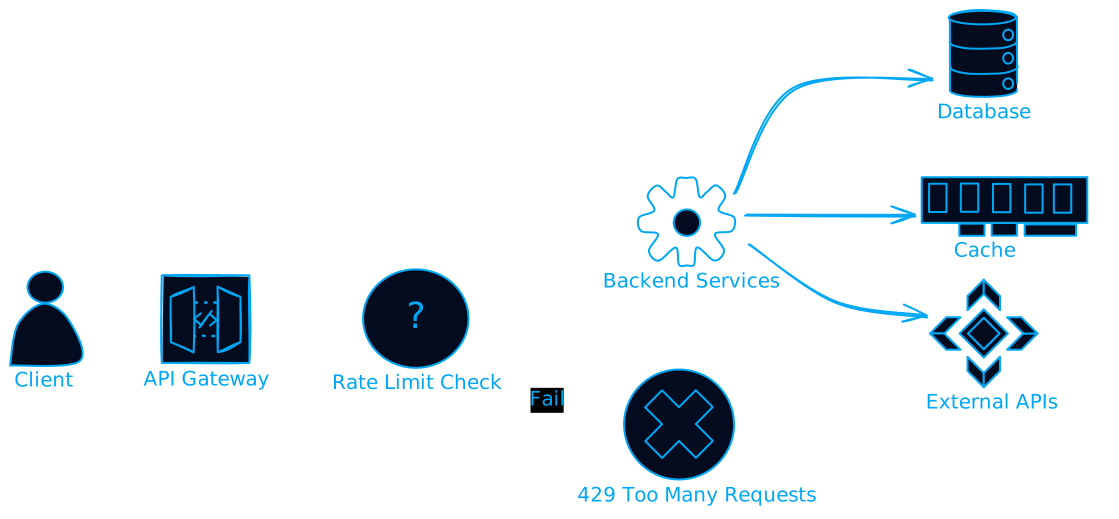
But here's the thing: API gateways might not know everything about your users. They see IP addresses and API keys, but they might not know that user123 is on the premium plan and should get higher limits.
Application Layer: The Inside Knowledge
Putting rate limiting in your application code gives you the most control. You know everything about the user, the specific operation they're trying to do, and how expensive it is.
The downside? Now every service needs to implement rate limiting, and you need to make sure they all do it consistently. It's like having every employee at a company make their own security decisions, it can work but it's risky.
Service Mesh: The Invisible Hand
Service meshes like Istio can handle rate limiting transparently. Your application code doesn't need to know about it, but all traffic gets controlled. It's like having an invisible security system that just works.
The trade-off is complexity. Service meshes are powerful but they're also another thing to learn, deploy, and maintain.
CDN: The Global Protector
For public APIs, you can push rate limiting all the way to the edge with CDNs like Cloudflare. This means rate limiting happens close to your users, reducing latency and protecting your origin servers.
The limitation is that CDN rate limiting is usually simpler and less customizable than what you can build yourself.
Dynamic Rate Limiting: The Smart Approach
Here's where rate limiting gets really cool. Instead of static limits, what if your rate limiter could adapt to conditions?
Load-Based Limiting
Imagine your rate limiter watching your CPU usage. When things get busy, it automatically tightens the limits. When things calm down, it relaxes them. It's like having a smart thermostat for your API.
class AdaptiveRateLimiter:
    def __init__(self, base_limit):
        self.base_limit = base_limit

    def get_current_limit(self):
        cpu_usage = self.get_cpu_usage()
        if cpu_usage > 80:
            return self.base_limit * 0.5  # Reduce by 50%
        elif cpu_usage < 30:
            return self.base_limit * 1.5  # Increase by 50%
        return self.base_limit
User Behavior Adaptation
What if your rate limiter learned from user behavior? New users might get lower limits until they prove they're legitimate. Power users who've been good citizens for months might get higher limits.
It's like building trust over time. The system learns who to trust and who to watch carefully.
The Real-World Implementation: Making It Happen
Let's talk about actually building this stuff. Here's a simple but effective rate limiter using Redis:
import redis
import time
import json

class RedisRateLimiter:
    def __init__(self, redis_client):
        self.redis = redis_client

    def is_allowed(self, key, limit, window_seconds):
        pipeline = self.redis.pipeline()
        now = time.time()

        # Remove old entries
        pipeline.zremrangebyscore(key, 0, now - window_seconds)

        # Count current entries
        pipeline.zcard(key)

        # Add current request
        pipeline.zadd(key, {str(now): now})

        # Set expiration
        pipeline.expire(key, window_seconds)

        results = pipeline.execute()
        current_count = results[1]

        return current_count < limit

# Usage
limiter = RedisRateLimiter(redis.Redis())
if limiter.is_allowed("user:123", limit=100, window_seconds=60):
    # Process request
    pass
else:
    # Return 429 Too Many Requests
    pass
This implementation uses Redis sorted sets to track request timestamps. It's efficient, distributed, and handles the sliding window approach naturally.
Common Pitfalls: Learning from Others' Mistakes
Let me save you some headaches by sharing common mistakes:
The Thundering Herd Problem: If all your rate limiters reset at the same time (like midnight), you get a massive spike of traffic. Stagger your windows or use sliding windows instead.
The Shared Counter Problem: Multiple servers incrementing the same counter can lead to race conditions. Use atomic operations or accept some inaccuracy.
The Cold Start Problem: When your rate limiter starts up, should it allow all requests until it builds up state? Or should it be conservative? There's no perfect answer, but be intentional about your choice.
The Key Explosion Problem: If you create a new rate limit key for every user, you might end up with millions of keys in your cache. Plan for cleanup and memory management.
Monitoring and Observability: Know What's Happening
A rate limiter without monitoring is like driving blindfolded. You need to know:
- How many requests are being rate limited?
- Which users are hitting limits most often?
- Are your limits too strict or too loose?
- Is your rate limiter itself becoming a bottleneck?
class MonitoredRateLimiter:
    def __init__(self, limiter, metrics):
        self.limiter = limiter
        self.metrics = metrics

    def is_allowed(self, key, limit, window):
        start_time = time.time()
        allowed = self.limiter.is_allowed(key, limit, window)

        # Record metrics
        self.metrics.increment('rate_limiter.requests.total')
        if allowed:
            self.metrics.increment('rate_limiter.requests.allowed')
        else:
            self.metrics.increment('rate_limiter.requests.denied')

        self.metrics.histogram('rate_limiter.latency',
                             time.time() - start_time)

        return allowed
Set up alerts for when rate limiting spikes, it often indicates either an attack or a problem with your system that's causing clients to retry excessively.
The Future of Rate Limiting: What's Next?
Rate limiting is evolving. We're seeing:
Machine Learning Integration: Rate limiters that learn normal patterns and automatically detect anomalies.
Intent-Based Limiting: Instead of just counting requests, understanding what the user is trying to accomplish and limiting based on that.
Collaborative Filtering: Rate limiters that share information across different services and companies to identify bad actors.
Edge Computing: Moving rate limiting closer to users for better performance and user experience.
Wrapping Up: Your Rate Limiting Journey
Rate limiting might seem like a simple concept, but as you've seen, there's a lot of depth here. The key is to start simple and evolve your approach as your needs grow.
Start with a basic implementation at your API gateway. Monitor how it performs. Learn from your users' behavior. Then gradually add more sophisticated features like dynamic limits, hierarchical controls, and advanced algorithms.
Remember, the best rate limiter is the one that protects your system without getting in the way of legitimate users. It should be invisible when things are working well and a lifesaver when things go wrong.
Your APIs deserve better than crossing your fingers and hoping for the best. Give them the protection they need with proper rate limiting. Your future self (and your users) will thank you.
Want to dive deeper into system design? Check out how rate limiting fits into the bigger picture of building resilient, scalable systems. And remember, every great system started with someone asking "But what if too many people use this at once?"