The Great Trade-off: Privacy vs Usability
You know that feeling when you're building a system and suddenly realize you're stuck between two impossible choices? Your users want Netflix-level personalization, but they also want Fort Knox-level privacy. Welcome to the privacy vs usability dilemma, the engineering challenge that keeps system architects awake at night.
Here's the thing though, this isn't just another theoretical debate. Every time someone abandons your app because the signup flow has 47 consent checkboxes, or when your recommendation engine serves generic garbage because you can't collect enough data, you're feeling the real-world impact of this trade-off.
But what if I told you that privacy and usability don't have to be mortal enemies? That with the right architectural patterns and some clever engineering, you can actually have both?
The Real Problem: Why This Trade-off Exists
Let's be honest about what's happening under the hood. Traditional systems work like this: collect everything, store it forever, and use it however you want. It's the digital equivalent of being that friend who remembers every embarrassing thing you've ever said.
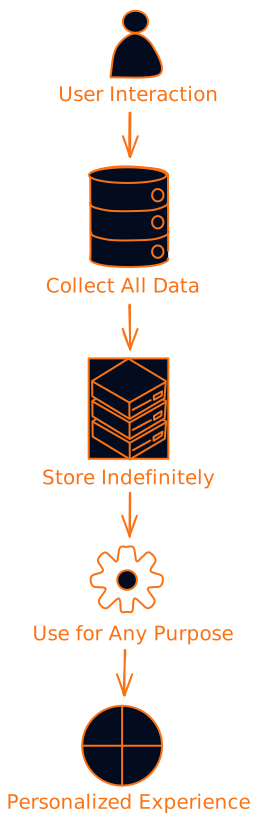
This approach works great for usability. Your system knows everything about users, so it can predict what they want before they even know it themselves. But it's a privacy nightmare.
On the flip side, privacy-first systems often go to the other extreme:
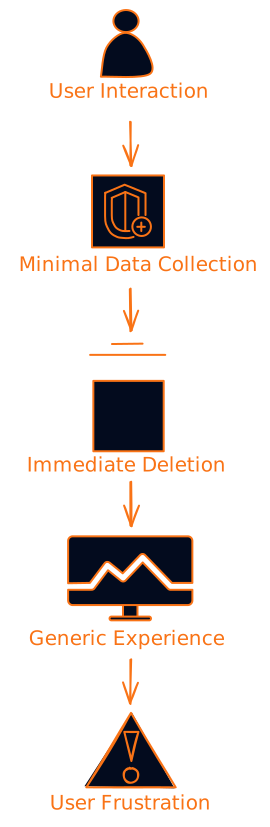
The result? Users get treated like strangers every time they visit. It's like having amnesia as a service.
The Architecture Patterns That Actually Work
Progressive Privacy: Start Small, Earn Trust
Instead of asking for everything upfront or nothing at all, progressive privacy lets you build trust gradually. Think of it like dating, you don't propose on the first date, but you also don't stay strangers forever.
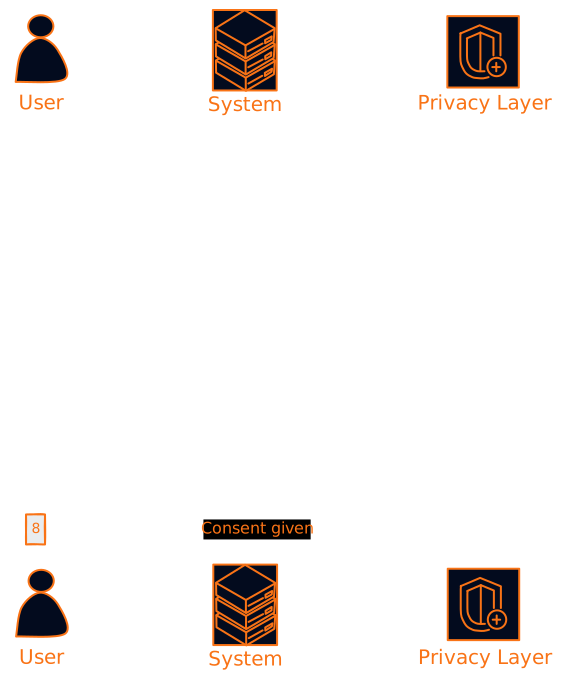
Here's how you implement this in practice:
class ProgressivePrivacyManager:
    def __init__(self):
        self.consent_levels = {
            'essential': ['authentication', 'security'],
            'functional': ['preferences', 'basic_analytics'],
            'enhanced': ['personalization', 'recommendations'],
            'marketing': ['targeted_content', 'email_campaigns']
        }

    def request_consent_for_feature(self, user_id, feature):
        current_consents = self.get_user_consents(user_id)
        required_level = self.get_required_level(feature)

        if self.has_sufficient_consent(current_consents, required_level):
            return self.enable_feature(feature)

        return {
            'consent_needed': True,
            'level': required_level,
            'explanation': f"To enable {feature}, we need to {self.explain_data_usage(required_level)}",
            'benefits': self.explain_benefits(feature),
            'alternatives': self.get_privacy_friendly_alternatives(feature)
        }
Privacy-Preserving Computation: Have Your Cake and Eat It Too
This is where things get really interesting. Modern cryptographic techniques let you analyze data without actually seeing it. It's like being able to count people in a room while wearing a blindfold.
Differential Privacy adds carefully calibrated noise to your data, so you can get useful insights without compromising individual privacy:
import numpy as np

class DifferentialPrivacy:
    def __init__(self, epsilon=1.0):
        self.epsilon = epsilon  # Privacy budget

    def private_average(self, values, min_val, max_val):
        if not values:
            return 0

        # Clamp values to known range
        clamped = [max(min_val, min(max_val, v)) for v in values]
        true_avg = sum(clamped) / len(clamped)

        # Add Laplace noise
        sensitivity = (max_val - min_val) / len(clamped)
        noise = np.random.laplace(0, sensitivity / self.epsilon)

        return true_avg + noise

# Usage: Get average user engagement without exposing individual scores
dp = DifferentialPrivacy(epsilon=0.5)
engagement_scores = [0.2, 0.8, 0.6, 0.9, 0.3]
private_avg = dp.private_average(engagement_scores, 0.0, 1.0)
Homomorphic Encryption lets you perform computations on encrypted data. Your servers can crunch numbers without ever seeing the actual values:
class SimpleHomomorphicEncryption:
    def __init__(self):
        self.key = self.generate_key()

    def encrypt(self, value):
        # Simplified: real implementations use complex math
        return (value * self.key) % (2**32)

    def decrypt(self, encrypted_value):
        return (encrypted_value * self.inverse_key) % (2**32)

    def add_encrypted(self, enc1, enc2):
        # Magic: add encrypted values without decrypting
        return (enc1 + enc2) % (2**32)

    def compute_encrypted_stats(self, encrypted_values):
        # Calculate sum without seeing individual values
        encrypted_sum = encrypted_values[0]
        for val in encrypted_values[1:]:
            encrypted_sum = self.add_encrypted(encrypted_sum, val)

        return {
            'encrypted_sum': encrypted_sum,
            'count': len(encrypted_values)
        }
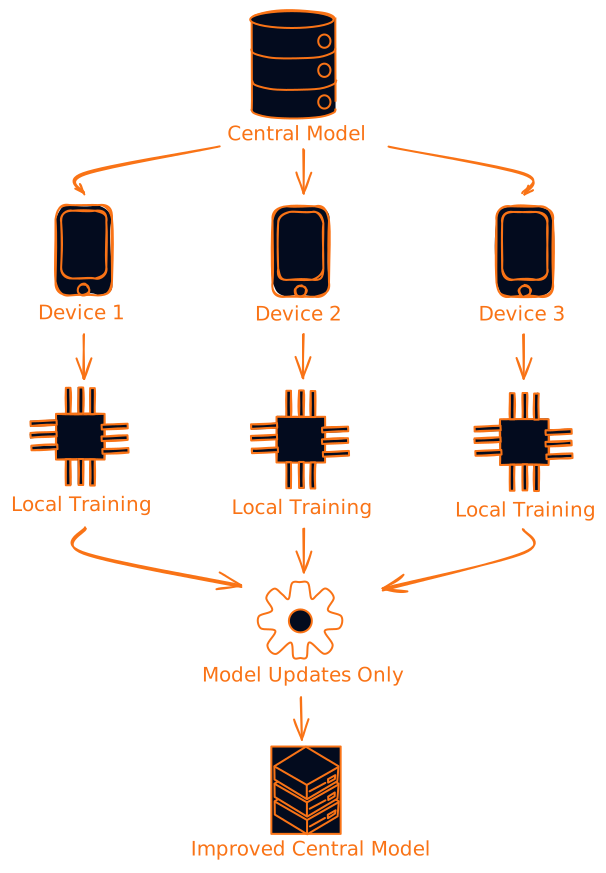
Federated Learning: Bring the Algorithm to the Data
Instead of centralizing all user data, federated learning flips the script. The model travels to where the data lives, learns locally, and only shares the insights.
The Real-World Implementation Strategies
Context-Aware Consent: Ask at the Right Moment
Nobody likes being bombarded with permission requests during onboarding. Smart systems ask for permissions when users actually need the feature:
class ContextualConsentManager:
    def __init__(self):
        self.consent_triggers = {
            'location': ['weather_widget', 'local_recommendations'],
            'camera': ['profile_photo', 'document_scan'],
            'contacts': ['friend_finder', 'invite_friends']
        }

    def handle_feature_request(self, user_id, feature):
        required_permissions = self.get_required_permissions(feature)

        for permission in required_permissions:
            if not self.has_permission(user_id, permission):
                return self.request_contextual_consent(
                    user_id,
                    permission,
                    feature,
                    explanation=f"To use {feature}, we need access to {permission}"
                )

        return self.enable_feature(user_id, feature)
Privacy Dashboards: Give Users Control
Users want to feel in control of their data. A well-designed privacy dashboard can actually increase trust and engagement:
class PrivacyDashboard:
    def get_user_data_summary(self, user_id):
        return {
            'data_collected': self.get_data_inventory(user_id),
            'consent_status': self.get_consent_history(user_id),
            'data_usage': self.get_usage_analytics(user_id),
            'retention_schedule': self.get_retention_info(user_id),
            'controls': {
                'download_data': f'/api/users/{user_id}/export',
                'delete_account': f'/api/users/{user_id}/delete',
                'modify_consents': f'/api/users/{user_id}/consents'
            }
        }

    def auto_expire_data(self, user_id):
        # Automatically delete data based on retention policies
        expired_data = self.find_expired_data(user_id)
        for data_type, items in expired_data.items():
            self.delete_data(user_id, data_type, items)
            self.log_deletion(user_id, data_type, len(items))
When Privacy Actually Improves Usability
Here's a counterintuitive insight: sometimes privacy features make your system more usable, not less.
Local Processing Reduces Latency: When you process data on-device instead of sending it to the cloud, responses are often faster. No network round-trips means snappier experiences.
Reduced Cognitive Load: Users don't have to worry about what you're doing with their data if you're transparent about not collecting it in the first place.
Better Performance: Systems that collect less data often perform better. Smaller databases, faster queries, lower infrastructure costs.

The Compliance Bonus: GDPR as a Feature, Not a Bug
Regulations like GDPR aren't just legal requirements, they're product features in disguise. When you build privacy-first systems, compliance becomes automatic:
class GDPRCompliantDataManager:
    def __init__(self):
        self.retention_policies = {
            'user_profiles': timedelta(days=365*2),  # 2 years
            'analytics_data': timedelta(days=90),    # 3 months
            'logs': timedelta(days=30)               # 1 month
        }

    def collect_data(self, user_id, data_type, data, purpose):
        # Principle of data minimization
        if not self.is_necessary_for_purpose(data_type, purpose):
            raise ValueError(f"Data type {data_type} not necessary for {purpose}")

        # Record lawful basis
        consent_record = {
            'user_id': user_id,
            'data_type': data_type,
            'purpose': purpose,
            'consent_timestamp': datetime.now(),
            'retention_until': datetime.now() + self.retention_policies[data_type]
        }

        self.store_with_expiration(user_id, data_type, data, consent_record)

    def handle_data_subject_request(self, user_id, request_type):
        if request_type == 'access':
            return self.export_user_data(user_id)
        elif request_type == 'deletion':
            return self.delete_user_data(user_id)
        elif request_type == 'portability':
            return self.export_portable_format(user_id)
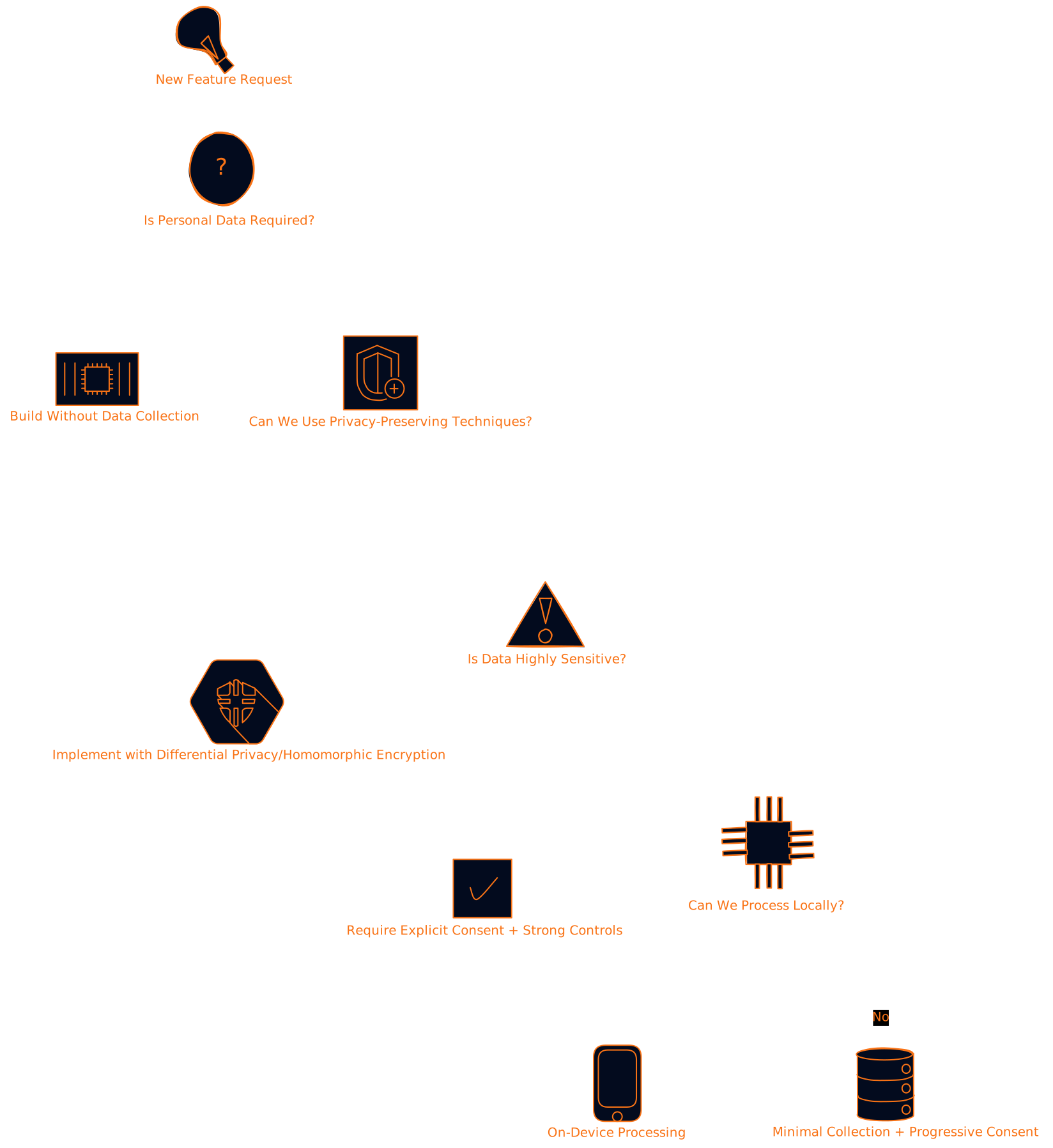
The Architecture Decision Framework
When you're designing a new feature, use this decision tree:
Common Pitfalls and How to Avoid Them
Consent Fatigue: Don't ask for everything upfront. Users will just click "Accept All" without reading.
Privacy Theater: Having complex privacy settings that don't actually protect users is worse than being honest about your data practices.
All-or-Nothing Thinking: You don't have to choose between zero data collection and surveillance capitalism. There's a middle ground.
Ignoring User Mental Models: Users understand "this app uses my location to show nearby restaurants" but not "we collect telemetry data for service optimization."
The Future: Privacy as a Competitive Advantage
Companies that figure out privacy-preserving personalization first will have a massive advantage. Users are getting smarter about privacy, and regulations are getting stricter.
The winners will be those who can deliver personalized experiences while genuinely protecting user privacy. Not through legal loopholes or dark patterns, but through better engineering.
Building Trust Through Transparency
The most successful privacy-focused systems don't just protect user data, they make protection visible:
class TransparencyEngine:
    def generate_privacy_report(self, user_id):
        return {
            'data_collected_this_month': self.get_monthly_collection_stats(user_id),
            'how_data_was_used': self.get_usage_breakdown(user_id),
            'data_shared_with_third_parties': [],  # Hopefully empty!
            'privacy_improvements': self.get_recent_privacy_updates(),
            'your_privacy_score': self.calculate_privacy_score(user_id)
        }

    def explain_algorithm_decision(self, user_id, recommendation):
        return {
            'why_recommended': 'Based on your recent activity in similar categories',
            'data_used': ['product_categories_viewed', 'time_spent_browsing'],
            'data_not_used': ['personal_messages', 'location_history', 'contacts'],
            'how_to_improve': 'Rate more items to get better recommendations'
        }
The Bottom Line
Privacy and usability don't have to be enemies. With progressive consent, privacy-preserving computation, and transparent design, you can build systems that users trust AND love to use.
The key is thinking about privacy as a design constraint that forces you to be more creative, not a roadblock that kills innovation. Some of the most elegant solutions come from working within constraints.
Start small. Pick one feature and implement it with privacy by design. Measure the impact on both user trust and engagement. You might be surprised to find that users actually prefer the privacy-focused version.
The future belongs to systems that respect users while delivering value. The question isn't whether you can afford to build privacy-first systems, it's whether you can afford not to.
Remember: users don't want to choose between privacy and great experiences. They want both. And with the right architecture, you can give them exactly that.
What's your experience with the privacy vs usability trade-off? Have you found creative solutions that work for both users and business needs? The engineering community learns best when we share our real-world experiences, not just theoretical frameworks.