Network Abstractions: Why Remote Procedure Calls Are Your Distributed System's Best Friend
Network Abstractions: Why Remote Procedure Calls Are Your Distributed System's Best Friend
So you're building a distributed system and someone mentions RPC. Your first thought? "Great, another acronym to learn." But here's the thing - Remote Procedure Calls aren't just another buzzword. They're the invisible glue holding most of your favorite apps together, and understanding them might just save you from a world of debugging pain.
Let me break down what RPCs actually do, why they matter, and when they might bite you in the back.
What Exactly Is RPC? (The Non-Boring Explanation)
Think of RPC like ordering food through a delivery app. You tap "order pizza," and magically, pizza shows up at your door. You don't need to know the restaurant's internal processes, how they make the dough, or which delivery driver picked it up. You just made a simple request and got what you wanted.
That's essentially what RPC does for your code. It lets you call a function that lives on a completely different server as if it were sitting right there in your local codebase.
# This looks like a normal function call
result = calculate_user_score(user_id, game_data)

# But actually, this might be happening across the internet
# on a server thousands of miles away
The magic happens because RPC creates an abstraction layer that hides all the messy network stuff - serialization, HTTP requests, error handling, timeouts. Your code just sees a function call.

The RPC Execution Dance: What Happens Under the Hood
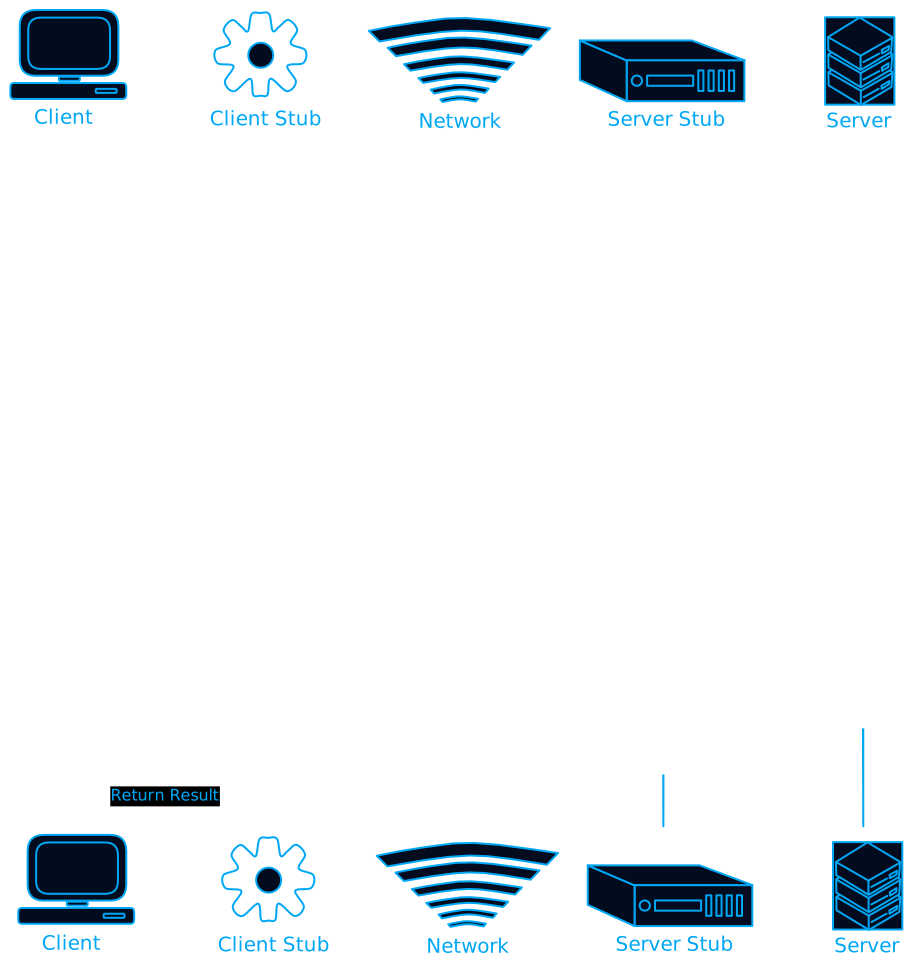
When you make an RPC call, there's a whole choreographed sequence happening behind the scenes. Let's walk through it step by step.
Step 1: Marshaling (AKA "Making Data Travel-Ready")
Before your data can hop across the network, it needs to be packaged up properly. This is called marshaling - think of it like vacuum-sealing your clothes before a trip.
Your function parameters get converted into a format that can survive the journey across different systems, programming languages, and network protocols. This might be JSON, Protocol Buffers, or some other serialization format.
// Your original data
const userData = {
  id: 12345,
  preferences: ["dark_mode", "notifications"],
  lastLogin: new Date()
}

// Gets marshaled into something like this for transport
// {"id":12345,"preferences":["dark_mode","notifications"],"lastLogin":"2024-12-08T07:09:07.972Z"}
Step 2: The Network Journey
Once marshaled, your request gets sent across the network. This is where things can get interesting (and by interesting, I mean potentially problematic). Network calls can fail, timeout, or get lost in the digital ether.
Step 3: Server-Side Processing
The server receives your request, unmarshals the data back into its original form, and executes the actual function. This is where your business logic lives.
Step 4: The Return Trip
The result gets marshaled again and sent back to you, where it's unmarshaled and returned as if it were a local function call.
Synchronous vs Asynchronous: The Waiting Game
Here's where RPC gets interesting. You've got two main flavors:
Synchronous RPC is like calling your friend and waiting on the line until they answer. Your code stops and waits for the response.
# Synchronous - your code blocks here
result = remote_service.get_user_data(user_id)
print(f"Got result: {result}")  # This won't run until the RPC completes
Asynchronous RPC is like sending a text message. You fire off the request and keep doing other stuff while waiting for a response.
# Asynchronous - your code keeps running
future = remote_service.get_user_data_async(user_id)
# Do other stuff here
result = await future  # Check for the result when you need it
The async approach is usually better for user-facing applications because nobody likes a frozen interface.
Why RPC Is Actually Pretty Great
1. It Makes Distributed Systems Feel Local
The biggest win with RPC is abstraction. You can split your monolith into microservices without completely rewriting how your code works. That massive UserService.calculateScore() method can live on a different server, but your calling code barely changes.
2. Language Independence
Want your Python web app to talk to a Go service? No problem. RPC frameworks like gRPC handle the translation between different languages automatically.
// Define your service once in Protocol Buffers
service UserService {
  rpc GetUser(UserRequest) returns (UserResponse);
  rpc UpdateUser(UpdateUserRequest) returns (UserResponse);
}
This single definition can generate client libraries for Python, Go, Java, JavaScript, and dozens of other languages.
3. Performance That Actually Matters
Modern RPC frameworks are fast. Really fast. gRPC uses HTTP/2 and Protocol Buffers, which means:
- Binary serialization (smaller payloads)
- Multiplexing (multiple requests over one connection)
- Header compression
- Bidirectional streaming
For high-throughput systems, this can make a huge difference.
4. Built-in Streaming
Need real-time updates? RPC frameworks support streaming out of the box.
# Server streaming - like a live feed
for update in user_service.stream_notifications(user_id):
    print(f"New notification: {update}")

# Bidirectional streaming - like a chat
chat_stream = chat_service.start_conversation()
chat_stream.send("Hello!")
for message in chat_stream:
    print(f"Received: {message}")
When RPC Becomes Your Worst Nightmare
But let's be real - RPC isn't all sunshine and rainbows. Here are the ways it can bite you:
1. The Tight Coupling Trap
RPC can make your services way too dependent on each other. Change a function signature on the server? Congratulations, you just broke every client that calls it.
# Version 1
def get_user(user_id: int) -> User:
    pass

# Version 2 - added a new parameter
def get_user(user_id: int, include_preferences: bool = False) -> User:
    pass
This seemingly innocent change can break clients that were compiled against the old interface. Versioning becomes a real headache.
2. Network Reality Check
RPC tries to hide the network, but the network is still there. And networks fail. A lot.
try:
    result = remote_service.critical_operation(data)
except NetworkError:
    # What do you do now?
    # Retry? How many times?
    # Return an error? Cache a result?
    # Your users are waiting...
    pass
You need to handle:
- Timeouts
- Connection failures
- Partial failures
- Retry logic
- Circuit breakers
- Fallback strategies
3. The Debugging Black Hole
When something goes wrong in a distributed RPC system, debugging becomes a nightmare. Was it a network issue? Server overload? Bad data? A bug in the marshaling code? Good luck figuring it out from a generic "RPC failed" error.
4. Security Headaches
RPC endpoints are essentially network-accessible functions. If you're not careful with authentication and input validation, you're basically giving attackers a menu of things they can execute on your servers.
# This is a security disaster waiting to happen
def execute_admin_command(command: str) -> str:
    return os.system(command)  # DON'T DO THIS
RPC in the Microservices World
Microservices and RPC go together like coffee and Monday mornings - they're practically inseparable. Here's why:
The Good Stuff
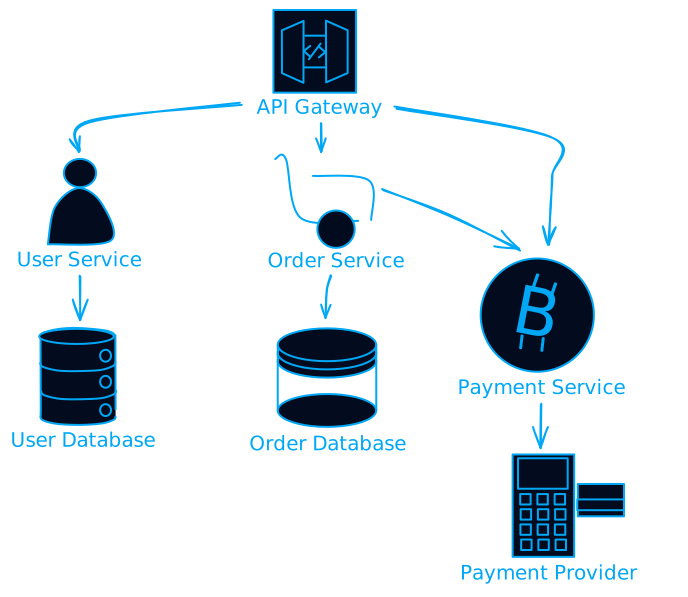
Service Independence: Each microservice can be developed, deployed, and scaled independently. Your user service can be written in Python while your payment service uses Go.
Clear Interfaces: RPC forces you to define clear contracts between services. This makes it easier to understand what each service does and how they interact.
Fault Isolation: When one service goes down, it doesn't necessarily take everything else with it (assuming you handle failures gracefully).
The Challenges
Distributed Complexity: Now instead of one application, you have a distributed system with all the complexity that entails. Network partitions, eventual consistency, distributed transactions - welcome to the fun zone.
Operational Overhead: You need service discovery, load balancing, monitoring, tracing, and a whole bunch of other infrastructure that wasn't necessary with a monolith.
Data Consistency: How do you handle transactions that span multiple services? What happens when the order service succeeds but the payment service fails?
RPC vs REST: The Eternal Debate
You've probably heard people argue about RPC vs REST. Here's the honest truth: they're different tools for different jobs.
Use RPC when:
- You need high performance and low latency
- You're building internal services that you control
- You want strong typing and code generation
- You need streaming or bidirectional communication
Use REST when:
- You're building public APIs
- You want maximum compatibility and caching
- You need to be discoverable and self-documenting
- You're working with web technologies
# RPC style - action-oriented
user_service.create_user(user_data)
user_service.update_user(user_id, changes)
user_service.delete_user(user_id)

# REST style - resource-oriented
POST /users (with user_data)
PUT /users/123 (with changes)
DELETE /users/123
Popular RPC Frameworks: Your Options
gRPC (Google's Baby)
- Uses Protocol Buffers and HTTP/2
- Excellent performance
- Great tooling and language support
- Can be overkill for simple use cases
Apache Thrift
- Battle-tested in large-scale systems
- Good performance
- Supports many languages
- More complex setup than gRPC
JSON-RPC
- Simple and lightweight
- Uses JSON (obviously)
- Easy to debug and understand
- Not as performant as binary protocols
Security: Don't Get Pwned
RPC security isn't optional. Here's what you need to think about:
Authentication and Authorization
Every RPC call should be authenticated. Use tokens, certificates, or whatever makes sense for your system.
@require_auth
@require_permission("user:read")
def get_user(user_id: int) -> User:
    return user_repository.get(user_id)
Input Validation
Never trust data coming over the network. Validate everything.
def update_user(user_id: int, updates: dict) -> User:
    # Validate user_id
    if not isinstance(user_id, int) or user_id <= 0:
        raise ValueError("Invalid user ID")

    # Validate updates
    allowed_fields = {"name", "email", "preferences"}
    if not set(updates.keys()).issubset(allowed_fields):
        raise ValueError("Invalid update fields")

    return user_repository.update(user_id, updates)
Encryption
Use TLS for all RPC communication. Yes, even internal services. Network sniffing is a thing.
Rate Limiting
Protect your services from being overwhelmed.
@rate_limit(requests_per_minute=100)
def expensive_operation(data: dict) -> dict:
    # This operation is now protected from abuse
    return process_data(data)
Best Practices: How to Not Shoot Yourself in the Foot
1. Design for Failure
Assume every RPC call will fail eventually. Build retry logic, timeouts, and fallbacks into your system from day one.
import asyncio
from typing import Optional

async def robust_rpc_call(service, method, *args, max_retries=3, timeout=5.0) -> Optional[dict]:
    for attempt in range(max_retries):
        try:
            return await asyncio.wait_for(
                getattr(service, method)(*args),
                timeout=timeout
            )
        except (NetworkError, TimeoutError) as e:
            if attempt == max_retries - 1:
                logger.error(f"RPC call failed after {max_retries} attempts: {e}")
                return None
            await asyncio.sleep(2 ** attempt)  # Exponential backoff
2. Version Your APIs
Use semantic versioning and maintain backward compatibility when possible.
service UserService {
  // v1 methods
  rpc GetUser(GetUserRequest) returns (GetUserResponse);

  // v2 methods - new functionality
  rpc GetUserV2(GetUserV2Request) returns (GetUserV2Response);
}
3. Monitor Everything
You need visibility into your RPC calls. Track latency, error rates, and throughput.
import time
from functools import wraps

def monitor_rpc(func):
    @wraps(func)
    def wrapper(*args, **kwargs):
        start_time = time.time()
        try:
            result = func(*args, **kwargs)
            metrics.increment(f"rpc.{func.__name__}.success")
            return result
        except Exception as e:
            metrics.increment(f"rpc.{func.__name__}.error")
            raise
        finally:
            duration = time.time() - start_time
            metrics.timing(f"rpc.{func.__name__}.duration", duration)
    return wrapper
4. Keep Interfaces Simple
Don't try to expose your entire object model over RPC. Design specific, focused interfaces.
# Bad - exposing internal complexity
def update_user_complex(user_id, name, email, preferences, settings, metadata, ...):
    pass

# Good - focused and clear
def update_user_profile(user_id: int, profile: UserProfile) -> User:
    pass

def update_user_preferences(user_id: int, preferences: UserPreferences) -> User:
    pass
The Future of RPC: What's Coming Next
RPC isn't standing still. Here's what's on the horizon:
WebAssembly Integration
WASM is making it possible to run RPC services in browsers and edge locations with near-native performance.
Better Observability
New tools are making it easier to trace requests across distributed RPC systems and understand what's happening when things go wrong.
AI-Powered Optimization
Machine learning is being used to optimize RPC routing, predict failures, and automatically tune performance parameters.
Edge Computing
RPC is evolving to work better in edge computing scenarios where latency and bandwidth are critical constraints.
Wrapping Up: Should You Use RPC?
RPC is a powerful tool, but like any tool, it's not right for every job. Here's my take:
Use RPC if:
- You're building internal services
- Performance is critical
- You need type safety and code generation
- You're comfortable with the operational complexity
Maybe think twice if:
- You're building public APIs
- You need maximum flexibility
- Your team isn't ready for distributed systems complexity
- You're just starting out and a monolith would work fine
The key is understanding the tradeoffs. RPC can make your distributed system more performant and easier to develop, but it comes with complexity costs. Make sure you're ready to pay them.
Remember, the best architecture is the one that solves your actual problems, not the one that looks good in a blog post. Start simple, measure everything, and evolve as you learn what your system actually needs.
And hey, if you do decide to go with RPC, at least now you know what you're getting into. Good luck out there in the distributed systems wilderness - it's dangerous, but the view from the top is pretty amazing.
Want to dive deeper into distributed systems? Check out the gRPC documentation, play around with some Protocol Buffers, and maybe spin up a few microservices to see how they talk to each other. The best way to understand RPC is to build something with it.