JSON vs TOON vs YAML in the AI Era
The Great Data Format Showdown: JSON vs TOON vs YAML in the AI Era
Why your choice of data format might be costing you thousands in AI bills
Picture this: you're running a chatbot that processes thousands of customer queries daily. Each interaction with your LLM costs money based on tokens consumed. Now imagine discovering that simply switching your data format could cut those costs by 30-60%. Sounds too good to be true? Welcome to the world of TOON.
The data format landscape is experiencing a seismic shift. While JSON has ruled the web for decades and YAML has carved out its niche in configuration management, a new player called TOON (Token-Oriented Object Notation) is challenging everything we thought we knew about efficient data representation.
But here's the thing - this isn't just another "new tech hype" story. This is about real money, real performance, and real decisions that could make or break your AI-powered applications.
The Token Tax: Why Every Character Counts Now
Let's start with a reality check. In the pre-AI world, a few extra characters in your JSON payload? No big deal. Network bandwidth was cheap, storage was abundant, and processing power could handle the overhead.
But then LLMs happened.
Suddenly, every single character in your data payload became a line item on your bill. That innocent-looking JSON object with its curly braces, quotes, and repeated keys? It's now eating into your profit margins one token at a time.
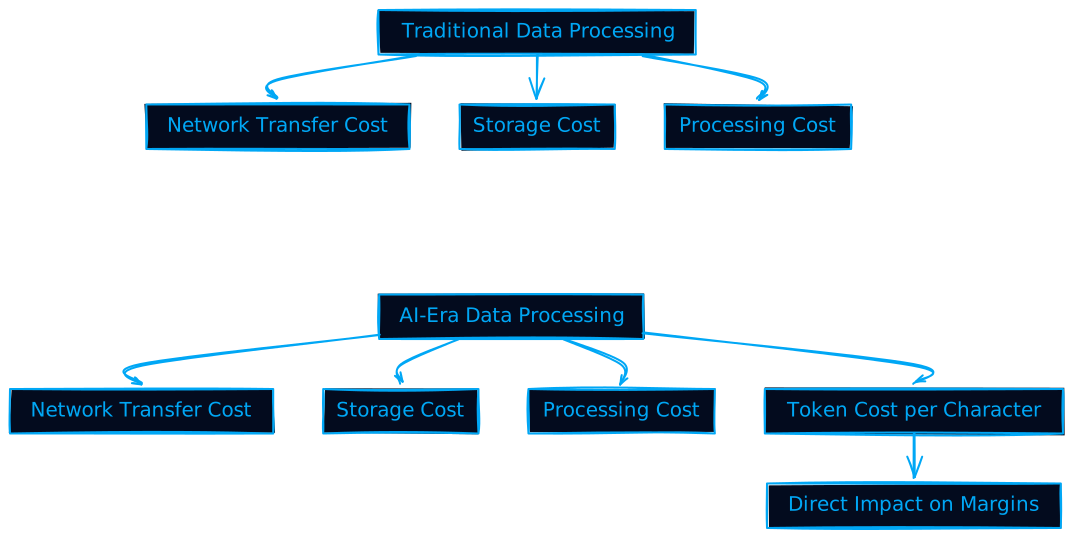
This shift has created what I call the "token tax" - an invisible cost that accumulates with every API call, every data exchange, every prompt sent to an LLM. And most developers don't even realize they're paying it.
Meet the Contenders
JSON: The Heavyweight Champion
JSON has been the undisputed king of data exchange for over two decades. Born from JavaScript but adopted by virtually every programming language, it's the format that built the modern web.
What makes JSON great:
- Universal support across all programming languages
- Human-readable structure
- Robust ecosystem of tools and libraries
- Battle-tested in production environments worldwide
- Standardized specification (RFC 8259)
The JSON tax in action:
{
  "users": [
    {
      "id": 1,
      "name": "Alice",
      "email": "alice@example.com",
      "active": true
    },
    {
      "id": 2,
      "name": "Bob",
      "email": "bob@example.com",
      "active": false
    }
  ]
}
Count those characters. Every quote, every brace, every repeated key like "id", "name", "email" - they all cost tokens.
YAML: The Human-Friendly Alternative
YAML took a different approach. Instead of optimizing for machines, it optimized for humans. Configuration files, documentation, data exchange where readability matters - YAML found its sweet spot.
YAML's strengths:
- Incredibly readable syntax
- Great for hierarchical data
- Supports comments (unlike JSON)
- No need for quotes in most cases
- Popular in DevOps and configuration management
The same data in YAML:
users:
  - id: 1
    name: Alice
    email: alice@example.com
    active: true
  - id: 2
    name: Bob
    email: bob@example.com
    active: false
Cleaner, yes. But still repeating those keys for every user.
TOON: The Token-Optimized Challenger
And then came TOON. Built specifically for the AI era, where every character matters. Instead of treating data like documents, TOON treats it like spreadsheets.
The same data in TOON:
users:
id  name   email              active
1   Alice  alice@example.com  true
2   Bob    bob@example.com    false
See what happened there? The keys are defined once as headers, then each row just contains the values. No repetition, no redundant punctuation, no wasted tokens.

The Numbers Don't Lie: Real-World Impact
Let's talk actual numbers. In testing with various datasets, TOON consistently delivers:
- 30-60% token reduction compared to JSON
- Direct cost savings on LLM API calls
- Faster processing times due to reduced payload size
- Improved retrieval accuracy in some AI tasks
But here's where it gets interesting. The savings aren't linear - they compound. The more data you process, the more you save. For companies running large-scale AI operations, we're talking about thousands of dollars in monthly savings.
One early adopter reported cutting their ChatGPT API costs by 45% simply by switching from JSON to TOON for their customer data feeds. Another saw a 38% improvement in response times for their AI-powered analytics dashboard.
When to Use What: The Practical Guide
Choose JSON when:
- Building APIs that need to integrate with existing systems
- Working with complex, deeply nested data structures
- Interoperability is more important than token efficiency
- You need the vast ecosystem of JSON tools and libraries
- Working with legacy systems that expect JSON
Choose YAML when:
- Writing configuration files
- Creating documentation that needs to be human-readable
- Working with hierarchical data where structure matters
- You need comments in your data files
- Building DevOps pipelines and infrastructure as code
Choose TOON when:
- Feeding data to LLMs or AI models
- Token count directly impacts your costs
- Working with tabular or flat data structures
- Building AI-first applications
- Processing large datasets through AI pipelines
The Hidden Costs of Format Choice
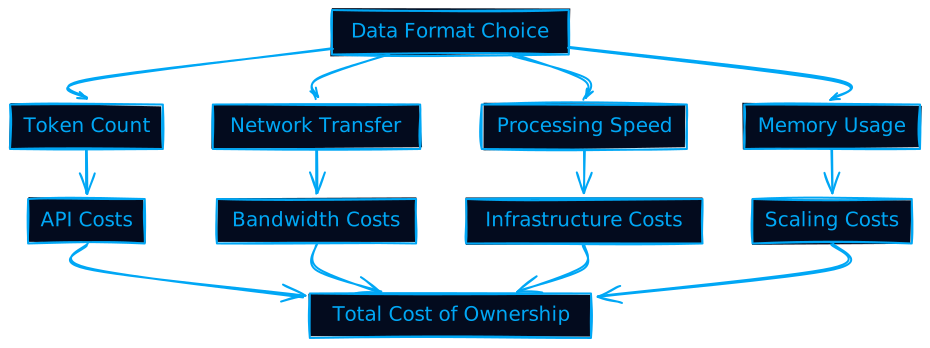
Here's something most developers don't consider: the format you choose has cascading effects beyond just the immediate token count.
Network effects:
- Smaller payloads mean faster transfers
- Reduced bandwidth costs
- Better performance on mobile networks
- Lower latency for real-time applications
Processing effects:
- Less data to parse means faster processing
- Reduced memory usage
- Better cache efficiency
- Improved overall system performance
Maintenance effects:
- Simpler formats are easier to debug
- Fewer parsing errors
- Reduced complexity in data transformation pipelines
The Hybrid Approach: Best of All Worlds
But here's the plot twist - you don't have to choose just one format. Smart developers are adopting a hybrid approach:
- Use JSON for APIs and interoperability - Keep your external interfaces JSON for maximum compatibility
- Use TOON for AI processing - Convert to TOON when feeding data to LLMs
- Use YAML for configuration - Keep human-readable configs in YAML
This approach lets you optimize for different use cases while maintaining compatibility where it matters.
Example architecture:
External API (JSON) → Data Pipeline → AI Processing (TOON) → Results (JSON)
                                ↓
                        Configuration (YAML)
What About Performance? The Benchmarks
Let's address the elephant in the room: parsing performance. JSON has decades of optimization behind it. Every language has highly optimized JSON parsers. TOON is new.
Current benchmarks show:
- JSON parsing: Highly optimized, battle-tested
- YAML parsing: Slower than JSON, but acceptable for most use cases
- TOON parsing: Still evolving, but showing promising results
However, for AI workloads, the token savings often outweigh the parsing overhead. A 40% reduction in tokens can easily compensate for a 10% increase in parsing time, especially when you factor in network transfer savings.
The Ecosystem Question: Tools and Support
JSON's biggest advantage isn't technical - it's ecosystem. Every IDE has JSON support. Every language has JSON libraries. Every developer knows JSON.
TOON is still building its ecosystem:
- Parser libraries: Available for major languages, but still growing
- IDE support: Basic syntax highlighting, but not universal
- Tooling: Limited compared to JSON's vast ecosystem
- Documentation: Growing but not comprehensive
This is the classic chicken-and-egg problem. TOON needs adoption to build ecosystem, but needs ecosystem to drive adoption.
Looking Forward: The Future of Data Formats
The rise of AI is fundamentally changing how we think about data representation. Token efficiency is becoming as important as human readability or parsing speed.
Emerging trends:
- AI-first design patterns where token count is a primary consideration
- Hybrid architectures using different formats for different purposes
- Compression techniques specifically designed for LLM workloads
- Unified representations that work efficiently both in memory and on disk
We're likely to see more specialized formats emerge, each optimized for specific AI use cases. TOON might be just the beginning.
The Real Question: What Should You Do?
If you're building new AI-powered applications, you can't ignore token efficiency anymore. But you also can't ignore interoperability and ecosystem support.
My recommendation:
- Audit your current data flows - Understand where tokens are being consumed
- Identify optimization opportunities - Look for high-volume, repetitive data structures
- Experiment with TOON - Try it in non-critical paths first
- Measure everything - Track token usage, costs, and performance
- Adopt gradually - Use a hybrid approach to minimize risk
The Bottom Line
The data format wars aren't really about which format is "best" - they're about choosing the right tool for the job. JSON isn't going anywhere. YAML has its place. But TOON represents something new: a format designed specifically for the AI era.
The question isn't whether TOON will replace JSON (it won't). The question is whether you can afford to ignore token efficiency in your AI applications (you can't).
In a world where every character costs money, every optimization matters. TOON might just be the optimization you didn't know you needed.
Key takeaways:
- Token efficiency is now a critical architectural consideration
- TOON can reduce token usage by 30-60% compared to JSON
- A hybrid approach often works best in practice
- The ecosystem is still evolving, but early adopters are seeing real benefits
- Your choice of data format has cascading effects on costs and performance
The future belongs to formats that understand the AI era. The question is: are you ready to embrace it?
What's your experience with data format optimization in AI applications? Have you tried TOON or other token-efficient formats? Share your thoughts and let's continue the conversation about building more efficient AI systems.