Graph Engineering for LLM Agents: A Practitioner's Guide to Stateful, Cyclic Workflows
The architecture you choose for your LLM agents isn't just a technical detail; it's a fundamental constraint on what your system can do. As teams push agents beyond simple question-answering into complex, multi-step workflows, an increasingly adopted approach is emerging: engineering agent systems as stateful, cyclic graphs rather than linear chains or even directed acyclic graphs (DAGs).
This shift isn't theoretical. The LangGraph framework, part of the broader LangChain ecosystem (which sees approximately 46.5 million monthly downloads monthly), has demonstrated measurable improvements for complex workflows: 3.6× speed improvements in tool-calling architectures and 36-37% end-to-end time reductions in content generation pipelines. More importantly, cyclic graphs unlock capabilities (self-reflection, conditional retries, human-in-the-loop interventions) that are awkward or impossible to implement in linear chains.
This post is a practitioner deep-dive into graph engineering for LLM agents. We'll examine why graphs beat chains and DAGs, how state and conditional routing work at the code level, what control patterns cycles enable, and what it takes to run these systems durably in production.
Why Graphs Beat Chains and DAGs
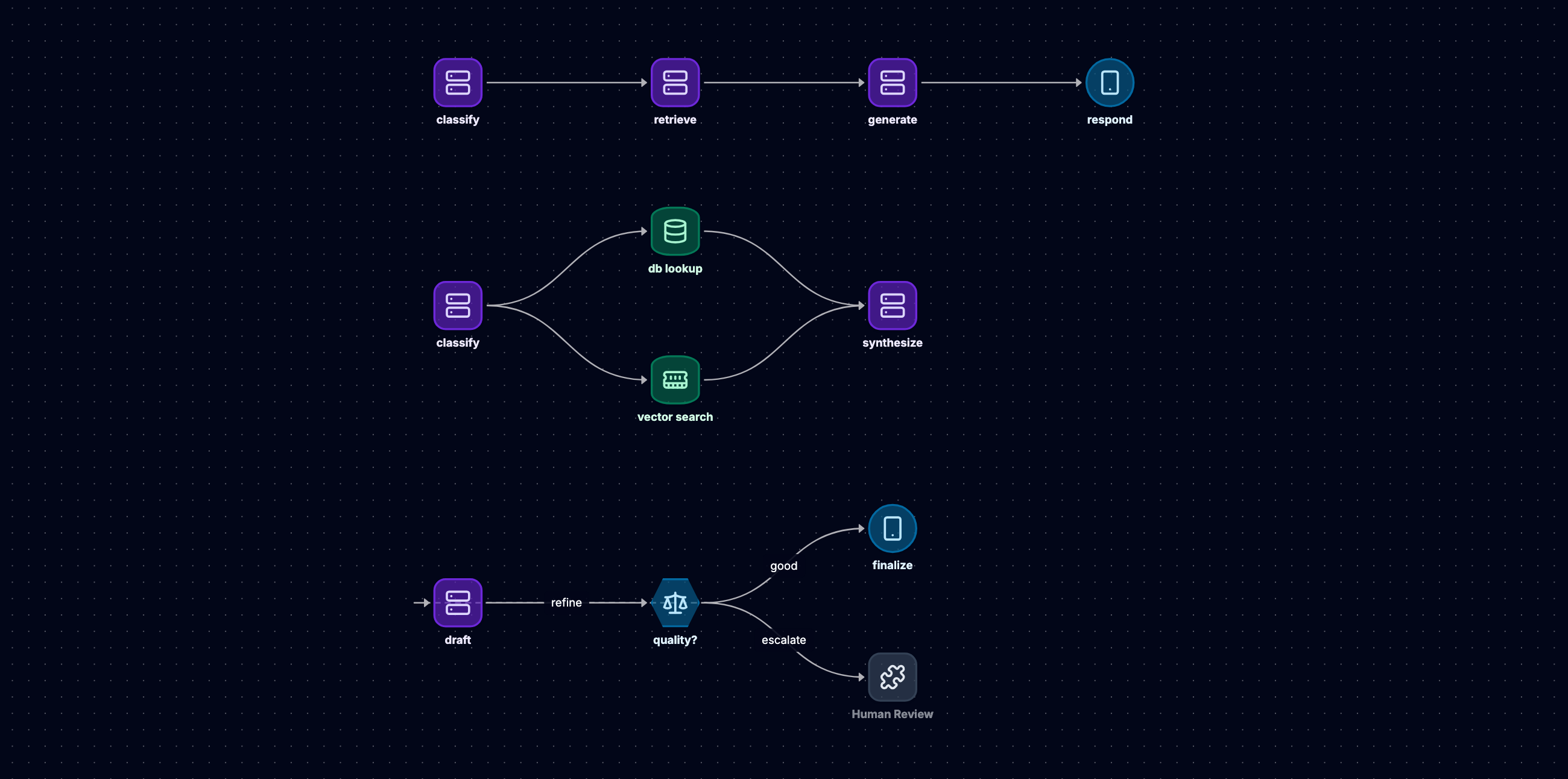
The three execution models differ in exactly one dimension that matters for agents: how flexibly control can flow between steps. Chains are strictly sequential, DAGs allow parallel branches but never loop back, and cyclic graphs can route execution backward based on runtime state.
The Technical Pathologies of Linear Chains
Most early LLM applications followed a simple pattern: chain together a sequence of LLM calls and tool invocations. User query → retrieval → context injection → generation → response. This works for straightforward workflows, but it breaks down quickly under three conditions:
Artificial Serialization: Consider a workflow where step A (query classification) feeds into both step B (database lookup) and step C (vector search), which are independent of each other. A linear chain forces B→C or C→B sequencing even though they could run simultaneously. Individual LLM steps typically take 2-5 seconds, so serializing steps that could have run in parallel adds latency that scales with the number of independent branches.
All-or-Nothing Failure: In a chain, failure at step 4 blocks all downstream operations. There's no mechanism for partial recovery, fallback paths, or conditional routing based on intermediate results. You either succeed completely or fail completely.
Rigid Control Flow: Chains can't express conditional logic without external wrapper code. Want to retry a step if confidence is low? Route to a human reviewer if the output is ambiguous? Iterate on a draft until quality thresholds are met? None of these patterns fit naturally into a linear chain model.
DAGs: Parallelism Without Cycles
DAGs solve the parallelism problem. By expressing workflows as directed acyclic graphs, you can execute independent nodes simultaneously while respecting dependencies. The LLMCompiler architecture demonstrated this with 3.6× speed improvements over sequential execution by expressing tool calls as DAG nodes with simultaneous dispatch.
Implementation examples below are illustrative (specific syntax may vary):
from langgraph.graph import StateGraph

# DAG structure: A feeds both B and C, which feed D
workflow = StateGraph(state_schema)

workflow.add_node("classify", classify_query)
workflow.add_node("db_lookup", database_search)
workflow.add_node("vector_search", vector_search)
workflow.add_node("synthesize", combine_results)

workflow.add_edge("classify", "db_lookup")
workflow.add_edge("classify", "vector_search")
workflow.add_edge("db_lookup", "synthesize")
workflow.add_edge("vector_search", "synthesize")

workflow.set_entry_point("classify")
This DAG executes db_lookup and vector_search in parallel once classify completes. Teams have reported 36-37% end-to-end time reductions in content workflows (1,000-1,500 words) after switching from sequential to parallel node execution.
But DAGs still can't cycle. They can't express "try this, evaluate the result, and if it's not good enough, try again with feedback." That limitation is where cyclic graphs become essential.
Cyclic Graphs: Iteration as First-Class Structure
Cyclic graphs add one critical capability: the ability to route execution back to earlier nodes based on runtime conditions. This unlocks iterative refinement, self-correction, and dynamic replanning: patterns that are fundamental to how we actually want agents to behave.
The difference isn't just architectural elegance. Research testing 9 popular LLMs (including GPT-4, Llama 2 70B, and Gemini 1.5 Pro) with 8 types of self-reflecting agents found aggregate results showing statistically significant gains (p<0.001) in problem-solving performance when agents could reflect on mistakes, generate self-guidance, and re-attempt tasks. These self-reflection loops are cyclic by nature: they require routing back to earlier reasoning steps with updated context.
State and the Graph Model: Nodes, Edges, Conditional Routing
State as Shared Memory
In graph-based agent systems, state is the shared memory structure that persists across node executions. Every node reads from state, performs some operation (LLM call, tool invocation, data transformation), and writes updates back to state.
from typing import TypedDict, Annotated
from operator import add

class AgentState(TypedDict):
    messages: Annotated[list, add]  # Append-only message history
    current_plan: str               # Mutable plan
    iteration_count: int            # Loop counter
    confidence_score: float         # Quality metric
    requires_human_review: bool     # Control flag
This schema defines what information flows through the graph. The Annotated[list, add] pattern is particularly important: it specifies that updates to messages should append rather than replace, ensuring message history accumulates across iterations.
State schema design is critical. Well-structured state prevents data conflicts and ensures nodes have proper context. Poorly designed state leads to subtle bugs where nodes overwrite each other's updates or lack information they need.
Nodes: Discrete Units of Work
Nodes are functions that take state as input and return state updates:
def research_node(state: AgentState) -> dict:
    """Execute research queries and gather information."""
    query = state["current_plan"]

    # LLM call to generate search queries
    search_queries = llm.invoke(
        f"Generate 3 search queries for: {query}"
    )

    # Execute searches (could be parallel)
    results = [search_tool(q) for q in search_queries]

    # Return state updates
    return {
        "messages": [HumanMessage(content=f"Research: {results}")],
        "iteration_count": state["iteration_count"] + 1
    }
Nodes should be modular and focused. A node that does one thing well is easier to test, debug, and reuse than a monolithic node that tries to handle multiple concerns. This modularity improves testing and enables logic reusability across projects.
Conditional Edges: Runtime Routing
Conditional edges are functions that examine state and return the name of the next node to execute:
def quality_check_router(state: AgentState) -> str:
    """Route based on output quality."""
    if state["confidence_score"] > 0.85:
        return "finalize"
    elif state["iteration_count"] < 3:
        return "refine"  # Loop back for another iteration
    else:
        return "human_review"  # Escalate after max retries

workflow.add_conditional_edges(
    "draft",
    quality_check_router,
    {
        "finalize": "finalize_node",
        "refine": "refine_node",
        "human_review": "human_review_node"
    }
)
This creates a cycle: draft → quality_check_router → refine → draft continues until confidence exceeds threshold or iteration limit is reached. Conditional routing as first-class edges encodes failure modes, fallback paths, and escalation branches directly in graph structure rather than burying them in node logic.
Complete Graph Example
from langgraph.graph import StateGraph, END

workflow = StateGraph(AgentState)

# Add nodes
workflow.add_node("plan", planning_node)
workflow.add_node("research", research_node)
workflow.add_node("draft", draft_node)
workflow.add_node("refine", refinement_node)
workflow.add_node("finalize", finalization_node)

# Static edges
workflow.add_edge("plan", "research")
workflow.add_edge("research", "draft")
workflow.add_edge("refine", "draft")  # Cycle back
workflow.add_edge("finalize", END)

# Conditional edge
workflow.add_conditional_edges(
    "draft",
    quality_check_router,
    {
        "finalize": "finalize",
        "refine": "refine",
        "human_review": "human_review"
    }
)

workflow.set_entry_point("plan")
app = workflow.compile()
This graph expresses a complete iterative workflow: plan → research → draft → evaluate quality → (refine and retry) OR (finalize) OR (escalate to human). The cycle enables self-improvement; the conditional routing enables intelligent control flow.
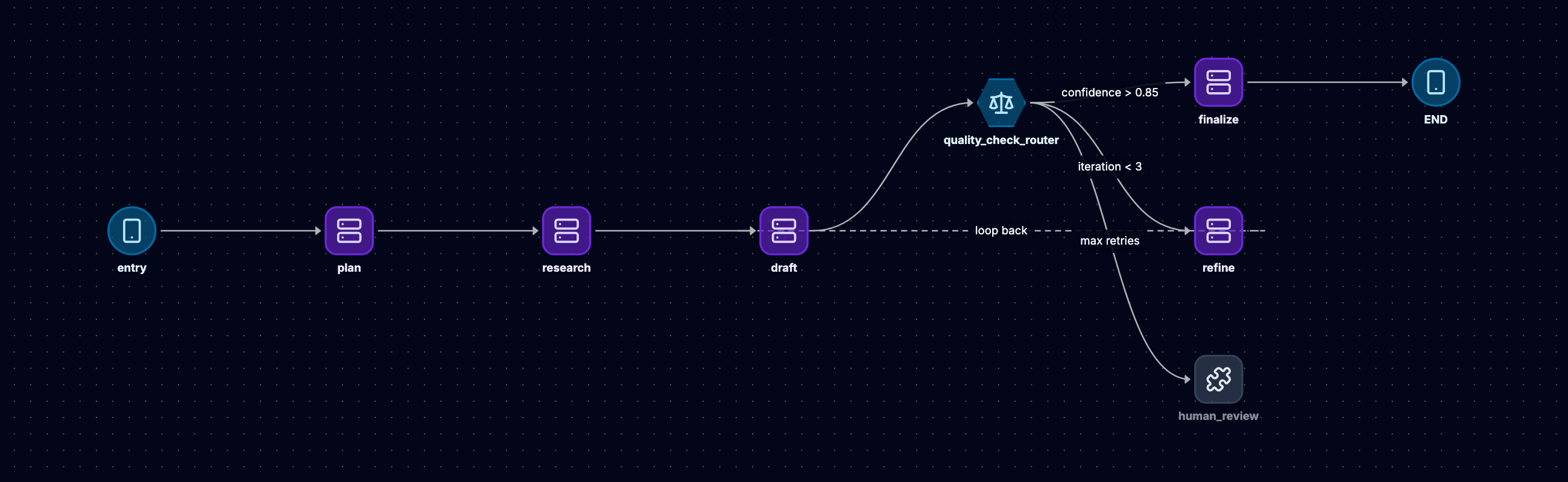
The refine → draft edge is what makes this a graph rather than a DAG: execution loops back to an earlier node, carrying updated state, until the router decides the output is good enough or the retry budget is exhausted.
Cycles, Loops, and Control: Reflection, Retries, Human-in-the-Loop
Self-Reflection Loops
Self-reflection is the pattern where an agent evaluates its own output, identifies errors or weaknesses, and generates guidance for improvement before re-attempting the task. This requires a cycle:
def reflection_node(state: AgentState) -> dict:
    """Analyze draft and generate improvement guidance."""
    draft = state["messages"][-1].content

    reflection_prompt = f"""
    Analyze this draft for:
    - Logical errors or inconsistencies
    - Missing information or weak arguments
    - Clarity and structure issues

    Draft: {draft}

    Provide specific guidance for improvement.
    """

    reflection = llm.invoke(reflection_prompt)

    return {
        "messages": [AIMessage(content=f"Reflection: {reflection}")],
        "current_plan": f"Improve draft based on: {reflection}"
    }

workflow.add_node("reflect", reflection_node)
workflow.add_edge("draft", "reflect")
workflow.add_edge("reflect", "refine")
workflow.add_edge("refine", "draft")  # Complete the cycle
The research evidence for self-reflection is compelling: studies testing multiple LLMs with various self-reflecting agent architectures found aggregate results showing statistically significant gains (p<0.001) in problem-solving performance. Agents reflected on mistakes in incorrectly answered multiple-choice questions, generated self-guidance, and then re-attempted questions with improved results.
The technical mechanism is straightforward: agents produce chain-of-thought reasoning before answering, self-reflection identifies errors in that reasoning (logic errors, mathematical mistakes, hallucinations), and the agent uses that feedback to avoid similar errors in subsequent attempts.
Retry Logic with Backoff
Cycles enable sophisticated retry patterns:
def retry_router(state: AgentState) -> str:
    """Implement exponential backoff for retries."""
    if state.get("error") is None:
        return "success"

    if state["iteration_count"] >= 5:
        return "fail"

    # Exponential backoff: wait before retry
    wait_time = 2 ** state["iteration_count"]
    time.sleep(wait_time)

    return "retry"

workflow.add_conditional_edges(
    "api_call",
    retry_router,
    {
        "success": "process_result",
        "retry": "api_call",  # Cycle back
        "fail": "error_handler"
    }
)
This pattern is impossible to express cleanly in a chain or DAG. The cycle from api_call back to itself, controlled by state-based routing, implements retry logic directly in the graph structure.
Human-in-the-Loop (HITL)
HITL is critical for high-accountability tasks: financial transactions, content approvals, medical decisions. Cyclic graphs support two HITL approaches:
Static Interrupts pause execution at predetermined points:
workflow = StateGraph(AgentState)
# ... add nodes ...

app = workflow.compile(
    interrupt_before=["human_review"],  # Pause before this node
    checkpointer=checkpointer  # Required for persistence
)

# Execution
config = {"configurable": {"thread_id": "user_123"}}
result = app.invoke(initial_state, config)

# Graph pauses at human_review node
# Human reviews state, makes edits
updated_state = modify_state(result)

# Resume execution
final_result = app.invoke(updated_state, config)
Dynamic Interrupts pause based on runtime conditions:
from langgraph.checkpoint import interrupt

def approval_node(state: AgentState) -> dict:
    """Dynamically interrupt if approval needed."""
    if state["requires_approval"]:
        # This pauses execution and returns control
        interrupt("Awaiting human approval")

    return {"approved": True}
The technical foundation for HITL is persistent execution state. The graph maintains checkpoints after each step, so state context persists while the workflow pauses awaiting human feedback. This enables asynchronous human review and state updates without losing execution context.
Durability and Production: Checkpointing, Observability, Multi-Agent Patterns
Checkpointing for State Persistence
Production agent systems must survive crashes, restarts, and failures. Checkpointing saves state after each node execution, enabling recovery and resumption:
from langgraph.checkpoint.postgres import PostgresSaver

# Production-grade checkpointer
checkpointer = PostgresSaver.from_conn_string(
    "postgresql://user:pass@host:5432/db"
)

app = workflow.compile(checkpointer=checkpointer)

# Each execution needs a unique thread_id
config = {"configurable": {"thread_id": "workflow_456"}}

# State is automatically checkpointed after each node
result = app.invoke(initial_state, config)

# If execution fails, resume from last checkpoint
result = app.invoke(None, config)  # Resumes automatically
Production-grade checkpointer options:
- PostgresSaver: For production systems requiring durability and concurrent access
- SQLite: Lightweight option for local development and single-instance deployments
- Redis: For distributed caching scenarios
Critical security note: Recent vulnerabilities highlight the importance of using updated versions:
- CVE-2025-67644 (CVSS 7.3): SQL injection in SQLite checkpointer
- CVE-2025-28277 & CVE-2025-27022: Remote code execution chain vulnerabilities
Required minimum versions:
langgraph-checkpoint-sqlite: 3.0.1+langgraph: 1.0.10+@langchain/langgraph-checkpoint-redis: 1.0.2+
Observability and Debugging
Complex cyclic graphs require visibility into execution:
# Built-in streaming for real-time monitoring
for event in app.stream(initial_state, config):
    node_name = list(event.keys())[0]
    node_output = event[node_name]
    print(f"Node '{node_name}' completed: {node_output}")

# Access full execution history
state_history = app.get_state_history(config)
for checkpoint in state_history:
    print(f"Step {checkpoint.step}: {checkpoint.values}")
LangGraph Studio provides visual debugging: real-time graph visualization showing which nodes are executing, state values at each step, and execution paths through conditional branches. This visibility is essential for debugging cyclic graphs where execution paths depend on runtime state.
Monitoring in production should track:
- Node-level latency (identify bottlenecks)
- Cycle iteration counts (detect infinite loops)
- Conditional branch frequencies (understand actual execution patterns)
- Error rates by node (target improvements)
Multi-Agent Patterns
Cyclic graphs scale to multi-agent systems where specialized agents collaborate:
class MultiAgentState(TypedDict):
    task: str
    researcher_output: str
    analyst_output: str
    writer_output: str
    current_agent: str
    iteration: int

def supervisor_router(state: MultiAgentState) -> str:
    """Supervisor agent routes to specialist agents."""
    if state["iteration"] == 0:
        return "researcher"
    elif state["researcher_output"] and not state["analyst_output"]:
        return "analyst"
    elif state["analyst_output"] and not state["writer_output"]:
        return "writer"
    elif needs_revision(state["writer_output"]):
        return "researcher"  # Cycle back for more research
    else:
        return END

workflow.add_conditional_edges("supervisor", supervisor_router, {
    "researcher": "researcher_agent",
    "analyst": "analyst_agent",
    "writer": "writer_agent",
    END: END
})
This supervisor pattern orchestrates specialized agents in cycles: research → analyze → write → (evaluate) → (research again if needed) OR (complete).

The supervisor sits at the center: every specialist returns control to it, and it decides what runs next based on shared state. The writer → supervisor → researcher path is the cycle that lets the system gather more evidence when a draft falls short.
Common multi-agent workflow (fan-out/fan-in):
- Planning node decomposes task into subtasks
- 3-10 worker nodes execute subtasks in parallel
- Synthesis node collects and combines outputs
- Covers many research and analysis workflows
Real-world implementations include:
- Software Development (Replit): Self-correcting code assistants that scale complex software builds through iterative refinement cycles
- Financial Services: Agents that analyze market sentiment and execute trades based on real-time trends, with human approval loops for high-value transactions
- Healthcare: Medical assistants managing patient records and providing symptom information, with mandatory human review for clinical decisions
Production Checklist Essentials
Before deploying cyclic agent graphs to production:
- Explicit state schemas that control information sharing and prevent conflicts
- Cycle limits to prevent infinite loops (max iterations per cycle)
- Token budgets (~200,000 tokens recommended for enterprise applications)
- Checkpoint strategy with appropriate persistence backend
- Error handling for each node with fallback paths
- Monitoring for latency, accuracy, and execution patterns
Conclusion
The shift from linear chains to cyclic graphs represents a measurable improvement for complex agent workflows. The data is clear: 3.6× speed improvements from parallelization, 36-37% time reductions in production content pipelines, and statistically significant gains (p<0.001) from self-reflection capabilities.
But the real value isn't just performance; it's capability. Cyclic graphs make iterative refinement, conditional routing, and human-in-the-loop interventions first-class architectural patterns rather than awkward workarounds. They let you express agent behavior as it should be: adaptive, self-correcting, and intelligently routed based on runtime conditions.
The engineering challenges are real: state management, cycle control, checkpointing, observability. But these are solved problems. The LangGraph framework (part of an ecosystem with approximately 46.5 million monthly downloads) provides production-ready primitives for building stateful, cyclic agent systems.
As you build your next agent system, ask: does this workflow need to iterate? Does it need conditional routing based on intermediate results? Does it need human oversight at critical decision points? If the answer to any of these is yes, linear chains won't cut it. You need graphs, and specifically, you need cycles.
The graph model isn't just a better abstraction. For complex agent workflows, it's the architecture that makes sophisticated behavior possible.
For practitioners looking to implement these patterns, start with modular state schemas, build simple cycles before complex multi-agent systems, and instrument everything for observability. The tooling is mature, the patterns are proven, and the performance benefits are measurable.