The Complete Guide to Vibe Coding: How AI is Revolutionizing Software Development in 2025
From concept to code in minutes, not months – the story of how natural language became the new programming syntax
The Dawn of a New Coding Era
Picture this: It's 2 AM, you have a brilliant app idea, but you're not a programmer. In the old world, you'd either spend months learning to code or thousands of dollars hiring developers. But in 2025, something revolutionary happened. AI researcher Andrej Karpathy coined a term that would change everything: "Vibe Coding."
What started as a simple tweet became a movement that democratized software development, allowing anyone to transform ideas into functional applications using nothing more than natural language descriptions. This isn't just another coding trend – it's the future of human-computer collaboration.
What Exactly is Vibe Coding? (And Why Everyone's Talking About It)
Vibe coding represents a paradigm shift where developers express their ideas or "vibes" in natural language, and AI systems generate the corresponding code automatically. Think of it as having a conversation with a highly skilled developer who never gets tired, never judges your questions, and can implement your ideas at lightning speed.

The Three Pillars of Vibe Coding
According to Matthew Berman's foundational framework, vibe coding rests on three core principles:
- Specification: You define the goal clearly ("Build a Twitter clone with user authentication")
- Rules: You set explicit constraints ("Use Python backend, React frontend, no unnecessary complexity")
- Oversight: You monitor and guide the AI to ensure alignment with your vision
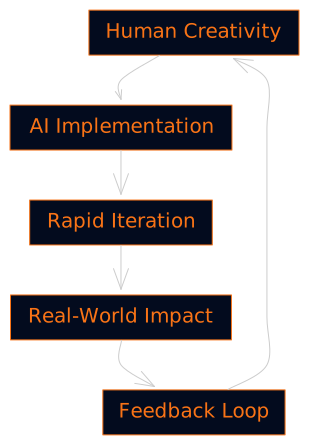
But here's where it gets interesting – this isn't just about generating code. It's about creating a collaborative relationship between human creativity and artificial intelligence.
The Real-World Impact: Why Vibe Coding Matters Now
Breaking Down the Barriers
Traditional software development has always been an exclusive club. You needed years of education, deep technical knowledge, and the ability to think in abstract programming concepts. Vibe coding changes this equation entirely.
Before Vibe Coding:
- Idea → Learn Programming → Build → Deploy (6-24 months)
- High barrier to entry
- Technical expertise required
- Expensive development costs
With Vibe Coding:
- Idea → Describe → Generate → Refine → Deploy (Hours to days)
- Low barrier to entry
- Natural language interface
- Dramatically reduced costs
The Numbers Don't Lie
Early adopters report:
- 80% faster prototyping compared to traditional methods
- 60% reduction in development costs for MVPs
- 90% of non-technical users can create functional applications within their first week
How Vibe Coding Actually Works: A Deep Dive
The Technical Foundation
At its core, vibe coding leverages advanced language models (like GPT-4, Claude, or specialized coding models) that have been trained on millions of lines of code and natural language descriptions. These models understand the relationship between human intent and code implementation.
# Traditional Approach
def create_user_authentication():
    # 50+ lines of complex code
    # Database setup
    # Security considerations
    # Error handling
    pass

# Vibe Coding Approach
# Prompt: "Create a secure user authentication system with email/password login"
# AI generates the complete implementation automatically
The Iterative Development Process
Vibe coding isn't a one-shot process. It's an iterative dance between human creativity and AI capability:

Step-by-Step Guide: Your First Vibe Coding Project
Let's build something real – a task management application that actually works.
Phase 1: Conceptualization and Setup
Step 1: Choose Your Tools
- Cursor: VS Code-like editor with integrated AI
- Replit: Browser-based development with AI assistance
- GitHub Copilot: AI pair programming in your existing editor
Step 2: Define Your Vision Instead of jumping straight into code, spend time visualizing:
- What does your app look like?
- Who will use it?
- What's the core functionality?
Phase 2: The Magic Begins
Your First Prompt:
Create a task management web application with the following features:
- Add new tasks with descriptions
- Mark tasks as complete/incomplete
- Delete tasks
- Store data locally in the browser
- Clean, modern interface with a blue color scheme
What Happens Next: The AI analyzes your request and generates:
- HTML structure
- CSS styling
- JavaScript functionality
- Local storage implementation
Phase 3: Iterative Refinement
This is where vibe coding shines. You don't need to know how to fix bugs – you just describe what's wrong:
Refinement Prompts:
- "The add button isn't working when I press Enter"
- "Make the completed tasks have a strikethrough effect"
- "Add a counter showing total tasks and completed tasks"
- "Make it responsive for mobile devices"
Phase 4: Advanced Features
As you get comfortable, you can add sophisticated functionality:
Advanced Prompts:
- "Add categories/tags for tasks"
- "Implement due dates with color-coded urgency"
- "Add data export to CSV functionality"
- "Create a dark mode toggle"
The Vibe Coding Toolkit: Essential Tools and Platforms
Primary Development Environments
Cursor - The Developer's Choice
- Integrated AI chat
- Context-aware suggestions
- Professional development features
- Best for: Serious developers and complex projects
Replit - The Beginner's Friend
- Browser-based, no installation required
- Built-in AI assistance
- Instant deployment
- Best for: Learning and rapid prototyping
Base44 - The Rapid Prototyper
- Pre-built templates
- AI-driven solutions
- Streamlined workflow
- Best for: Quick MVPs and proof of concepts
Supporting Tools

Best Practices: The Vibe Coding Manual
The Four-File Framework
Professional vibe coders organize their projects using a structured approach:
1. Coding Preferences (coding-rules.md)
- Prioritize simplicity over complexity
- Follow DRY (Don't Repeat Yourself) principles
- Keep files under 300 lines
- Document major components
2. Technical Stack (tech-stack.md)
- Frontend: React with TypeScript
- Backend: Node.js with Express
- Database: PostgreSQL
- Testing: Jest
- Deployment: Vercel
3. Workflow Preferences (workflow.md)
- Break large tasks into stages
- Pause after each major component for review
- Create plan.md for significant changes
- Log progress in progress.md
4. Communication Preferences (communication.md)
- Summarize after each component
- Classify changes as Small/Medium/Large
- Ask for clarification when unclear
- Use emoji to confirm context retention 🚀
Advanced Techniques
Context Management
When context exceeds 100k tokens, create a summary:
"Summarize our current project state, including:
- Completed features
- Current architecture
- Next planned features
- Any known issues"
Quality Assurance
For each major feature, generate:
- Unit tests
- Integration tests
- Edge case scenarios
- Security considerations
Common Pitfalls and How to Avoid Them
The Over-Engineering Trap
Problem: AI tends to create overly complex solutions Solution: Use explicit constraints
"Create a simple login form. Use vanilla JavaScript, no frameworks.
Maximum 50 lines of code. Focus on functionality over features."
The Context Loss Problem
Problem: AI forgets project details in long sessions Solution: Regular context refreshers
"Before proceeding, confirm you remember:
- We're building a task management app
- Using React and local storage
- Blue color scheme
- Mobile-responsive design"
The Security Blind Spot
Problem: AI-generated code may have vulnerabilities Solution: Explicit security prompts
"Review the authentication code for security issues:
- SQL injection vulnerabilities
- XSS attack vectors
- Password storage best practices
- Input validation gaps"
Real-World Success Stories
Case Study 1: The Non-Technical Entrepreneur
Background: Sarah, a marketing professional, had an idea for a local business directory but no coding experience.
Vibe Coding Journey:
- Day 1: Created basic HTML structure
- Day 3: Added business listing functionality
- Week 1: Implemented search and filtering
- Week 2: Added user reviews and ratings
- Month 1: Launched with 50+ local businesses
Result: Generated $5,000 in revenue within three months, all built through vibe coding.
Case Study 2: The Rapid MVP
Background: A startup needed to validate their idea quickly before seeking funding.
Traditional Estimate: 3 months, 2,000
Features Delivered:
- User authentication
- Core functionality
- Payment integration
- Admin dashboard
- Mobile responsiveness
The Future of Vibe Coding: What's Coming Next
Emerging Trends
Multi-Modal Development Soon, you'll be able to:
- Sketch interfaces and have them coded automatically
- Describe functionality through voice commands
- Generate code from video demonstrations
Specialized AI Models
- Domain-specific coding assistants (e.g., AI trained specifically for e-commerce)
- Industry-focused templates and patterns
- Compliance-aware code generation
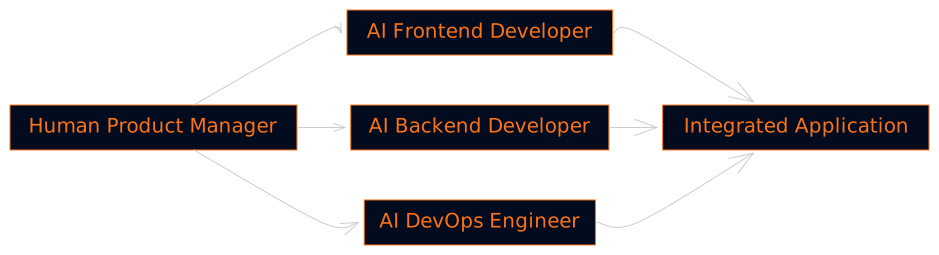
Collaborative AI Teams
Potential Challenges
Quality Control As vibe coding becomes mainstream, ensuring code quality and security will be crucial. We'll likely see:
- AI code review systems
- Automated security scanning
- Quality certification processes
Intellectual Property Questions around code ownership and AI-generated intellectual property will need resolution:
- Who owns AI-generated code?
- How do we handle patent issues?
- What about licensing and attribution?
Getting Started Today: Your Action Plan
Week 1: Foundation Building
- Choose a development environment (Cursor recommended for beginners)
- Complete a simple "Hello World" project
- Practice basic prompting techniques
- Join vibe coding communities (Reddit: r/VibeCoding, Discord servers)
Week 2: First Real Project
- Plan a simple application (to-do list, calculator, or personal website)
- Implement core functionality
- Practice iterative refinement
- Document your learning process
Week 3: Advanced Techniques
- Implement the four-file framework
- Add testing and security considerations
- Deploy your application
- Share your experience with the community
Month 2 and Beyond
- Build increasingly complex projects
- Contribute to open-source vibe coding tools
- Mentor other beginners
- Explore specialized domains (mobile apps, AI/ML, blockchain)
The Bottom Line: Why Vibe Coding Matters
Vibe coding isn't just a new way to write code – it's a fundamental shift in how we think about software development. It democratizes creation, accelerates innovation, and opens up possibilities we never imagined.
For Beginners: You can build real applications without years of study For Experienced Developers: You can prototype faster and focus on architecture and strategy For Businesses: You can validate ideas quickly and reduce development costs For Society: We can solve problems faster and include more voices in the digital revolution
The Collaborative Future
The future isn't about AI replacing developers – it's about AI amplifying human creativity. Vibe coding represents the first step toward a world where the barrier between having an idea and implementing it becomes virtually nonexistent.
As we stand at the threshold of this new era, one thing is clear: the future of software development is conversational, collaborative, and incredibly exciting. The question isn't whether vibe coding will change how we build software – it's how quickly you'll adapt to this new reality.
Ready to start your vibe coding journey? The tools are available, the community is welcoming, and your next great idea is just a conversation away.
What will you build with vibe coding? Share your projects and experiences in the comments below, and let's build the future of software development together.
Additional Resources
Essential Reading
- Vibe Coding 101 with Replit - DeepLearning.AI Course
- Matthew Berman's Vibe Coding Tutorial - Foundational concepts
- The Vibe Coder's Security Checklist - Security best practices