The Complete Guide to Fault Tolerance in Modern Software Architecture
The Complete Guide to Fault Tolerance in Modern Software Architecture
Ever wondered why Netflix keeps streaming even when servers crash, or how your bank processes millions of transactions without missing a beat? The secret sauce is fault tolerance, and it's way more fascinating than you might think.
What Is Fault Tolerance and Why Should You Care?
Picture this: you're running a critical system that handles thousands of requests per second. Suddenly, a server dies, a network cable gets unplugged, or someone accidentally deletes a database table. In a world without fault tolerance, your system would crash harder than a Windows 95 machine trying to run Cyberpunk 2077.
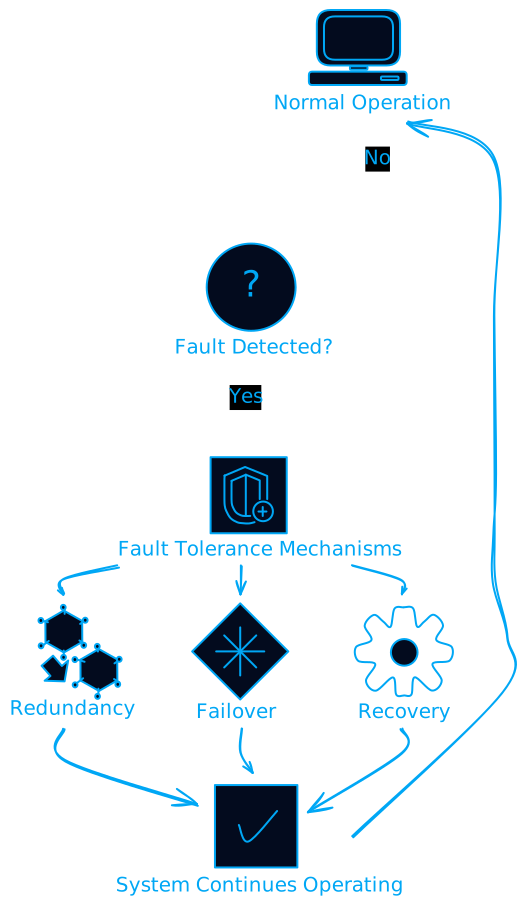
Fault tolerance is basically your system's ability to keep working even when things go wrong. And trust me, things WILL go wrong. It's not a matter of if, but when. The question is: will your system gracefully handle the chaos, or will it crumble like a house of cards?
The Core Techniques That Keep Systems Alive
Redundancy and Replication: Your Digital Insurance Policy
Think of redundancy like having multiple spare tires in your car. If one fails, you've got backups ready to roll. In software systems, this means running multiple instances of critical components across different servers, data centers, or even geographic regions.
But here's where it gets interesting: not all redundancy is created equal. You've got:
- Active-Active: All instances handle traffic simultaneously (like having multiple cashiers at a busy store)
- Active-Passive: One instance handles traffic while others wait on standby (like having a backup quarterback)
- N+1 Redundancy: You have one extra instance beyond what you need (because math is beautiful)
// Simple example of client-side failover logic
class FaultTolerantClient {
    constructor(endpoints) {
        this.endpoints = endpoints;
        this.currentIndex = 0;
    }

    async makeRequest(data) {
        for (let attempt = 0; attempt < this.endpoints.length; attempt++) {
            try {
                const response = await fetch(this.endpoints[this.currentIndex], {
                    method: 'POST',
                    body: JSON.stringify(data)
                });
                return response;
            } catch (error) {
                console.log(`Endpoint ${this.currentIndex} failed, trying next...`);
                this.currentIndex = (this.currentIndex + 1) % this.endpoints.length;
            }
        }
        throw new Error('All endpoints failed');
    }
}
Load Balancing and Failover: The Traffic Directors
Load balancers are like really smart traffic cops. They direct incoming requests to healthy servers and automatically reroute traffic when something goes wrong. But here's the kicker: modern load balancers are way smarter than just round-robin distribution.
They can:
- Monitor server health in real-time
- Detect slow responses and route around them
- Implement circuit breakers to prevent cascade failures
- Use weighted routing based on server capacity
Checkpointing and Rollback Recovery: Time Travel for Systems
Imagine if you could save your game progress and reload from a checkpoint when you die. That's essentially what checkpointing does for distributed systems. It periodically saves the system state so you can roll back to a known good state when things go sideways.
This is particularly crucial for long-running computations or complex transactions where starting over would be prohibitively expensive.
class CheckpointManager:
    def __init__(self, checkpoint_interval=300):  # 5 minutes
        self.checkpoint_interval = checkpoint_interval
        self.last_checkpoint = time.time()
        self.state_history = []

    def save_checkpoint(self, system_state):
        if time.time() - self.last_checkpoint >= self.checkpoint_interval:
            self.state_history.append({
                'timestamp': time.time(),
                'state': copy.deepcopy(system_state)
            })
            self.last_checkpoint = time.time()
            # Keep only last 10 checkpoints
            self.state_history = self.state_history[-10:]

    def rollback_to_checkpoint(self, steps_back=1):
        if len(self.state_history) >= steps_back:
            return self.state_history[-steps_back]['state']
        return None
Hardware-Level Fault Tolerance: When Silicon Gets Smart
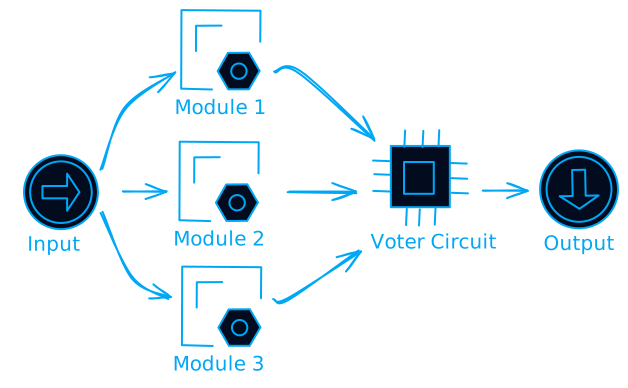
Triple Modular Redundancy (TMR): The Democracy of Computing
TMR is like having three judges vote on every decision. If one judge goes rogue (hardware failure), the other two can outvote them. This technique is used in mission-critical systems like spacecraft and nuclear power plants where failure isn't just inconvenient, it's catastrophic.
Error Detection and Correction Codes: The Spell Checkers of Computing
ECC memory is like having a really good spell checker that not only finds typos but fixes them automatically. These codes add extra bits to data that can detect and correct single-bit errors, or detect (but not correct) multi-bit errors.
Fun fact: Your smartphone probably uses ECC in its storage controller, and you never even knew it was silently fixing data corruption in the background.
Watchdog Timers: The Digital Heartbeat Monitors
A watchdog timer is like having a friend check on you every few minutes. If you don't respond, they assume something's wrong and take action. In computing terms, if a process doesn't "pet the watchdog" within a specified time, the system assumes it's hung and restarts it.
// Simple watchdog implementation
#include <signal.h>
#include <unistd.h>

volatile int watchdog_counter = 0;

void watchdog_handler(int sig) {
    if (watchdog_counter == 0) {
        // Process hasn't reset the counter - assume it's hung
        printf("Watchdog timeout! Restarting process...\n");
        exit(1);
    }
    watchdog_counter = 0;  // Reset counter
    alarm(5);  // Set next alarm in 5 seconds
}

void pet_watchdog() {
    watchdog_counter = 1;  // Reset the watchdog
}
Software-Based Fault Tolerance: When Code Gets Clever
N-Version Programming: The Wisdom of Crowds
Imagine asking three different programmers to solve the same problem independently. They'll probably come up with three different solutions. N-Version Programming leverages this diversity by running multiple implementations simultaneously and comparing their outputs.
The catch? This approach is expensive and assumes that different implementations will fail independently. Sometimes they don't, especially if all programmers make the same logical error.
Recovery Blocks: The Backup Plan's Backup Plan
Recovery blocks are like having a primary plan, a backup plan, and a backup to your backup plan. The system tries the primary implementation first. If it fails an acceptance test, it tries the backup. If that fails, it tries the tertiary backup, and so on.
class RecoveryBlock:
    def __init__(self):
        self.implementations = []
        self.acceptance_test = None

    def add_implementation(self, func):
        self.implementations.append(func)

    def set_acceptance_test(self, test_func):
        self.acceptance_test = test_func

    def execute(self, *args, **kwargs):
        for i, impl in enumerate(self.implementations):
            try:
                result = impl(*args, **kwargs)
                if self.acceptance_test and self.acceptance_test(result):
                    return result
                elif not self.acceptance_test:
                    return result
            except Exception as e:
                print(f"Implementation {i} failed: {e}")
                continue

        raise Exception("All implementations failed")
Best Practices: Building Fault Tolerance That Actually Works
Embrace the Chaos: Circuit Breakers and Fallback Mechanisms
Circuit breakers are like the electrical breakers in your house. When they detect a problem (like too many failed requests), they "trip" and stop sending traffic to the failing service. This prevents cascade failures where one failing service brings down everything else.
class CircuitBreaker {
    constructor(threshold = 5, timeout = 60000) {
        this.threshold = threshold;
        this.timeout = timeout;
        this.failureCount = 0;
        this.lastFailureTime = null;
        this.state = 'CLOSED'; // CLOSED, OPEN, HALF_OPEN
    }

    async call(fn) {
        if (this.state === 'OPEN') {
            if (Date.now() - this.lastFailureTime > this.timeout) {
                this.state = 'HALF_OPEN';
            } else {
                throw new Error('Circuit breaker is OPEN');
            }
        }

        try {
            const result = await fn();
            this.onSuccess();
            return result;
        } catch (error) {
            this.onFailure();
            throw error;
        }
    }

    onSuccess() {
        this.failureCount = 0;
        this.state = 'CLOSED';
    }

    onFailure() {
        this.failureCount++;
        this.lastFailureTime = Date.now();

        if (this.failureCount >= this.threshold) {
            this.state = 'OPEN';
        }
    }
}
Monitoring and Alerting: Your System's Nervous System
You can't fix what you can't see. Comprehensive monitoring is like having sensors throughout your system that constantly report on health, performance, and potential issues. But here's the thing: too many alerts and you'll suffer from alert fatigue. Too few, and you'll miss critical issues.
The golden rule: Alert on symptoms that affect users, not just on internal metrics that might not matter.
Chaos Engineering: Breaking Things on Purpose
This might sound crazy, but intentionally breaking parts of your system in controlled ways helps you understand how it behaves under stress. Netflix pioneered this with their "Chaos Monkey" tool that randomly terminates services in production.
Why does this work? Because it forces you to build systems that can handle failures gracefully, and it reveals weaknesses before they cause real outages.
Real-World Applications: Where Fault Tolerance Saves the Day
Financial Systems: When Every Millisecond Counts
Banks and trading systems use multiple layers of fault tolerance:
- Geographic redundancy across data centers
- Real-time data replication
- Automated failover with sub-second recovery times
- Extensive audit trails for regulatory compliance
Aerospace and Defense: When Failure Isn't an Option
Space missions and military systems often use:
- Triple modular redundancy for critical computations
- Radiation-hardened components
- Formal verification methods to prove correctness
- Extensive testing in simulated failure conditions
Cloud Services: Keeping the Internet Running
Major cloud providers implement fault tolerance through:
- Multi-region deployments
- Automated scaling and healing
- Microservices architectures that isolate failures
- Sophisticated load balancing and traffic management
Common Pitfalls and How to Avoid Them
The Shared Fate Problem
What is it? When your "redundant" systems all depend on the same underlying infrastructure or have the same bugs.
How to avoid it: True diversity in implementation, infrastructure, and even teams building the systems.
Over-Engineering vs. Under-Engineering
The trap: Either building so much fault tolerance that your system becomes impossibly complex, or building so little that it fails at the first sign of trouble.
The solution: Start with understanding your actual requirements. What's your acceptable downtime? What's the cost of failure? Build accordingly.
Testing in Production (The Right Way)
The problem: Many fault tolerance mechanisms only get tested when real failures occur.
The solution: Implement chaos engineering practices and regularly test your failure scenarios in controlled ways.
The Future of Fault Tolerance
AI-Powered Fault Detection
Machine learning is increasingly being used to predict failures before they happen, analyze patterns in system behavior, and automatically adjust fault tolerance mechanisms.
Edge Computing Challenges
As computing moves closer to users through edge deployments, fault tolerance becomes more complex because you have more points of failure but potentially less infrastructure redundancy.
Quantum Computing Considerations
Quantum systems are inherently more fragile than classical computers, requiring entirely new approaches to fault tolerance that account for quantum decoherence and error rates.
Wrapping Up: Your Fault Tolerance Action Plan
Building fault-tolerant systems isn't just about adding more servers or implementing fancy algorithms. It's about understanding your system's failure modes, designing for graceful degradation, and continuously testing and improving your resilience.
Start here:
- Identify your single points of failure
- Implement basic redundancy for critical components
- Add monitoring and alerting
- Test failure scenarios regularly
- Gradually add more sophisticated techniques as needed
Remember, fault tolerance isn't a destination, it's a journey. Systems evolve, requirements change, and new failure modes emerge. The key is building a culture of resilience where fault tolerance is considered from day one, not bolted on as an afterthought.
The bottom line? In today's interconnected world, fault tolerance isn't optional. It's the difference between systems that merely work and systems that keep working when everything else falls apart. And in a world where downtime can cost millions per minute, that difference is everything.
Want to dive deeper into fault tolerance? Check out the Netflix Tech Blog for real-world chaos engineering examples, or explore the AWS Well-Architected Framework for cloud-native fault tolerance patterns. The rabbit hole goes deep, and it's fascinating all the way down.