Bias in AI Systems - Detection, Mitigation, and Real-World Impacts
Introduction
Artificial Intelligence (AI) systems have become increasingly prevalent in various domains, from healthcare and finance to education and criminal justice. While these systems offer numerous benefits, such as improved efficiency and decision-making, they also pose significant risks if not developed and deployed responsibly. One of the most pressing concerns is the potential for AI bias, which can lead to discriminatory or unfair outcomes for certain groups based on characteristics like race, gender, age, or socioeconomic status.
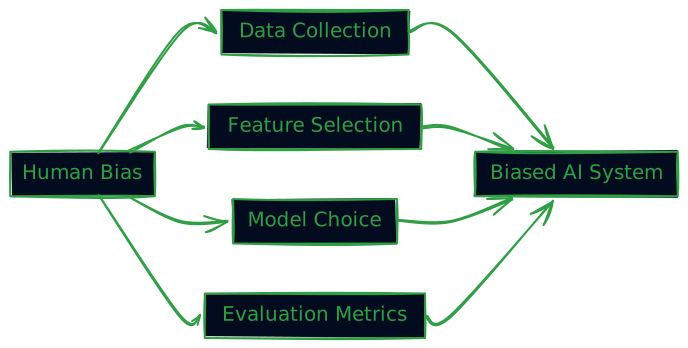
AI bias can originate from various sources, including biased training data, algorithmic design flaws, and human biases during development and deployment. If the data used to train an AI model is skewed or lacks diversity, the model may learn and perpetuate those biases, leading to inaccurate or discriminatory outputs. Additionally, the choice of algorithm, model architecture, or feature selection can introduce biases into AI systems, amplifying existing societal biases or exhibiting unfair treatment of certain groups.
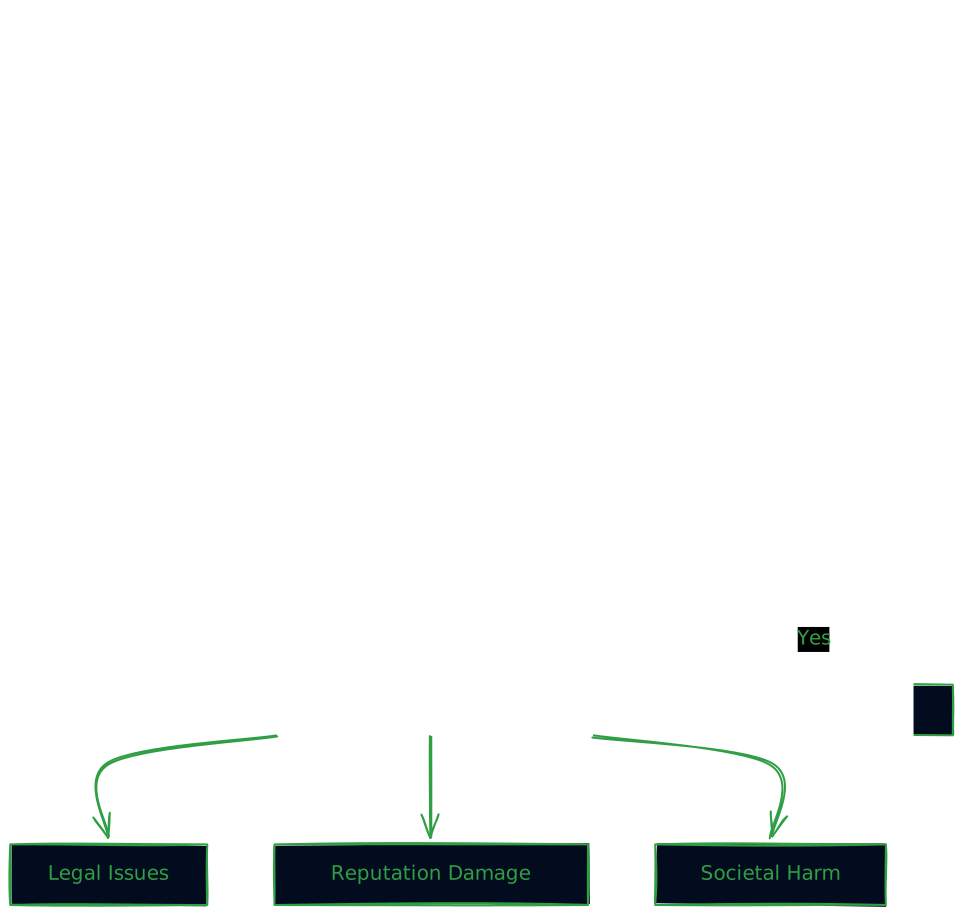
The real-world impacts of AI bias can be severe and far-reaching, perpetuating societal biases, exacerbating existing inequalities, undermining trust in AI systems, and hindering the adoption of these technologies. For instance, biased healthcare algorithms have been found to prioritize care for white patients over black patients, potentially leading to disparities in health outcomes. Similarly, biased hiring algorithms can discriminate against certain candidates based on their gender, race, or other protected characteristics, hindering diversity and inclusion efforts.
Addressing AI bias is a multifaceted challenge that requires a combination of technical solutions, ethical considerations, and ongoing vigilance. Ensuring diverse and representative training data, developing algorithmic debiasing techniques, promoting transparency and accountability, and involving diverse stakeholders throughout the AI development lifecycle are crucial steps in mitigating bias and fostering fair and inclusive AI systems.
Understanding AI Bias
Defining AI Bias
AI bias refers to the systematic errors or unfair outcomes that can arise in artificial intelligence systems due to various factors, such as biased training data, algorithmic design, or human biases during development and deployment. It can lead to discriminatory or unfair treatment of certain groups based on characteristics like race, gender, age, or socioeconomic status.
Sources of AI Bias
AI bias can originate from various sources, including:
Biased Training Data
If the data used to train an AI model is biased or lacks diversity, the model may learn and perpetuate those biases. For example, if the training data for a facial recognition system primarily consists of images of white individuals, the system may perform poorly or exhibit biases when recognizing individuals from other racial groups.
Algorithmic Bias
The choice of algorithm, model architecture, or feature selection can introduce biases into AI systems. Some algorithms may be more prone to amplifying existing biases or exhibiting unfair treatment of certain groups.
Human Bias
Human biases can be introduced during the development, deployment, or interpretation of AI systems. Developers' unconscious biases may influence the design choices or evaluation criteria, leading to biased outcomes.
Real-World Impacts of AI Bias
AI bias can have significant real-world consequences, including:
Discrimination in Healthcare
An algorithm used in US hospitals to predict which patients would need extra medical care heavily favored white patients over black patients, even though race was not an explicit input. This bias could lead to unequal access to healthcare and potentially worse health outcomes for certain groups.
Biased Hiring Practices
AI systems used in hiring processes have been found to exhibit biases against certain groups, such as women or racial minorities. This can perpetuate discrimination and limit opportunities for qualified candidates.
Unfair Judicial Decisions
The COMPAS algorithm used in US court systems to predict the likelihood of recidivism was found to exhibit racial biases, with higher false positive rates for black offenders compared to white offenders. This could lead to unfair sentencing and disproportionate incarceration rates.
Mitigating AI Bias
Addressing AI bias requires a multi-faceted approach, including:
Diverse and Representative Data
Ensuring that the training data for AI models is diverse, representative, and free from biases is crucial. This can involve techniques like data augmentation, resampling, or collecting additional data from underrepresented groups.
Algorithmic Debiasing
Researchers and developers are exploring various algorithmic techniques to mitigate biases, such as adversarial debiasing, causal reasoning, and fairness-aware machine learning algorithms. These approaches aim to reduce biases during the model training and inference stages.
Human Oversight and Auditing
Involving diverse teams of experts, including ethicists, social scientists, and domain experts, can help identify and address biases throughout the AI development lifecycle. Regular audits and bias testing should be conducted to monitor and mitigate potential biases.
Transparency and Accountability
Promoting transparency and accountability in AI systems is essential for identifying and addressing biases. This can involve documenting the data sources, algorithms, and decision-making processes, as well as establishing clear governance frameworks and reporting mechanisms.
Continuous Monitoring and Improvement
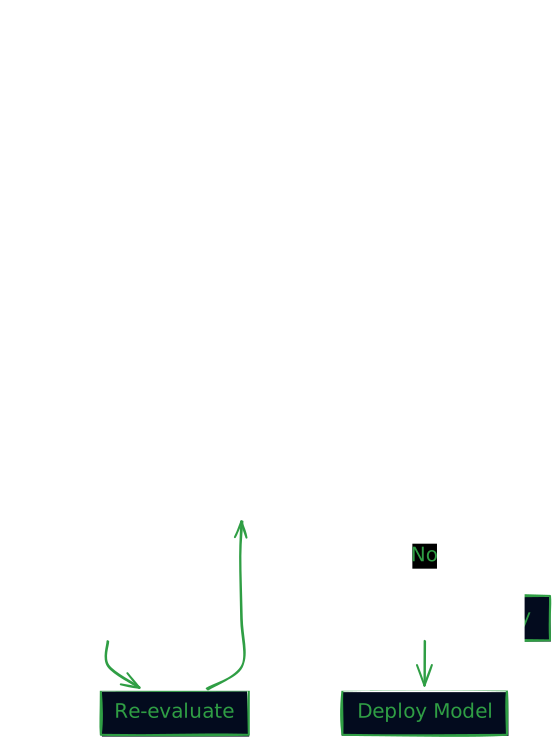
As AI systems are deployed and used in real-world scenarios, it is crucial to continuously monitor their performance and outcomes for potential biases. Feedback loops and iterative improvements should be implemented to address any identified biases and ensure fairness and equity over time.
By addressing AI bias through a combination of technical solutions, ethical considerations, and ongoing vigilance, we can work towards developing AI systems that are fair, inclusive, and beneficial to society as a whole.
Real-World Impacts of AI Bias
Perpetuating Societal Biases and Discrimination
Biased AI systems can perpetuate and amplify existing societal biases and discrimination, leading to harmful real-world consequences. For instance, biased facial recognition systems have been shown to have higher error rates for individuals from certain racial or ethnic groups, potentially leading to wrongful arrests or denials of services. Similarly, biased hiring algorithms can discriminate against certain candidates based on their gender, race, or other protected characteristics, hindering diversity and inclusion efforts.
Exacerbating Existing Inequalities
AI bias can exacerbate existing inequalities in various domains, such as healthcare, education, and financial services. For example, biased healthcare algorithms have been found to prioritize care for White patients over Black patients, potentially leading to disparities in health outcomes. In education, biased AI-powered grading systems or admissions algorithms can disadvantage students from underrepresented backgrounds, further widening the achievement gap.
Undermining Trust and Accountability
The presence of bias in AI systems can undermine public trust in these technologies and the organizations that deploy them. When AI systems produce biased or discriminatory outputs, it can erode confidence in their fairness and reliability, potentially leading to backlash and legal challenges. Additionally, the opaque nature of many AI models can make it difficult to hold developers and deployers accountable for the biases and harms caused by their systems.
Economic and Reputational Consequences
AI bias can also have significant economic and reputational consequences for organizations that fail to address it. Companies that deploy biased AI systems may face legal liabilities, fines, and reputational damage, which can ultimately impact their bottom line. For instance, in 2019, the U.S. Department of Housing and Urban Development (HUD) charged Facebook with violating the Fair Housing Act by allowing advertisers to discriminate based on race, religion, and other protected characteristics.
Eroding Public Trust and Hindering Adoption
The real-world impacts of AI bias can also hinder the adoption and acceptance of these technologies by the general public. If individuals perceive AI systems as biased or unfair, they may be less likely to trust or use them, potentially limiting the benefits and potential of these technologies. This can create a vicious cycle, where biased AI systems erode public trust, leading to lower adoption rates, which in turn can limit the availability of diverse data needed to mitigate biases.
Detecting Bias in AI Models
Bias Testing Frameworks and Toolkits
Several open-source frameworks and toolkits have been developed to assist in detecting and mitigating bias in AI models. These tools provide a structured approach to evaluating fairness across different stages of the machine learning lifecycle, from data preprocessing to model deployment. Some popular examples include:
-
IBM AI Fairness 360: This comprehensive toolkit offers a suite of metrics and algorithms for detecting and mitigating bias in datasets and models. It supports various fairness metrics, including demographic parity, equal opportunity, and equalized odds. Additionally, it provides algorithms for bias mitigation, such as reweighing, prejudice remover, and adversarial debiasing.
-
Microsoft Fairlearn: Developed by Microsoft, Fairlearn is a Python package that enables users to assess and improve the fairness of their machine learning models. It offers a range of fairness metrics, including demographic parity, equalized odds, and equal opportunity. Fairlearn also provides algorithms for mitigating bias, such as reweighing and constraint-based approaches.
-
Google What-If Tool: This interactive tool from Google allows users to explore and evaluate the performance and fairness of their machine learning models. It provides visualizations and metrics to assess model behavior across different subgroups and supports various fairness metrics, including demographic parity and equal opportunity.
Bias Auditing and Reporting
As the adoption of AI systems continues to grow, there is an increasing emphasis on bias auditing and reporting to ensure transparency and accountability. Several organizations and initiatives have emerged to provide guidance and best practices for conducting bias audits and reporting on AI fairness:
-
AI Fairness 360 Bias Reports: IBM's AI Fairness 360 toolkit includes a bias report generation feature that provides detailed insights into the fairness of a model across different protected attributes and fairness metrics. These reports can be used to document and communicate bias findings to stakeholders.
-
Aequitas Toolkit: Developed by the University of Chicago's Center for Data Science and Public Policy, Aequitas is an open-source bias audit toolkit designed to support intersectional bias analysis. It generates detailed reports on fairness metrics, including disparate impact, statistical parity, and predictive parity.
-
AI Fairness Checklist: The AI Fairness Checklist is a collaborative effort by researchers and practitioners to provide a comprehensive set of guidelines for auditing AI systems for fairness. It covers various aspects of the AI lifecycle, including data collection, model development, and deployment, and offers recommendations for mitigating bias.
Regulatory Compliance and Industry Standards
As the impact of AI systems on society becomes more significant, there is a growing need for regulatory compliance and industry standards to ensure fairness and accountability. Several initiatives and regulations have been introduced to address bias in AI:
-
Algorithmic Accountability Act: Proposed in the United States, the Algorithmic Accountability Act aims to regulate the use of AI systems by companies and government agencies. It would require entities to conduct bias audits and impact assessments for their AI systems, as well as provide transparency about their use of AI.
-
EU AI Act: The European Union's proposed AI Act seeks to establish a comprehensive regulatory framework for AI systems. It includes provisions for assessing and mitigating bias in high-risk AI applications, such as those used in employment, education, and law enforcement.
-
NIST AI Risk Management Framework: The National Institute of Standards and Technology (NIST) has developed an AI Risk Management Framework (AI RMF) to provide guidance on managing risks associated with AI systems, including bias and fairness concerns. The framework outlines best practices for identifying, assessing, and mitigating AI risks throughout the system lifecycle.
Emerging Techniques and Research
As the field of AI fairness continues to evolve, researchers and practitioners are exploring new techniques and approaches to detect and mitigate bias in AI models. Some emerging areas of research include:
-
Causal Reasoning and Counterfactual Fairness: Researchers are investigating the use of causal reasoning and counterfactual fairness to better understand and mitigate bias in AI models. These approaches aim to identify and address the root causes of bias by considering the causal relationships between variables and exploring counterfactual scenarios.
-
Federated Learning for Fairness: Federated learning, a decentralized approach to machine learning, has shown promise in addressing bias and fairness concerns. By training models on distributed data sources, federated learning can potentially mitigate biases present in centralized datasets and improve fairness across diverse populations.
-
Adversarial Debiasing: Adversarial debiasing techniques leverage adversarial training to remove sensitive information from the learned representations of AI models, thereby mitigating bias. These approaches involve training a discriminator network to identify and remove protected attributes from the model's internal representations.
While the existing content covers various aspects of bias detection and mitigation in AI systems, this section focuses specifically on techniques and tools for detecting bias in AI models. It provides an overview of popular bias testing frameworks and toolkits, bias auditing and reporting practices, regulatory compliance and industry standards, and emerging research areas in bias detection and fairness.
Mitigating Bias in AI Systems
Bias Mitigation through Data Curation
One of the primary sources of bias in AI systems is the training data used to develop the models. If the data is skewed or unrepresentative, the resulting AI system will reflect and amplify those biases. To mitigate this issue, organizations are increasingly focusing on curating diverse and inclusive datasets. This involves actively seeking out underrepresented groups, removing sensitive attributes that could lead to discrimination, and ensuring that the data accurately reflects the target population.
Algorithmic Debiasing Techniques
In addition to data curation, researchers are developing algorithmic techniques to mitigate bias during the model training process. These include adversarial debiasing, which involves training a separate neural network to identify and remove bias from the main model, and causal reasoning approaches that aim to disentangle sensitive attributes from the target variable. Other techniques, such as reweighting and data augmentation, can also help to reduce bias in AI systems.
Explainable AI and Bias Auditing
As AI systems become more complex, it is increasingly important to ensure transparency and interpretability. Explainable AI (XAI) techniques aim to make the decision-making process of AI models more understandable to humans, allowing for better identification and mitigation of biases. Organizations are also implementing regular bias audits, which involve testing AI systems for unfair treatment of different demographic groups and taking corrective action when necessary.
Regulatory Frameworks and Industry Standards
To ensure the responsible development and deployment of AI systems, governments and industry organizations are establishing regulatory frameworks and standards for AI fairness and bias mitigation. For example, the European Union's AI Act, which is expected to be finalized in 2025, will require high-risk AI systems to undergo rigorous testing for bias and discrimination before being deployed.
Multistakeholder Collaboration and Education
Mitigating bias in AI systems requires a collaborative effort involving researchers, developers, policymakers, and end-users. Organizations are increasingly engaging with diverse stakeholders, including marginalized communities, to understand their perspectives and concerns regarding AI bias. Additionally, there is a growing emphasis on educating both technical and non-technical professionals on the ethical implications of AI and the importance of bias mitigation.
Conclusion
The issue of bias in AI systems is a complex and multifaceted challenge that requires a concerted effort from various stakeholders, including researchers, developers, policymakers, and end-users. As AI technologies continue to permeate various aspects of our lives, it is imperative to address the potential for bias and discrimination to ensure that these systems are fair, inclusive, and beneficial to society as a whole.
Mitigating AI bias involves a multifaceted approach that encompasses data curation, algorithmic debiasing techniques, explainable AI and bias auditing, regulatory frameworks and industry standards, and multistakeholder collaboration and education. By curating diverse and inclusive datasets, organizations can reduce the risk of perpetuating societal biases through their AI systems. Additionally, algorithmic debiasing techniques, such as adversarial debiasing and causal reasoning approaches, can help mitigate bias during the model training process.
Explainable AI (XAI) techniques and regular bias audits are crucial for ensuring transparency and accountability in AI systems, allowing for the identification and mitigation of biases. Furthermore, regulatory frameworks and industry standards, such as the European Union's AI Act, will play a vital role in establishing guidelines and requirements for AI fairness and bias mitigation.
Ultimately, addressing AI bias requires a collaborative effort involving researchers, developers, policymakers, and end-users, as well as engagement with diverse stakeholders, including marginalized communities. By fostering multistakeholder collaboration and education, we can better understand the perspectives and concerns of different groups and work towards developing AI systems that are fair, inclusive, and beneficial to society as a whole.
References
- Understanding AI Bias. (n.d.). IBM. https://www.ibm.com/topics/ai-bias
- Strategies to Mitigate Bias in AI Algorithms. (n.d.). eLearning Industry. https://elearningindustry.com/strategies-to-mitigate-bias-in-ai-algorithms
- Mehrabi, N., Morstatter, F., Saxena, N., Lerman, K., & Galstyan, A. (2021). A survey on bias and fairness in machine learning. ACM Computing Surveys (CSUR), 54(6), 1-35. https://pmc.ncbi.nlm.nih.gov/articles/PMC10287014/
- Real-Life Examples of Discriminating Artificial Intelligence. (n.d.). Datatron. https://datatron.com/real-life-examples-of-discriminating-artificial-intelligence/
- Research Reveals Truth About AI Bias. (2022, March 16). Findem. https://www.findem.ai/blog/research-reveals-truth-about-ai-bias
- AI Research: Identifying and Managing Harmful Bias in AI. (n.d.). National Institute of Standards and Technology. https://www.nist.gov/artificial-intelligence/ai-research-identifying-managing-harmful-bias-ai
- Obermeyer, Z., Powers, B., Vogeli, C., & Mullainathan, S. (2019). Dissecting racial bias in an algorithm used to manage the health of populations. Science, 366(6464), 447-453. https://www.nature.com/articles/s42256-022-00465-6
- Chuang, C. Y., & Keiser, M. S. (2021). Adversarial debiasing and beyond: Algorithms for unresolved distribution shift. arXiv preprint arXiv:2011.07559. https://arxiv.org/abs/2011.07559
- Explainable AI for Trusted AI. (2018, August 8). IBM Research. https://www.ibm.com/blogs/research/2018/08/ai-explainability-360/
- European Approach to Artificial Intelligence. (n.d.). European Commission. https://digital-strategy.ec.europa.eu/en/policies/european-approach-artificial-intelligence
- OECD AI Principles. (n.d.). OECD. https://www.oecd.org/going-digital/ai/principles/