Amazon DynamoDB Service Disruption Analysis: A Comprehensive Technical Review
On October 19-20, 2025, Amazon Web Services experienced a significant service disruption in the Northern Virginia (us-east-1) region that lasted approximately 15 hours and affected multiple core services. This analysis examines the root cause, cascading effects, recovery procedures, and lessons learned from this incident.
Executive Summary
The outage originated from a latent race condition in DynamoDB's DNS management system at 11:48 PM PDT on October 19, 2025. While the primary DNS issue was resolved by 2:40 AM on October 20, cascading failures across interconnected AWS services extended the full recovery timeline to 2:20 PM PDT. The incident demonstrates the complexity of modern distributed systems and the challenges inherent in recovering from control plane failures in highly interconnected cloud infrastructure.
System Architecture Context
To understand the scope and impact of this incident, it's essential to examine the architectural dependencies within the AWS ecosystem. DynamoDB serves as a foundational data store for numerous AWS services, including authentication systems, resource management platforms, and operational tooling. The service's DNS management infrastructure operates through a sophisticated multi-component system designed for high availability and fault tolerance.
DNS Management Architecture
DynamoDB's DNS infrastructure consists of two primary components:
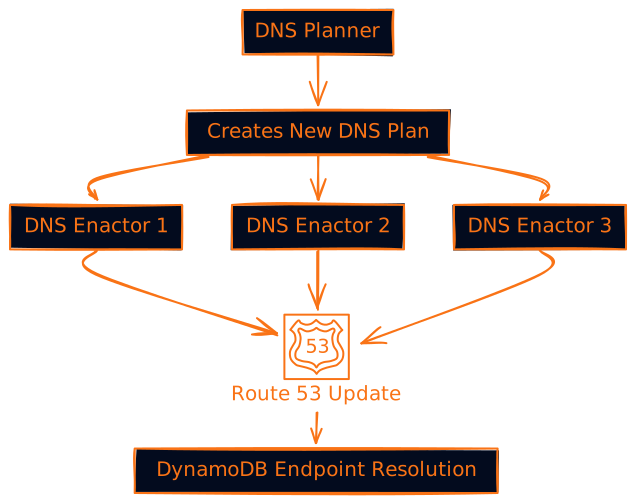
DNS Planner: A monitoring and planning service that continuously evaluates load balancer health and capacity, generating DNS plans that specify traffic distribution across available endpoints.
DNS Enactor: A distributed execution system operating redundantly across three Availability Zones, responsible for implementing DNS plans by updating Route53 records through atomic transactions.
This architecture was designed to handle the complexity of managing hundreds of thousands of DNS records across multiple endpoint variants, including regional, FIPS-compliant, IPv6, and account-specific endpoints.
Root Cause Analysis
The Race Condition
The incident was triggered by a previously unidentified race condition within the DNS management system. The failure sequence occurred as follows:
Initial Conditions: DNS Enactor 1 began processing a DNS plan but experienced unusual delays during Route53 transaction processing, likely due to transaction conflicts with other enactors.
Concurrent Operations: While Enactor 1 was delayed, the DNS Planner continued generating newer plan iterations. DNS Enactor 2 acquired and rapidly implemented a more recent plan across all endpoints.
Race Condition Trigger: Upon completing its updates, Enactor 2 initiated the cleanup process, which identifies and removes significantly outdated plans. Simultaneously, the delayed Enactor 1 completed its work, applying the older plan and overwriting Enactor 2's recent updates.
System Failure: The cleanup process then removed the "outdated" plan that had just been applied, resulting in empty DNS records for the regional DynamoDB endpoint (dynamodb.us-east-1.amazonaws.com) and leaving the system in an inconsistent state that prevented automated recovery.
DNS Management System Architecture
Technical Timeline
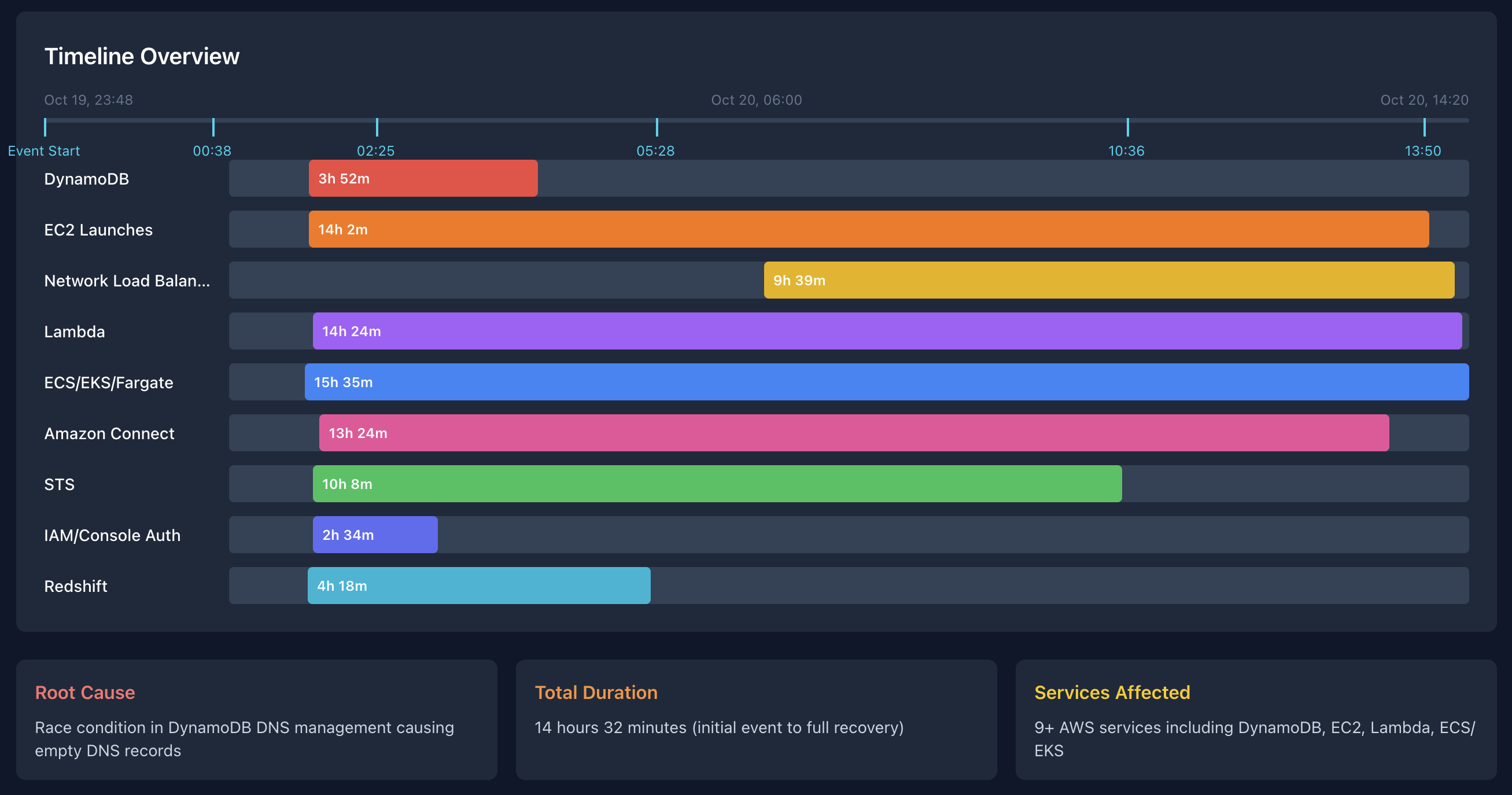
Impact Assessment
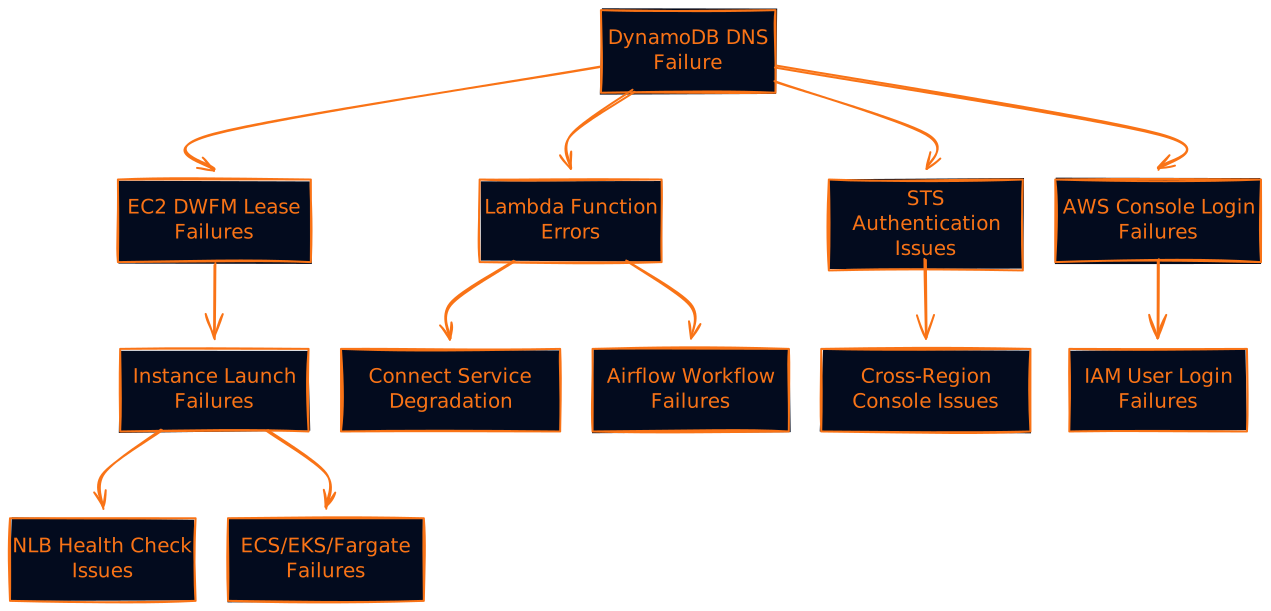
Service Dependency Cascade Analysis
Primary Service Disruption
DynamoDB (11:48 PM - 2:40 AM): Complete inability to establish new connections to the service in us-east-1. Existing connections remained functional, but no new client connections could be established due to DNS resolution failures.
Global Tables Impact: Customers with DynamoDB global tables maintained access to replica tables in other regions but experienced prolonged replication lag to and from us-east-1 replicas.
Cascading Service Failures
The DynamoDB disruption triggered a complex cascade of failures across AWS services due to architectural dependencies:
EC2 Infrastructure Impact
DropletWorkflow Manager (DWFM) Failure: DWFM, responsible for managing physical server leases for EC2 instances, lost connectivity to DynamoDB. This resulted in gradual lease timeouts across the entire EC2 fleet in us-east-1.
Recovery Complications: When DynamoDB connectivity was restored at 2:25 AM, DWFM attempted to re-establish leases with thousands of servers simultaneously, resulting in congestive collapse - a state where the system became so overloaded with recovery work that it could not make forward progress.

Resolution Strategy: Engineers implemented selective DWFM host restarts at 4:14 AM to clear processing queues and enable successful lease re-establishment by 5:28 AM.
Network Infrastructure Cascade
Network Manager Backlog: The restoration of EC2 instance launching capability created a significant backlog of network configuration propagation tasks. Network Manager experienced increased latencies starting at 6:21 AM as it processed delayed network state changes.
NLB Health Check Failures: Network Load Balancers began experiencing health check failures at 5:30 AM due to attempting health checks against EC2 instances that had not yet received their network configurations. This created a cycle of capacity removal and restoration that degraded NLB performance.
Recovery Analysis
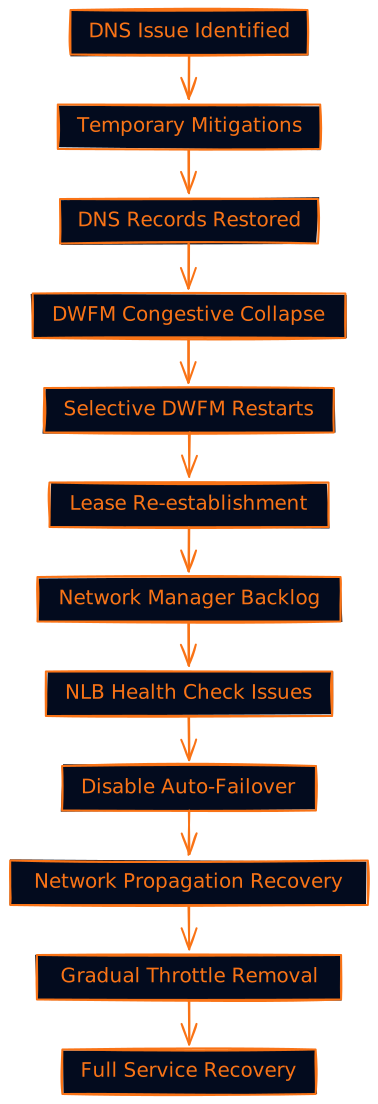
Recovery Phase Architecture
Phase 1: Initial Response and DNS Restoration (11:48 PM - 2:40 AM)
Detection and Investigation: AWS engineering teams identified the DNS state issue by 12:38 AM, approximately 50 minutes after the initial failure.
Temporary Mitigations: By 1:15 AM, engineers implemented workarounds that enabled critical internal services to connect to DynamoDB, restoring essential monitoring and recovery tooling.
Complete DNS Restoration: Full DNS record restoration was achieved by 2:25 AM, with customer connectivity fully restored by 2:40 AM as DNS caches expired.
Phase 2: Infrastructure Recovery (2:25 AM - 1:50 PM)
DWFM Recovery: The most complex aspect of the recovery involved addressing the congestive collapse in DWFM. Engineers employed a careful strategy of selective service restarts and throttling to enable gradual system recovery.
Network Propagation Recovery: Network Manager required until 10:36 AM to process the accumulated backlog of network configuration changes, during which new EC2 instances experienced connectivity issues.
Throttle Management: Engineers gradually removed request throttles between 11:23 AM and 1:50 PM, carefully monitoring system stability throughout the process.
Phase 3: Load Balancer Stabilization (5:30 AM - 2:09 PM)
Health Check Management: Engineers disabled automatic DNS failover for NLB at 9:36 AM to prevent further capacity loss due to false health check failures.
Final Recovery: With EC2 fully operational, automatic health check failover was re-enabled at 2:09 PM, completing the recovery process.
Service-Specific Impact Analysis
AWS Lambda
Lambda experienced function creation and update failures initially, followed by SQS event source processing issues that persisted until 4:40 AM due to a failed internal polling subsystem that required manual restoration.
Amazon Connect
Contact center operations were severely impacted, with customers experiencing call failures, chat service disruptions, and agent login issues. Service restoration occurred at 1:20 PM following Lambda recovery.
Amazon Redshift
Query processing and cluster management operations failed due to DynamoDB dependencies. Additional complications arose when cluster replacement workflows were blocked by EC2 launch failures, requiring manual intervention that extended until October 21.
Security Token Service (STS)
Authentication services experienced failures affecting AWS Console access across multiple regions, demonstrating the cross-regional impact of us-east-1 control plane dependencies.
Preventive Measures and Improvements
Immediate Actions Taken
DNS System Modifications: AWS disabled the problematic DNS automation worldwide pending implementation of race condition fixes and additional safety mechanisms.
Enhanced Testing: Development of comprehensive test suites to exercise recovery workflows and identify potential regressions in critical systems like DWFM.
Throttling Improvements: Implementation of queue-size-based throttling mechanisms to prevent congestive collapse during high-load recovery scenarios.
Architectural Enhancements
NLB Velocity Controls: Introduction of mechanisms to limit the rate of capacity removal during health check failures, preventing excessive capacity loss during transient issues.
DNS Plan Validation: Additional protections against the application of incorrect DNS plans, including enhanced consistency checks and validation procedures.
Lessons for Cloud Architecture
Dependency Management
This incident highlights the critical importance of understanding and managing service dependencies in cloud architectures. The cascading nature of the failures demonstrates how a single component failure can propagate through an entire ecosystem.
Recovery Complexity
The extended recovery timeline illustrates that restoring service availability involves more than simply fixing the root cause. Complex distributed systems require careful orchestration of recovery procedures to prevent secondary failures.
Monitoring and Observability
The incident underscores the need for comprehensive monitoring that extends beyond individual service health to include dependency relationships and cascade failure detection.
Design for Failure
Modern cloud architectures must be designed with the assumption that any component can fail, including foundational services like DNS. Circuit breakers, graceful degradation, and multi-region strategies are essential for maintaining service availability.
Industry Implications
This outage serves as a case study in the challenges of operating large-scale distributed systems. Despite AWS's extensive engineering expertise, sophisticated monitoring systems, and comprehensive testing procedures, a subtle race condition still resulted in significant service disruption.
The incident demonstrates that:
-
Complexity introduces risk: Even well-designed systems with multiple layers of redundancy can fail in unexpected ways.
-
Recovery is often more complex than the initial failure: The cascading effects and interdependencies in modern systems can make recovery significantly more challenging than the original problem.
-
Transparency builds trust: AWS's detailed technical post-mortem and transparent communication during the incident exemplify best practices for incident management and customer communication.
Conclusion
The October 2025 DynamoDB outage represents a significant learning opportunity for the cloud computing industry. While the immediate impact was substantial, the incident has driven important improvements in system design, recovery procedures, and operational practices.
The comprehensive nature of AWS's response - from the immediate technical fixes to the detailed post-mortem analysis - demonstrates the maturity of their operational practices and commitment to continuous improvement. The lessons learned from this incident will contribute to more resilient cloud infrastructure designs and better disaster recovery practices across the industry.
For organizations building on cloud platforms, this incident reinforces the importance of multi-region architectures, comprehensive disaster recovery planning, and deep understanding of service dependencies. The complexity revealed in this outage should inform architectural decisions and operational procedures for any organization operating at scale in cloud environments.
The ultimate measure of a system's reliability is not the absence of failures, but how effectively it learns from and recovers from those failures. By this measure, AWS's handling of this incident and the resulting improvements represent a positive outcome for the entire cloud computing ecosystem.
This analysis is based on AWS's official post-mortem documentation and represents a technical examination of the incident for educational and operational improvement purposes.