Availability in Modern Systems
Ever been in that nightmare scenario where your app crashes right during peak traffic? Yeah, we've all been there. That sinking feeling when your monitoring dashboard lights up like a Christmas tree and your phone starts buzzing with angry customer emails.
Here's the thing though - system downtime isn't just an "oops" moment anymore. It's a business killer. We're talking about $300,000 per hour for mission-critical apps according to Gartner. And get this - 51% of customers will straight up abandon your company after one bad digital experience.
But here's what most people don't get: availability isn't just about keeping servers running. It's about building systems that can handle the chaos of the real world. Let me break down what actually works (and what doesn't) when it comes to keeping your systems alive.
What Does "Available" Actually Mean?
Before we dive into the technical stuff, let's get our definitions straight. Availability isn't just "is my server on or off?" It's way more nuanced than that.
Think of availability like this: if your users can't do what they came to do, your system isn't available. Period. Doesn't matter if your servers are humming along nicely in the background.
There are actually three different ways to measure this:
User-Perceived Availability: What your users actually experience. If your site loads but takes 30 seconds to show a product page, that's not really "available" from a user perspective.
Business-Impacting Availability: Can your critical business functions actually work? Your login might be up, but if payments are down, your e-commerce site is basically useless.
Component-Level Availability: Individual pieces of your system. Your database might be fine, but if your API gateway is choking, nothing else matters.
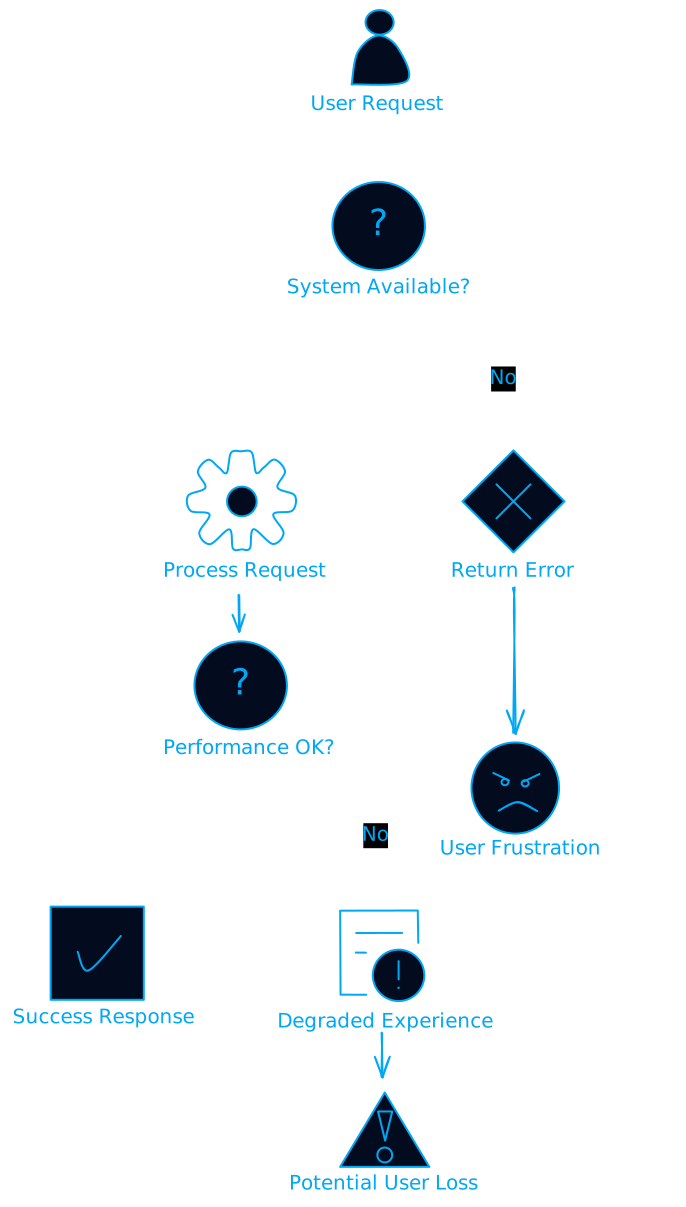
The brutal truth? Most companies only track the third one and wonder why their users are still complaining.
The Real Cost of Going Down
Let's talk numbers for a second. When your system goes down, you're not just losing the revenue from that downtime. You're dealing with:
- Direct revenue loss: Every minute offline is money walking out the door
- Customer acquisition cost waste: All that marketing spend to get users to your broken site
- Support costs: Your team scrambling to fix things and handle angry customers
- Reputation damage: The long-term hit to your brand that's impossible to quantify
But here's what really hurts - the compound effect. That 88% of customers who get frustrated with unavailable services? They don't just leave quietly. They tell their friends, post on social media, and leave reviews. One outage can haunt you for months.
The Architecture of Resilience
Now let's get into the good stuff. How do you actually build systems that don't fall over when things get interesting?
Redundancy: Your Safety Net
Redundancy is like having multiple parachutes when you're skydiving. You hope you never need the backup, but you'll be really glad it's there when your main one fails.
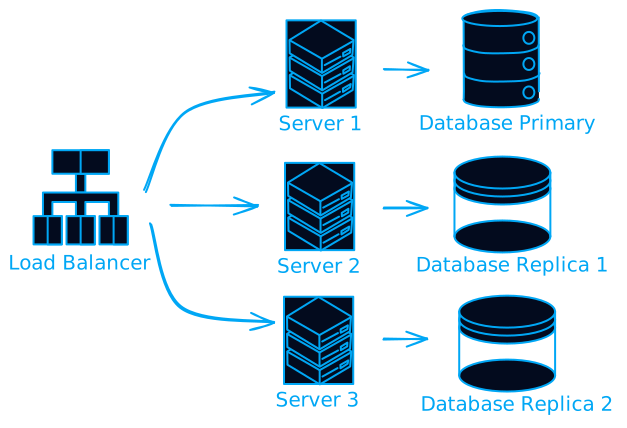
But here's where people mess up - they think redundancy means "just spin up another server." That's like having two cars but only one set of keys. Real redundancy means:
- Geographic distribution: Spread your stuff across different data centers, regions, even cloud providers
- Component diversity: Don't put all your eggs in one technology basket
- Failure domain isolation: Make sure one component failing can't take down everything else
Load Balancing: Traffic Management That Actually Works
Load balancing isn't just about distributing requests evenly. It's about being smart about where you send traffic based on what's actually happening right now.
// Simple health check implementation
const healthCheck = async (server) => {
  try {
    const response = await fetch(`${server.url}/health`, {
      timeout: 5000
    });
    return response.status === 200;
  } catch (error) {
    return false;
  }
};

// Smart load balancing with health awareness
const selectServer = (servers) => {
  const healthyServers = servers.filter(server => server.isHealthy);

  if (healthyServers.length === 0) {
    throw new Error('No healthy servers available');
  }

  // Weighted round-robin based on current load
  return healthyServers.reduce((best, current) =>
    current.currentLoad < best.currentLoad ? current : best
  );
};
The key is making your load balancer aware of what's actually happening. CPU usage, response times, error rates - all of this should factor into routing decisions.
Failover: When Plan A Goes to Hell
Failover is where the rubber meets the road. When something breaks (and it will), how fast can you switch to your backup?
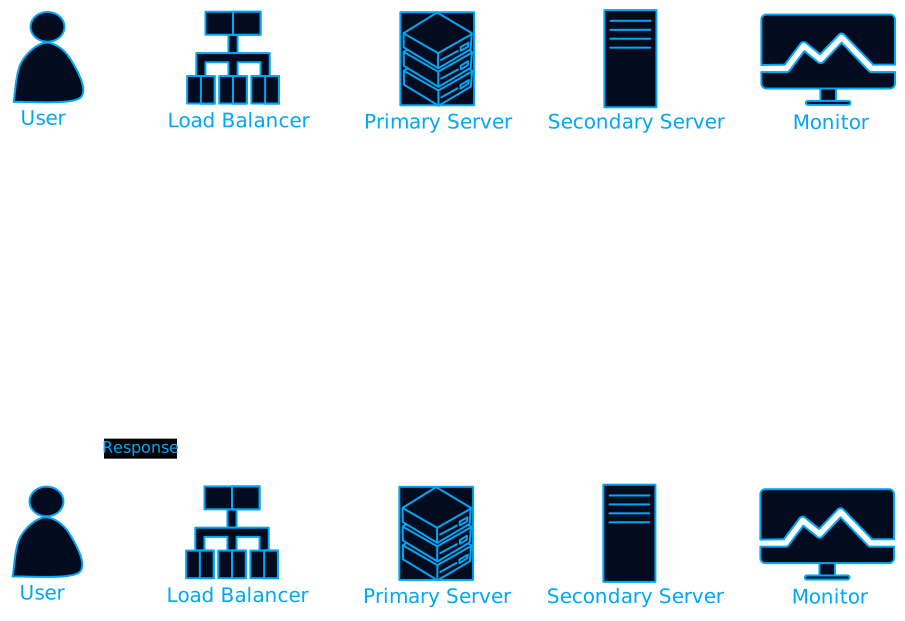
But here's the thing about failover - it's not just about having a backup. It's about:
- Detection speed: How fast do you know something's wrong?
- Decision making: Automated vs manual failover (hint: automated wins)
- State management: Can your backup pick up where the primary left off?
- Rollback capability: What if your "fix" makes things worse?
Cloud-Native Resilience Patterns
If you're building new systems today, you'd be crazy not to leverage cloud-native patterns. The cloud providers have figured out a lot of this stuff for you.
Multi-Cloud: Don't Put All Your Eggs in One Basket
Yeah, multi-cloud is more complex. But when AWS has an outage (and they do), you'll be glad your critical services are also running on GCP or Azure.
# Kubernetes deployment across multiple clouds
apiVersion: apps/v1
kind: Deployment
metadata:
  name: critical-service
spec:
  replicas: 6
  template:
    spec:
      affinity:
        podAntiAffinity:
          requiredDuringSchedulingIgnoredDuringExecution:
          - labelSelector:
              matchLabels:
                app: critical-service
            topologyKey: failure-domain.beta.kubernetes.io/zone
      containers:
      - name: app
        image: myapp:latest
        resources:
          requests:
            memory: "256Mi"
            cpu: "250m"
          limits:
            memory: "512Mi"
            cpu: "500m"
Microservices: Isolation is Your Friend
Microservices get a lot of hate, but they're actually great for availability. When your payment service goes down, your product catalog can keep working. Users can still browse, add items to cart, and come back to buy later.
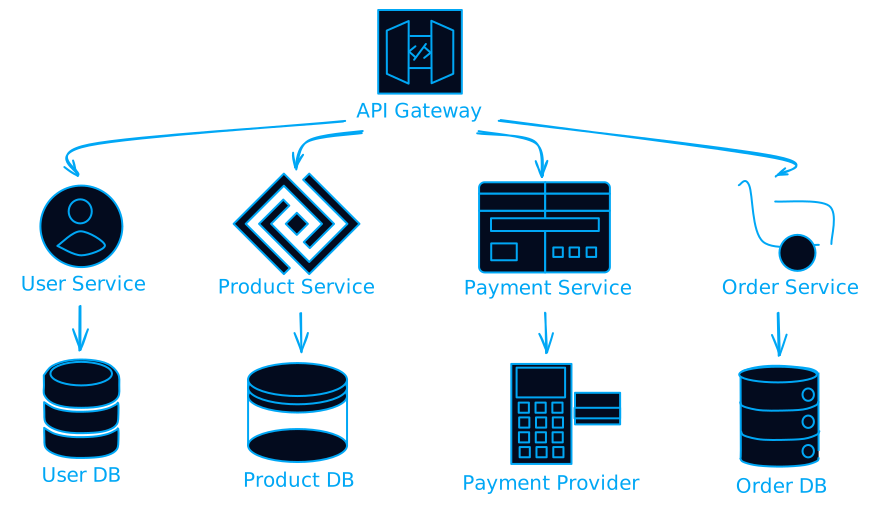
The key is designing your service boundaries around business capabilities, not technical ones. Each service should be able to degrade gracefully when its dependencies are having issues.
Serverless: Let Someone Else Worry About Servers
Serverless isn't just about cost savings. It's about availability. When you're running on Lambda or Cloud Functions, you're leveraging the cloud provider's infrastructure and their availability guarantees.
# AWS Lambda with built-in retry and error handling
import json
import boto3
from botocore.exceptions import ClientError

def lambda_handler(event, context):
    try:
        # Your business logic here
        result = process_request(event)

        return {
            'statusCode': 200,
            'body': json.dumps(result)
        }
    except ClientError as e:
        # Log the error for monitoring
        print(f"AWS service error: {e}")

        return {
            'statusCode': 503,
            'body': json.dumps({
                'error': 'Service temporarily unavailable'
            })
        }
    except Exception as e:
        # Log unexpected errors
        print(f"Unexpected error: {e}")

        return {
            'statusCode': 500,
            'body': json.dumps({
                'error': 'Internal server error'
            })
        }
Monitoring: You Can't Fix What You Can't See
Here's where most people screw up. They wait until something breaks to start paying attention. By then, it's too late.
The Four Golden Signals
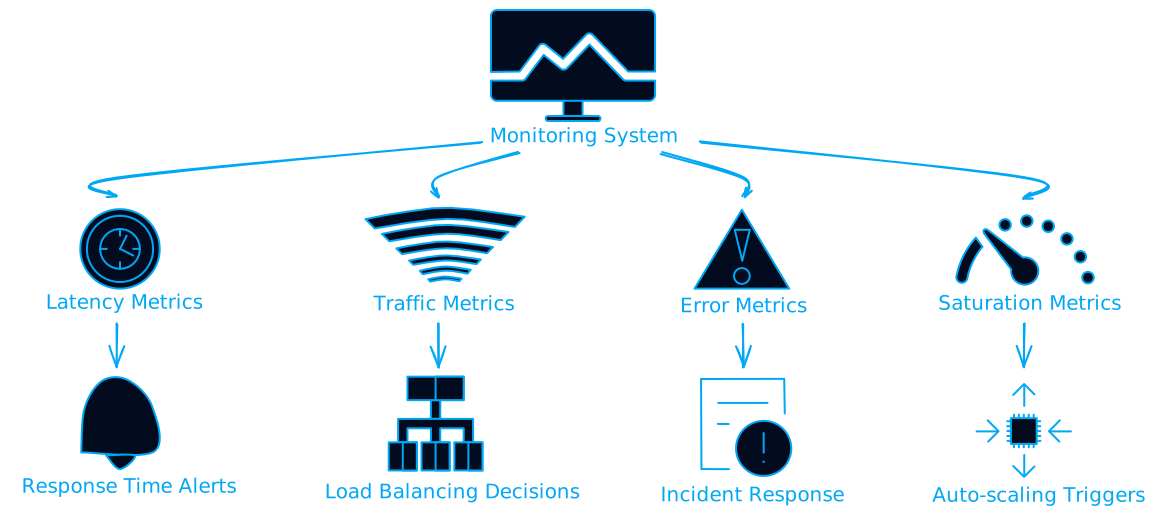
Google's SRE team figured out that there are four metrics that matter most:
- Latency: How long requests take
- Traffic: How much demand you're handling
- Errors: Rate of failed requests
- Saturation: How "full" your service is
Proactive vs Reactive Monitoring
Reactive monitoring is like calling the fire department after your house burns down. Proactive monitoring is like having smoke detectors.
# Proactive health monitoring
class HealthMonitor:
    def __init__(self):
        self.thresholds = {
            'response_time': 500,  # ms
            'error_rate': 0.01,    # 1%
            'cpu_usage': 0.80,     # 80%
            'memory_usage': 0.85   # 85%
        }

    def check_health(self, metrics):
        alerts = []

        if metrics['response_time'] > self.thresholds['response_time']:
            alerts.append('High response time detected')

        if metrics['error_rate'] > self.thresholds['error_rate']:
            alerts.append('Error rate threshold exceeded')

        # Predictive alerting based on trends
        if self.predict_resource_exhaustion(metrics):
            alerts.append('Resource exhaustion predicted in next 30 minutes')

        return alerts

    def predict_resource_exhaustion(self, metrics):
        # Simple trend analysis - in reality you'd use more sophisticated ML
        cpu_trend = self.calculate_trend(metrics['cpu_history'])
        return cpu_trend > 0.05  # 5% increase per minute
The Human Factor: Why Culture Matters
Here's something that doesn't get talked about enough - availability isn't just a technical problem. It's a cultural one.
Blameless Post-Mortems
When something breaks, your first instinct is to find who screwed up. Don't. Instead, ask "how did our system allow this to happen?" and "how can we prevent it next time?"
Chaos Engineering: Breaking Things on Purpose
This sounds crazy, but hear me out. Netflix popularized this with their Chaos Monkey tool. The idea is simple - randomly break parts of your system during normal business hours to see what happens.
# Simple chaos engineering example
import random
import time

class ChaosMonkey:
    def __init__(self, services):
        self.services = services
        self.failure_rate = 0.001  # 0.1% chance per check

    def maybe_cause_chaos(self):
        if random.random() < self.failure_rate:
            service = random.choice(self.services)
            failure_type = random.choice(['latency', 'error', 'timeout'])

            print(f"🐒 Chaos Monkey: Injecting {failure_type} into {service}")
            self.inject_failure(service, failure_type)

    def inject_failure(self, service, failure_type):
        # Implement actual failure injection
        pass
The goal isn't to break things for fun. It's to find your weak spots before your customers do.
Measuring What Matters
You can't improve what you don't measure. But measuring the wrong things is worse than not measuring at all.
Beyond Simple Uptime
Everyone talks about "five nines" (99.999% uptime), but that's not the whole story. What matters is:
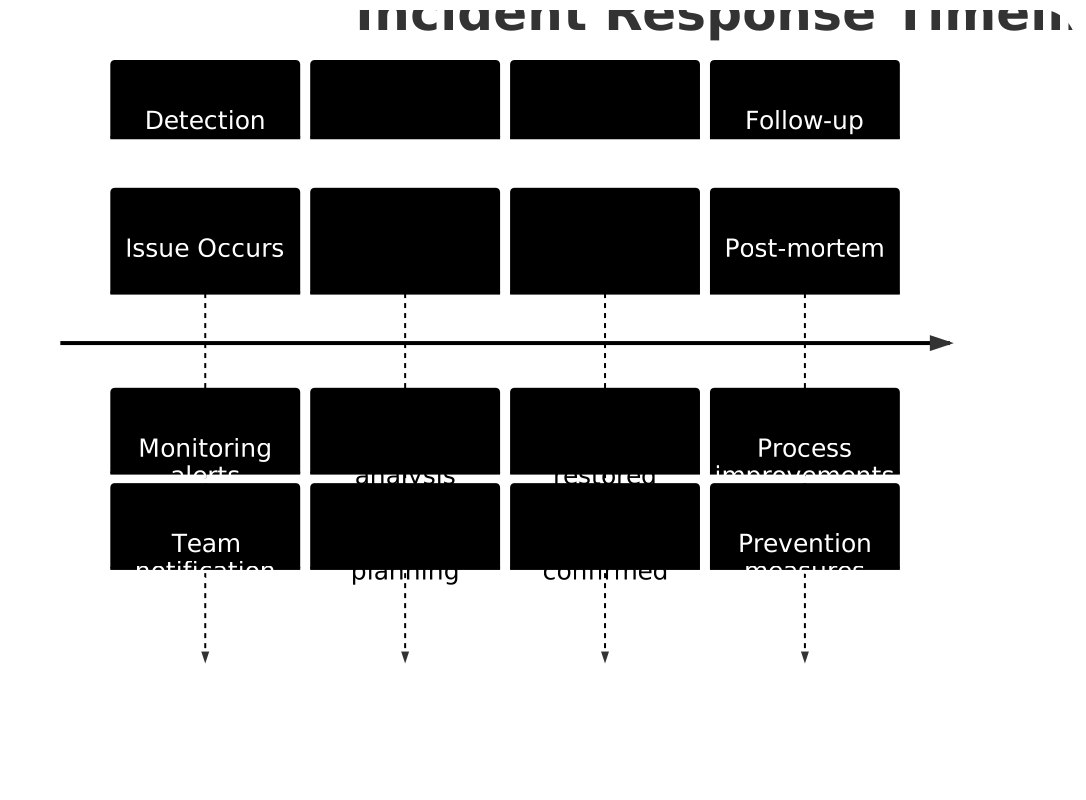
- Mean Time Between Failures (MTBF): How often do things break?
- Mean Time to Recovery (MTTR): How fast can you fix them?
- Mean Time to Detection (MTTD): How fast do you know something's wrong?
The Availability Equation
Here's the math that actually matters:
Availability = MTBF / (MTBF + MTTR)
This tells you something important - you can improve availability in two ways:
- Make failures less frequent (increase MTBF)
- Fix failures faster (decrease MTTR)
Most people focus on #1, but #2 is often easier and more impactful.
Real-World Trade-offs
Let's be honest - perfect availability is impossible and infinitely expensive. You need to make smart trade-offs based on your business needs.
The CAP Theorem Reality Check
You've probably heard of the CAP theorem - you can only have two of Consistency, Availability, and Partition tolerance. In the real world, network partitions happen, so you're really choosing between consistency and availability.
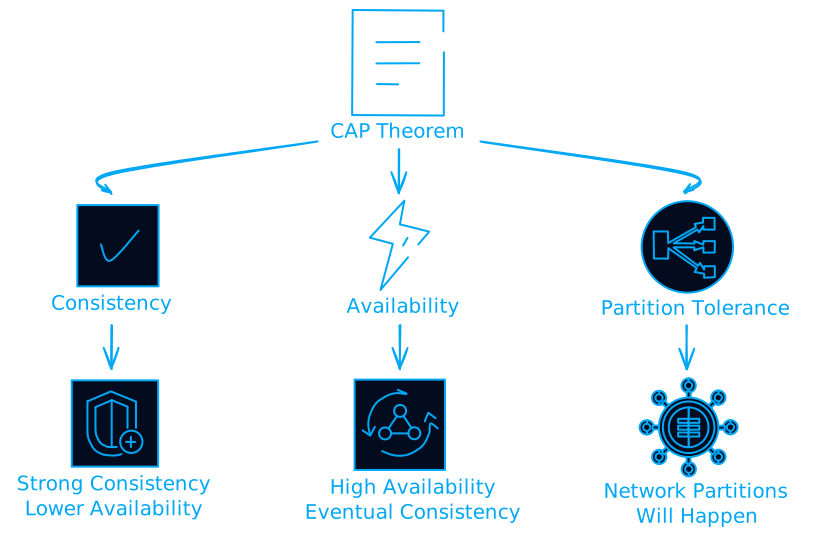
For most applications, eventual consistency is fine. Your users can handle seeing slightly stale data better than they can handle your app being down.
Cost vs Benefit Analysis
Every availability improvement has a cost. More servers, more complexity, more operational overhead. The trick is finding the sweet spot where the cost of downtime exceeds the cost of prevention.
# Simple availability cost calculator
def calculate_availability_investment(
    current_uptime_pct,
    target_uptime_pct,
    revenue_per_hour,
    infrastructure_cost_multiplier
):
    current_downtime_hours = (100 - current_uptime_pct) / 100 * 8760  # hours per year
    target_downtime_hours = (100 - target_uptime_pct) / 100 * 8760

    downtime_reduction = current_downtime_hours - target_downtime_hours
    revenue_saved = downtime_reduction * revenue_per_hour

    # Rough estimate - each "nine" costs exponentially more
    nines_improvement = target_uptime_pct - current_uptime_pct
    infrastructure_cost = infrastructure_cost_multiplier ** nines_improvement

    roi = (revenue_saved - infrastructure_cost) / infrastructure_cost

    return {
        'revenue_saved': revenue_saved,
        'infrastructure_cost': infrastructure_cost,
        'roi': roi,
        'payback_period_months': infrastructure_cost / (revenue_saved / 12)
    }
The Future of Availability
Where is all this heading? A few trends worth watching:
AI-Powered Operations
Machine learning is getting really good at predicting failures before they happen. Instead of reacting to problems, we're moving toward preventing them.
Edge Computing
Moving computation closer to users isn't just about performance - it's about availability. When your app runs in 100+ edge locations, a regional outage becomes a minor blip.
Immutable Infrastructure
The idea of "cattle, not pets" is winning. Instead of nursing sick servers back to health, just replace them with fresh ones.
What You Should Do Right Now
Okay, enough theory. Here's your action plan:
-
Audit your current state: What's your actual availability? Not what you think it is, what your monitoring says it is.
-
Identify your critical path: What are the components that, if they fail, take down your whole system?
-
Implement basic monitoring: Start with the four golden signals. You can get fancy later.
-
Plan for failure: Write down what you'll do when (not if) things break. Practice it.
-
Start small: Pick one component and make it more resilient. Learn from that before tackling the whole system.
The Bottom Line
Building highly available systems isn't about having perfect uptime. It's about building systems that fail gracefully and recover quickly. Your users don't expect perfection - they expect predictability.
The companies that get this right don't just survive outages - they use them as competitive advantages. While their competitors are scrambling to get back online, they're already serving customers and learning from what went wrong.
Remember - availability isn't a destination, it's a journey. Every failure is a chance to get better. Every outage is a lesson in disguise. The goal isn't to never fail - it's to fail better than your competition.
Your users are counting on you. Don't let them down.
Want to dive deeper into system reliability? Check out Google's SRE book (it's free online) and start experimenting with chaos engineering tools like Chaos Monkey or Gremlin. The best way to learn about availability is to break things in a controlled way and see what happens.