APIs Idempotency: Your Secret Weapon Against Chaos
Ever had that sinking feeling when your payment API charged a customer twice because of a network hiccup? Or watched your database fill up with duplicate records after a retry storm? Yeah, we've all been there. Today we're diving deep into idempotency, the unsung hero that keeps distributed systems sane when everything else goes sideways.
What the Heck Is Idempotency Anyway?
Think of idempotency like a light switch. Whether you flip it once or mash it frantically ten times, the light either stays on or stays off. The end result is always the same. In API terms, an idempotent operation produces identical results whether you call it once or a hundred times.
But here's where it gets interesting. Not all HTTP methods are created equal:
- GET requests: Naturally idempotent (just reading data)
- PUT requests: Should be idempotent (replacing entire resources)
- DELETE requests: Idempotent by design (deleting something already gone is fine)
- POST requests: The wild card that usually isn't idempotent
The Real-World Pain Points
Let's get real about why this matters. Picture this: you're running an e-commerce platform during Black Friday. Network timeouts are happening left and right. Without idempotency, you're looking at:
- Customers getting charged multiple times for the same order
- Inventory counts going haywire from duplicate updates
- Support tickets flooding in faster than you can handle them
- Your reputation taking a nosedive on social media
I've seen teams spend entire weekends manually reconciling duplicate transactions because they skipped implementing proper idempotency. Don't be that team.
The Anatomy of Idempotent API Design
Idempotency Keys: Your First Line of Defense
The most common approach is using idempotency keys. Think of them as unique fingerprints for each operation. Here's how it works:
// Client generates a unique key for each request
const idempotencyKey = `order-${userId}-${timestamp}-${randomId}`;

const response = await fetch('/api/orders', {
  method: 'POST',
  headers: {
    'Content-Type': 'application/json',
    'Idempotency-Key': idempotencyKey
  },
  body: JSON.stringify({
    productId: 'widget-123',
    quantity: 2,
    userId: userId
  })
});
On the server side, you'd implement something like this:
import redis
import json
from datetime import timedelta

class IdempotencyManager:
    def __init__(self, redis_client):
        self.redis = redis_client
        self.ttl = timedelta(hours=24)  # Keys expire after 24 hours

    def get_cached_response(self, key):
        """Check if we've seen this request before"""
        cached = self.redis.get(f"idempotency:{key}")
        if cached:
            return json.loads(cached)
        return None

    def cache_response(self, key, response_data):
        """Store the response for future duplicate requests"""
        self.redis.setex(
            f"idempotency:{key}",
            self.ttl,
            json.dumps(response_data)
        )

    def process_request(self, key, request_handler):
        """Main idempotency logic"""
        # Check cache first
        cached_response = self.get_cached_response(key)
        if cached_response:
            return cached_response

        # Process the request
        response = request_handler()

        # Cache the result
        self.cache_response(key, response)
        return response
But Wait, There's More: Handling Edge Cases
Real-world idempotency gets messy fast. What happens when:
- The same idempotency key comes with different request bodies?
- Your cache goes down mid-request?
- Requests arrive simultaneously with the same key?
Here's a more robust approach:
import hashlib
from contextlib import contextmanager

class RobustIdempotencyManager:
    def __init__(self, redis_client, db_connection):
        self.redis = redis_client
        self.db = db_connection

    def generate_request_hash(self, request_body):
        """Create a hash of the request to detect body changes"""
        return hashlib.sha256(
            json.dumps(request_body, sort_keys=True).encode()
        ).hexdigest()

    @contextmanager
    def distributed_lock(self, key, timeout=30):
        """Prevent race conditions with distributed locking"""
        lock_key = f"lock:{key}"
        acquired = self.redis.set(lock_key, "locked", nx=True, ex=timeout)

        if not acquired:
            raise Exception("Request already in progress")

        try:
            yield
        finally:
            self.redis.delete(lock_key)

    def validate_request_consistency(self, key, request_body):
        """Ensure the same key isn't used with different data"""
        stored_hash = self.redis.get(f"hash:{key}")
        current_hash = self.generate_request_hash(request_body)

        if stored_hash and stored_hash.decode() != current_hash:
            raise Exception("Idempotency key reused with different request body")

        if not stored_hash:
            self.redis.setex(f"hash:{key}", timedelta(hours=24), current_hash)
Event-Driven Architecture: Where Things Get Spicy
APIs are just the tip of the iceberg. In event-driven systems, idempotency becomes even more critical. Events can be delivered multiple times, arrive out of order, or get replayed during system recovery.

Event Deduplication Strategies
Here's a practical event handler that deals with duplicates:
class IdempotentEventHandler:
    def __init__(self, db_connection):
        self.db = db_connection

    def handle_order_created_event(self, event):
        event_id = event['id']

        # Check if we've processed this event before
        if self.is_event_processed(event_id):
            print(f"Event {event_id} already processed, skipping")
            return

        try:
            # Start transaction
            with self.db.transaction():
                # Process the event
                self.create_order_record(event['data'])

                # Mark event as processed
                self.mark_event_processed(event_id)

        except Exception as e:
            print(f"Failed to process event {event_id}: {e}")
            raise

    def is_event_processed(self, event_id):
        """Check our processed events table"""
        result = self.db.execute(
            "SELECT 1 FROM processed_events WHERE event_id = %s",
            (event_id,)
        )
        return result.rowcount > 0

    def mark_event_processed(self, event_id):
        """Record that we've handled this event"""
        self.db.execute(
            "INSERT INTO processed_events (event_id, processed_at) VALUES (%s, NOW())",
            (event_id,)
        )
The Distributed Systems Minefield
When you're dealing with microservices, idempotency becomes a distributed problem. Each service needs to coordinate without stepping on each other's toes.
Saga Pattern with Idempotency
Consider an order processing saga that involves multiple services:
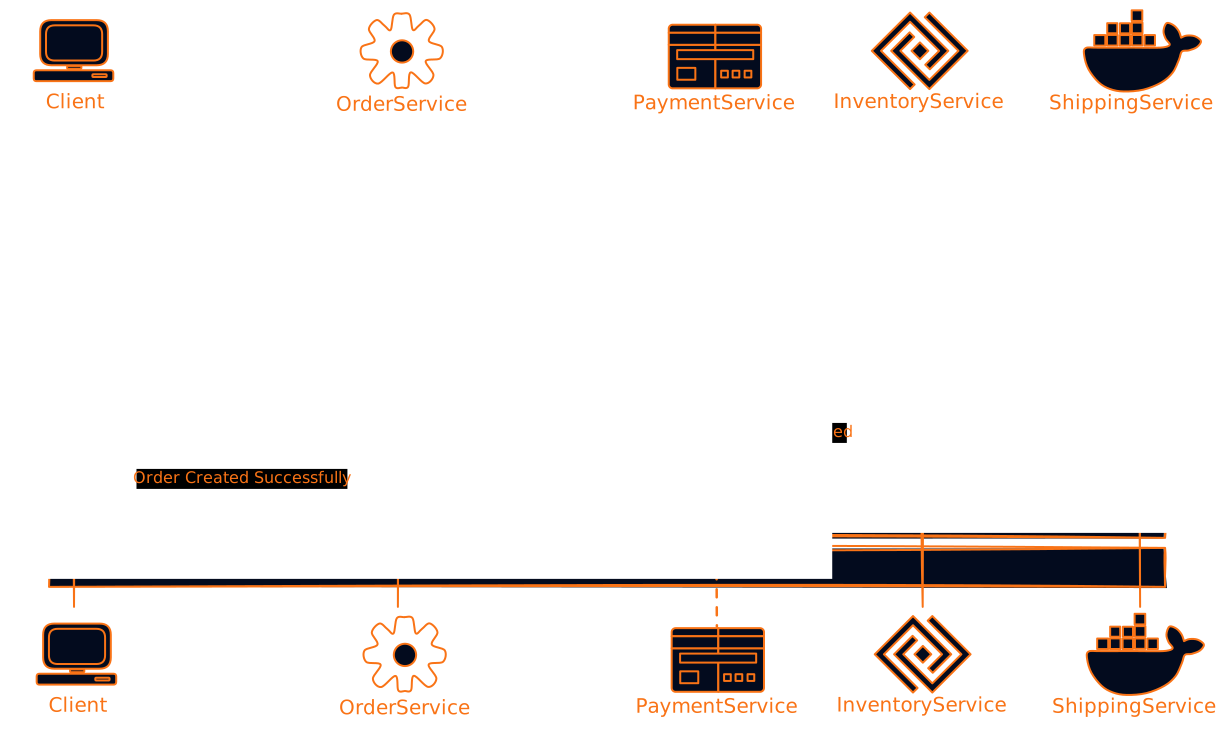
Each service in the saga needs to handle retries gracefully:
class SagaStep:
    def __init__(self, service_name, db_connection):
        self.service_name = service_name
        self.db = db_connection

    def execute_step(self, saga_id, step_name, operation):
        """Execute a saga step idempotently"""
        step_key = f"{saga_id}:{step_name}"

        # Check if this step was already completed
        if self.is_step_completed(step_key):
            return self.get_step_result(step_key)

        # Check if step is currently running
        if self.is_step_running(step_key):
            raise Exception(f"Step {step_name} already in progress for saga {saga_id}")

        try:
            # Mark step as running
            self.mark_step_running(step_key)

            # Execute the actual operation
            result = operation()

            # Mark step as completed with result
            self.mark_step_completed(step_key, result)

            return result

        except Exception as e:
            # Mark step as failed
            self.mark_step_failed(step_key, str(e))
            raise

    def is_step_completed(self, step_key):
        result = self.db.execute(
            "SELECT 1 FROM saga_steps WHERE step_key = %s AND status = 'completed'",
            (step_key,)
        )
        return result.rowcount > 0
Performance Considerations: The Hidden Costs
Idempotency isn't free. Every idempotency check adds latency and storage overhead. Here's how to optimize:
Smart Caching Strategies
class OptimizedIdempotencyCache:
    def __init__(self, redis_client, local_cache_size=1000):
        self.redis = redis_client
        self.local_cache = {}
        self.local_cache_size = local_cache_size
        self.access_order = []

    def get_cached_response(self, key):
        # Check local cache first (fastest)
        if key in self.local_cache:
            self.update_access_order(key)
            return self.local_cache[key]

        # Check Redis (slower but distributed)
        cached = self.redis.get(f"idempotency:{key}")
        if cached:
            response = json.loads(cached)
            self.add_to_local_cache(key, response)
            return response

        return None

    def add_to_local_cache(self, key, response):
        # Implement LRU eviction
        if len(self.local_cache) >= self.local_cache_size:
            oldest_key = self.access_order.pop(0)
            del self.local_cache[oldest_key]

        self.local_cache[key] = response
        self.access_order.append(key)
Batch Processing for High Throughput
For high-volume scenarios, batch your idempotency checks:
class BatchIdempotencyProcessor:
    def __init__(self, redis_client, batch_size=100):
        self.redis = redis_client
        self.batch_size = batch_size
        self.pending_requests = []

    def add_request(self, idempotency_key, request_data):
        self.pending_requests.append({
            'key': idempotency_key,
            'data': request_data
        })

        if len(self.pending_requests) >= self.batch_size:
            return self.process_batch()

        return None

    def process_batch(self):
        if not self.pending_requests:
            return []

        # Batch check all keys at once
        keys = [f"idempotency:{req['key']}" for req in self.pending_requests]
        cached_responses = self.redis.mget(keys)

        results = []
        new_requests = []

        for i, cached in enumerate(cached_responses):
            if cached:
                # Return cached response
                results.append(json.loads(cached))
            else:
                # Queue for processing
                new_requests.append(self.pending_requests[i])

        # Process new requests
        for req in new_requests:
            result = self.process_new_request(req['data'])
            results.append(result)

            # Cache the result
            self.redis.setex(
                f"idempotency:{req['key']}",
                timedelta(hours=24),
                json.dumps(result)
            )

        self.pending_requests = []
        return results
Testing Your Idempotent APIs: Because Murphy's Law Is Real
Testing idempotency requires simulating the chaos of production. Here's a comprehensive testing strategy:
import asyncio
import random
from concurrent.futures import ThreadPoolExecutor

class IdempotencyTester:
    def __init__(self, api_client):
        self.client = api_client

    async def test_concurrent_requests(self, endpoint, payload, num_requests=10):
        """Send multiple identical requests concurrently"""
        idempotency_key = f"test-{random.randint(1000, 9999)}"

        async def make_request():
            return await self.client.post(
                endpoint,
                json=payload,
                headers={'Idempotency-Key': idempotency_key}
            )

        # Fire off multiple requests simultaneously
        tasks = [make_request() for _ in range(num_requests)]
        responses = await asyncio.gather(*tasks, return_exceptions=True)

        # Verify all responses are identical
        successful_responses = [r for r in responses if not isinstance(r, Exception)]

        assert len(successful_responses) > 0, "No successful responses"

        first_response = successful_responses[0]
        for response in successful_responses[1:]:
            assert response.json() == first_response.json(), "Responses differ"

        print(f"✅ All {len(successful_responses)} responses identical")

    def test_network_failure_simulation(self, endpoint, payload):
        """Test behavior during network failures"""
        idempotency_key = f"failure-test-{random.randint(1000, 9999)}"

        # First request succeeds
        response1 = self.client.post(
            endpoint,
            json=payload,
            headers={'Idempotency-Key': idempotency_key}
        )

        # Simulate network timeout (client retries)
        response2 = self.client.post(
            endpoint,
            json=payload,
            headers={'Idempotency-Key': idempotency_key}
        )

        assert response1.json() == response2.json(), "Retry response differs"
        print("✅ Network failure retry handled correctly")

    def test_key_reuse_with_different_data(self, endpoint):
        """Verify protection against key reuse"""
        idempotency_key = f"reuse-test-{random.randint(1000, 9999)}"

        # First request
        response1 = self.client.post(
            endpoint,
            json={'data': 'original'},
            headers={'Idempotency-Key': idempotency_key}
        )

        # Second request with same key but different data
        response2 = self.client.post(
            endpoint,
            json={'data': 'modified'},
            headers={'Idempotency-Key': idempotency_key}
        )

        # Should either return original response or error
        assert (response2.json() == response1.json() or
                response2.status_code == 400), "Key reuse not handled properly"

        print("✅ Key reuse protection working")
Monitoring and Observability: Know When Things Go Wrong
You can't manage what you can't measure. Here are the key metrics to track:
Essential Idempotency Metrics
from prometheus_client import Counter, Histogram, Gauge

# Metrics to track
idempotency_cache_hits = Counter('idempotency_cache_hits_total', 'Cache hits')
idempotency_cache_misses = Counter('idempotency_cache_misses_total', 'Cache misses')
idempotency_key_conflicts = Counter('idempotency_key_conflicts_total', 'Key conflicts')
idempotency_processing_time = Histogram('idempotency_processing_seconds', 'Processing time')
active_idempotency_locks = Gauge('idempotency_active_locks', 'Active locks')

class MonitoredIdempotencyManager:
    def __init__(self, redis_client):
        self.redis = redis_client

    def process_request(self, key, request_handler):
        with idempotency_processing_time.time():
            # Check cache
            cached_response = self.get_cached_response(key)
            if cached_response:
                idempotency_cache_hits.inc()
                return cached_response

            idempotency_cache_misses.inc()

            # Process new request
            try:
                active_idempotency_locks.inc()
                response = request_handler()
                self.cache_response(key, response)
                return response
            finally:
                active_idempotency_locks.dec()
Alerting on Idempotency Issues
Set up alerts for:
- High cache miss rates (might indicate cache issues)
- Increasing key conflicts (possible client bugs)
- Long processing times (performance degradation)
- High lock contention (scaling issues)
Common Pitfalls and How to Avoid Them
The "Almost Idempotent" Trap
# ❌ BAD: This looks idempotent but isn't
def create_user_bad(email, name):
    if User.objects.filter(email=email).exists():
        return User.objects.get(email=email)

    # Race condition here! Two requests might both pass the check
    return User.objects.create(email=email, name=name)

# ✅ GOOD: Truly idempotent with proper error handling
def create_user_good(email, name):
    try:
        return User.objects.create(email=email, name=name)
    except IntegrityError:
        # User already exists, return existing one
        return User.objects.get(email=email)
The Expiring Key Problem
# ❌ BAD: Keys expire too quickly
def short_lived_cache(key, response):
    redis.setex(key, 60, response)  # Only 1 minute!

# ✅ GOOD: Reasonable expiration with cleanup
def proper_cache_management(key, response):
    # Keep for 24 hours for active requests
    redis.setex(f"idempotency:{key}", 86400, response)

    # Also store in long-term audit log
    audit_log.record_request(key, response, timestamp=now())
Advanced Patterns: Beyond Basic Idempotency
Conditional Idempotency
Sometimes you want idempotency only under certain conditions:
class ConditionalIdempotencyManager:
    def __init__(self, redis_client):
        self.redis = redis_client

    def process_conditional_request(self, key, request_data, condition_func):
        """Only apply idempotency if condition is met"""

        if not condition_func(request_data):
            # Process normally without idempotency
            return self.process_request_directly(request_data)

        # Apply idempotency
        cached = self.get_cached_response(key)
        if cached:
            return cached

        response = self.process_request_directly(request_data)
        self.cache_response(key, response)
        return response

# Usage example
def should_be_idempotent(request_data):
    # Only apply idempotency to payment requests
    return request_data.get('type') == 'payment'
Hierarchical Idempotency Keys
For complex operations, use hierarchical keys:
class HierarchicalIdempotencyManager:
    def generate_hierarchical_key(self, user_id, operation_type, sub_operation=None):
        """Create nested idempotency scopes"""
        base_key = f"user:{user_id}:op:{operation_type}"

        if sub_operation:
            return f"{base_key}:sub:{sub_operation}"

        return base_key

    def process_order_creation(self, user_id, order_data, idempotency_key):
        # Main order creation
        order_key = self.generate_hierarchical_key(user_id, "create_order")

        # Sub-operations with their own idempotency
        payment_key = f"{order_key}:payment:{idempotency_key}"
        inventory_key = f"{order_key}:inventory:{idempotency_key}"

        # Each step can be retried independently
        order = self.process_with_key(order_key, lambda: self.create_order(order_data))
        payment = self.process_with_key(payment_key, lambda: self.process_payment(order))
        inventory = self.process_with_key(inventory_key, lambda: self.reserve_inventory(order))

        return {
            'order': order,
            'payment': payment,
            'inventory': inventory
        }
The Future of Idempotency
As systems get more complex, idempotency patterns are evolving:
Blockchain-Inspired Approaches
Some teams are experimenting with blockchain-like patterns for distributed idempotency:
class DistributedIdempotencyLedger:
    """Experimental: Distributed ledger for idempotency tracking"""

    def __init__(self, node_id, peer_nodes):
        self.node_id = node_id
        self.peers = peer_nodes
        self.ledger = []

    def propose_operation(self, idempotency_key, operation_hash):
        """Propose an operation to the network"""
        proposal = {
            'key': idempotency_key,
            'hash': operation_hash,
            'proposer': self.node_id,
            'timestamp': time.time()
        }

        # Get consensus from majority of nodes
        votes = self.request_votes(proposal)

        if len(votes) > len(self.peers) // 2:
            self.commit_operation(proposal)
            return True

        return False
AI-Powered Idempotency
Machine learning could help optimize idempotency strategies:
class SmartIdempotencyManager:
    """AI-powered idempotency optimization"""

    def __init__(self, ml_model):
        self.model = ml_model
        self.request_patterns = []

    def predict_cache_duration(self, request_features):
        """Use ML to predict optimal cache duration"""
        features = self.extract_features(request_features)
        predicted_duration = self.model.predict([features])[0]

        # Clamp to reasonable bounds
        return max(300, min(86400, predicted_duration))

    def adaptive_caching(self, key, response, request_context):
        """Dynamically adjust cache settings based on patterns"""
        duration = self.predict_cache_duration(request_context)

        self.redis.setex(key, duration, response)

        # Learn from this request
        self.request_patterns.append({
            'features': request_context,
            'duration_used': duration,
            'timestamp': time.time()
        })
Wrapping Up: Your Idempotency Checklist
Before you ship that API, make sure you've covered these bases:
✅ Design Checklist
- Identified which operations need idempotency
- Chosen appropriate idempotency key strategy
- Implemented proper error handling for key conflicts
- Added distributed locking for race condition prevention
- Set up monitoring and alerting
✅ Testing Checklist
- Concurrent request testing
- Network failure simulation
- Key reuse validation
- Performance testing under load
- Cache failure scenarios
✅ Production Checklist
- Monitoring dashboards configured
- Alerting thresholds set
- Cache sizing and expiration tuned
- Documentation for troubleshooting
- Runbooks for common issues
The Bottom Line
Idempotency isn't just a nice-to-have feature, it's essential for building systems that work reliably in the real world. Networks fail, clients retry, and users get impatient. But with proper idempotency design, your APIs can handle whatever chaos the internet throws at them.
The key is to start simple with basic idempotency keys, then evolve your approach as your system grows. Don't try to build the perfect idempotency system on day one. Build something that works, measure it, and improve it over time.
Remember: a system that works correctly 99% of the time isn't reliable, it's a ticking time bomb. That 1% of edge cases will find you eventually, usually at the worst possible moment. Idempotency helps you sleep better at night knowing your system can handle the chaos.
Now go forth and build bulletproof APIs. Your future self (and your users) will thank you.
Want to dive deeper? Check out the HTTP specification for idempotent methods and explore how major platforms like Stripe implement idempotency in their APIs. The patterns we've covered here are battle-tested in production systems handling millions of requests per day.