𝗔𝗜 𝗣𝗲𝗿𝘀𝗼𝗻𝗮𝗹𝗶𝘇𝗮𝘁𝗶𝗼𝗻 𝗮𝘁 𝗦𝗰𝗮𝗹𝗲
You know that moment when Netflix suggests exactly the show you didn't know you needed? Or when Amazon somehow predicts you're about to run out of coffee before you do? That's not some mystical algorithm magic, that's AI personalization working at massive scale, and honestly, the tech behind it is way more fascinating than most people realize.
I've been diving deep into how companies are actually pulling this off, and the reality is both more impressive and more complex than the marketing hype suggests. Let me walk you through what's really happening when millions of users get personalized experiences simultaneously.
The Scale Problem Nobody Talks About
Here's the thing everyone glosses over: personalizing for one user is easy. Personalizing for 100 million users in real-time without everything crashing? That's where things get interesting.
Traditional recommendation systems used to work in batches. They'd crunch numbers overnight and serve you yesterday's predictions. But modern AI personalization happens in milliseconds, adapting to your behavior as it happens.
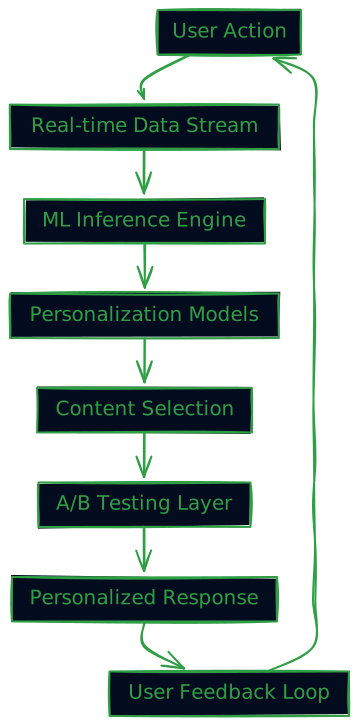
The architecture looks simple, but each component is handling massive throughput. We're talking about systems that process millions of events per second while maintaining sub-100ms response times.
Five Trends That Are Actually Changing the Game
1. Hyper-Personalization with Predictive Analytics
This goes way beyond "customers who bought X also bought Y." Modern systems are predicting what you'll need before you know you need it.
McKinsey's research shows hyper-personalized experiences can generate up to 40% more revenue by 2025. But here's what they don't tell you about the tech stack:
- Stream processing engines (Apache Kafka, AWS Kinesis) handling millions of events per second
- Real-time feature stores that can serve ML features with microsecond latency
- Multi-armed bandit algorithms that balance exploration vs exploitation in real-time
The predictive models aren't just looking at your purchase history. They're factoring in:
- Seasonal patterns and external events
- Your interaction velocity and session behavior
- Cross-device activity correlation
- Even things like local weather or news events
# Simplified example of real-time feature engineering
def generate_user_features(user_id, context):
    features = {
        'recent_clicks': get_recent_activity(user_id, window='1h'),
        'seasonal_affinity': calculate_seasonal_preferences(user_id),
        'context_signals': extract_context_features(context),
        'cross_device_sync': merge_device_profiles(user_id)
    }
    return vectorize_features(features)
2. AI-Driven Emotional Intelligence
This is where things get really interesting. AI systems can now detect emotional states from how you interact with interfaces, not just what you click on.
The tech involves:
- Computer vision models analyzing micro-expressions in video calls
- Natural language processing detecting sentiment and frustration in text
- Behavioral pattern recognition identifying stress signals in interaction patterns

I've seen systems that can detect when someone's getting frustrated with a checkout process and automatically simplify the interface or offer help. The emotional intelligence layer runs parallel to the main recommendation engine, providing context that dramatically improves personalization accuracy.
3. Generative AI for Dynamic Content Creation
This isn't just about generating product descriptions anymore. We're talking about AI that creates personalized content at the individual level, in real-time.
The architecture typically involves:
- Large language models fine-tuned on brand voice and user preferences
- Content templating systems that maintain consistency while allowing variation
- Real-time personalization layers that adapt content based on user context
Here's what's actually happening behind the scenes:
The challenge isn't just generating content, it's doing it fast enough for real-time experiences while maintaining quality and brand consistency.
4. Voice and Speech Analytics at Scale
Voice data is incredibly rich for personalization, but processing it at scale requires some serious engineering.
Modern voice analytics systems use:
- Real-time speech-to-text with custom acoustic models
- Sentiment analysis on both content and prosodic features
- Speaker identification for cross-session personalization
- Intent classification that goes beyond simple command recognition
The interesting part is how this integrates with other personalization signals. Your voice patterns can indicate stress, excitement, or confusion, which then influences not just the immediate response but future interactions across all channels.
5. Omnichannel AI Integration
This is probably the most technically challenging aspect. Creating consistent personalization across web, mobile, voice, email, and physical stores requires some serious data engineering.
The architecture looks something like this:
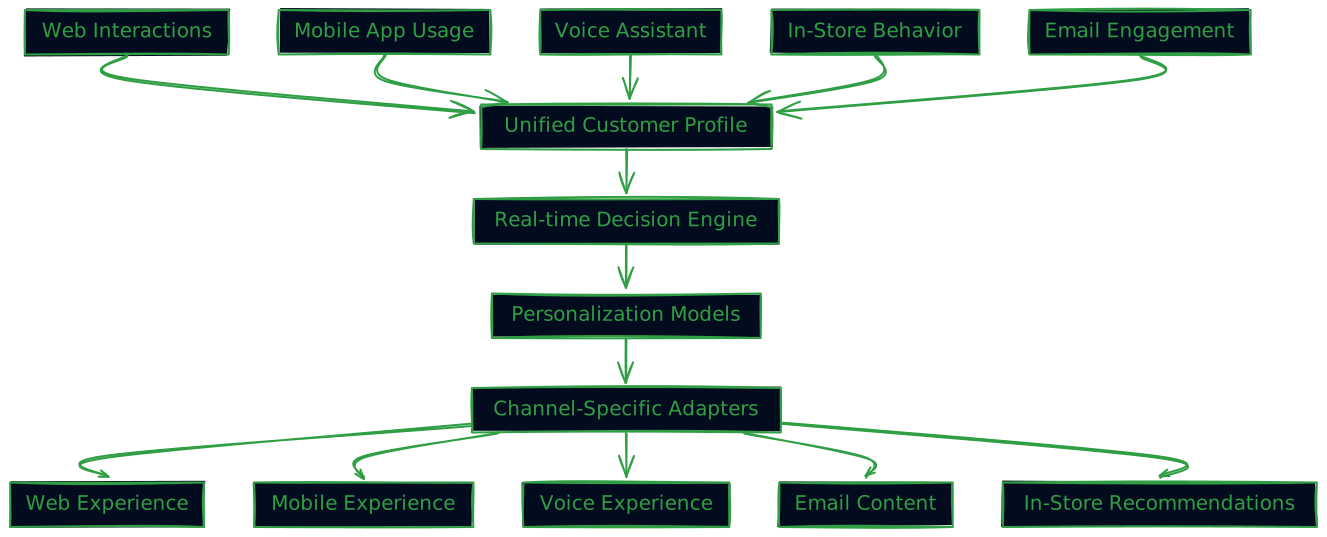
The technical challenges include:
- Identity resolution across devices and sessions
- Real-time data synchronization between systems
- Consistent model serving across different platforms
- Cross-channel attribution for measuring effectiveness
The Numbers That Actually Matter
Let's talk about real impact, not just marketing fluff:
- 80% of consumers are more likely to purchase from companies offering personalized experiences
- AI-powered personalization can boost customer retention by 15%
- Customer satisfaction jumps 30% when personalization is implemented properly
- Customer acquisition costs can drop by up to 50% with effective personalization
But here's what those numbers don't tell you: the operational efficiency gains are often bigger than the revenue increases. When customers feel understood, support tickets decrease, resolution times improve, and overall system load actually goes down despite serving more personalized content.
The Technical Implementation Reality
Data Architecture That Actually Works
Most companies start with the wrong foundation. You can't bolt personalization onto existing systems and expect it to work at scale.
The data architecture needs to support:
- Real-time ingestion of behavioral data
- Low-latency feature serving for ML models
- Consistent identity resolution across touchpoints
- Privacy-compliant data handling from day one
# Example of a real-time feature store architecture
class FeatureStore:
    def __init__(self):
        self.online_store = RedisCluster()  # Sub-ms latency
        self.offline_store = DeltaLake()    # Historical features
        self.streaming_pipeline = KafkaStreams()

    def get_features(self, user_id, feature_names):
        # Serve features with <10ms latency
        return self.online_store.mget(
            [f"{user_id}:{name}" for name in feature_names]
        )
Real-time ML Inference at Scale
Serving ML models to millions of users simultaneously requires careful architecture:
- Model serving platforms (TensorFlow Serving, MLflow) with auto-scaling
- Feature caching strategies to minimize compute overhead
- A/B testing frameworks built into the inference pipeline
- Fallback mechanisms for when models fail or are unavailable
The key insight: you need multiple models running in parallel, not just one "personalization algorithm." Different models handle different aspects (content recommendation, UI personalization, timing optimization, etc.).
Privacy-First Architecture
This isn't optional anymore. Privacy needs to be built into the architecture from the ground floor:

Key components:
- Differential privacy for protecting individual data points
- Federated learning for training models without centralizing data
- Homomorphic encryption for computing on encrypted data
- Zero-knowledge proofs for verification without data exposure
The Challenges Nobody Warns You About
Algorithmic Bias at Scale
When you're personalizing for millions of users, small biases get amplified massively. I've seen systems that inadvertently excluded entire demographic groups because the training data wasn't representative.
The technical solutions involve:
- Bias detection algorithms that run continuously
- Fairness constraints built into model training
- Diverse training data with active bias mitigation
- Regular algorithmic audits by independent teams
The Filter Bubble Problem
Hyper-personalization can trap users in increasingly narrow content bubbles. The solution isn't to abandon personalization, but to build in diversity mechanisms:
def diversified_recommendations(user_profile, candidate_items):
    # Balance relevance with diversity
    relevance_scores = model.predict(user_profile, candidate_items)
    diversity_scores = calculate_diversity(candidate_items, user_history)

    # Multi-objective optimization
    final_scores = alpha * relevance_scores + beta * diversity_scores
    return rank_items(final_scores)
The Authenticity Challenge
AI-generated content can feel robotic at scale. The solution is hybrid approaches:
- AI for data analysis and initial content generation
- Human oversight for creativity and emotional resonance
- Brand voice models trained on authentic company content
- Quality scoring systems that catch generic or off-brand content
What's Actually Coming Next
Contextual AI That Gets Nuance
Current AI understands what you've done. Next-gen AI will understand why you did it, factoring in:
- Situational context (location, time, weather, calendar)
- Emotional state derived from multiple signals
- Social context (who you're with, what's happening around you)
- Intent prediction based on subtle behavioral cues
Collaborative Intelligence Networks
Instead of isolated personalization systems, we're moving toward AI networks that share insights:
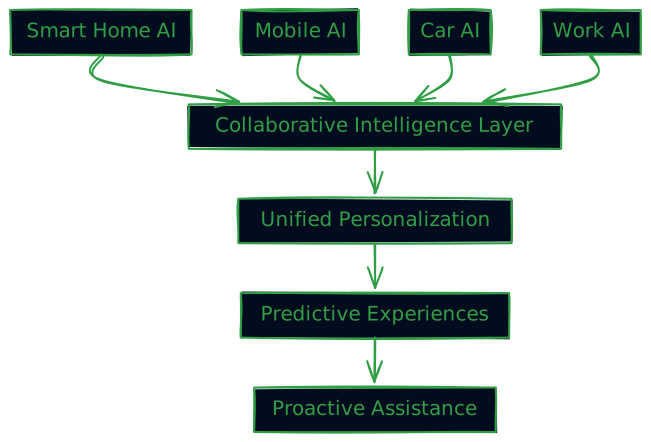
Predictive Personalization
Moving from reactive to predictive personalization:
- Anticipatory content loading based on predicted user paths
- Proactive problem solving before users encounter issues
- Dynamic interface adaptation based on predicted user needs
- Contextual service orchestration across multiple platforms
The Bottom Line for Builders
AI personalization at scale isn't just about better recommendations anymore. It's about creating systems that genuinely understand and anticipate user needs while respecting privacy and avoiding harmful biases.
The technical challenges are significant:
- Real-time processing at massive scale
- Privacy-preserving machine learning
- Bias-free algorithmic decision making
- Cross-platform consistency and identity resolution
But the companies getting this right aren't just seeing better conversion rates. They're building deeper, more trusted relationships with users. The ones getting it wrong? Users notice, and they remember.
The technology exists today to build truly helpful personalization systems. The question isn't whether AI will transform user experiences, it's whether your implementation will feel helpful or manipulative.
What's your experience with AI personalization? Are you seeing systems that genuinely help, or are you still getting those weird recommendations that make you wonder what the algorithm was thinking?
The future of personalization isn't about more data or smarter algorithms. It's about building systems that respect users while genuinely making their lives better. That's a technical challenge worth solving.
The landscape of AI personalization is evolving rapidly. Understanding both the technical implementation and the human psychology behind it is crucial for building systems that users will actually trust and value.
References
- Top AI CX Trends for 2025: How Artificial Intelligence is Transforming Customer Experience, n.d., NICE https://www.nice.com/info/top-ai-cx-trends-for-2025-how-artificial-intelligence-is-transforming-customer-experience
- The impact of AI-driven personalization on customer loyalty, 2022, Academy of Marketing Studies Journal https://www.abacademies.org/articles/the-impact-of-aidriven-personalization-on-customer-loyalty-17516.html
- How AI and Real-Time Data are Powering Hyper-Personalized Customer Experiences, n.d., Computer Talk https://computer-talk.com/blogs/how-ai-and-real-time-data-are-powering-hyper-personalized-customer-experiences
- AI Personalization, n.d., IBM https://www.ibm.com/think/topics/ai-personalization
- AI Personalization, n.d., Salesforce https://www.salesforce.com/marketing/personalization/ai/
- AI Predictions 2023, n.d., PwC https://www.pwc.com/us/en/tech-effect/ai-analytics/ai-predictions.html
- The Privacy Challenges of Emerging Personalized AI Services, 2022, Tech Policy Press https://www.techpolicy.press/the-privacy-challenges-of-emerging-personalized-ai-services
- Ethical AI for Personalized Experiences, n.d., Gracker https://gracker.ai/cybersecurity-marketing-101/ethical-ai-personalized-experiences
- AI and the Ethics of Personalization: Finding the Right Balance, 2022, BusySeed https://www.busyseed.com/ai-and-the-ethics-of-personalization-finding-the-right-balance
- Key Risks Using AI for Hyper-Personalized Content in 2025, 2023, LinkedIn https://www.linkedin.com/pulse/key-risks-using-ai-hyper-personalized-content-2025-reilley-iii-bxode