AI Implementation in Enterprise
Here's a sobering statistic that should make every CTO nervous: 70% of enterprise AI projects fail to deliver meaningful business value. Companies are spending billions on AI initiatives, and most of them are basically lighting money on fire. But here's the thing, the failures aren't usually because the technology doesn't work, they're because organizations don't know how to implement it properly.
The Reality of Enterprise AI Implementation
Let's start with some uncomfortable truths. Most enterprise AI projects fail not because of technical limitations, but because of organizational, cultural, and strategic failures. Companies see AI demos, get excited about the possibilities, and then crash into the harsh reality of enterprise implementation.
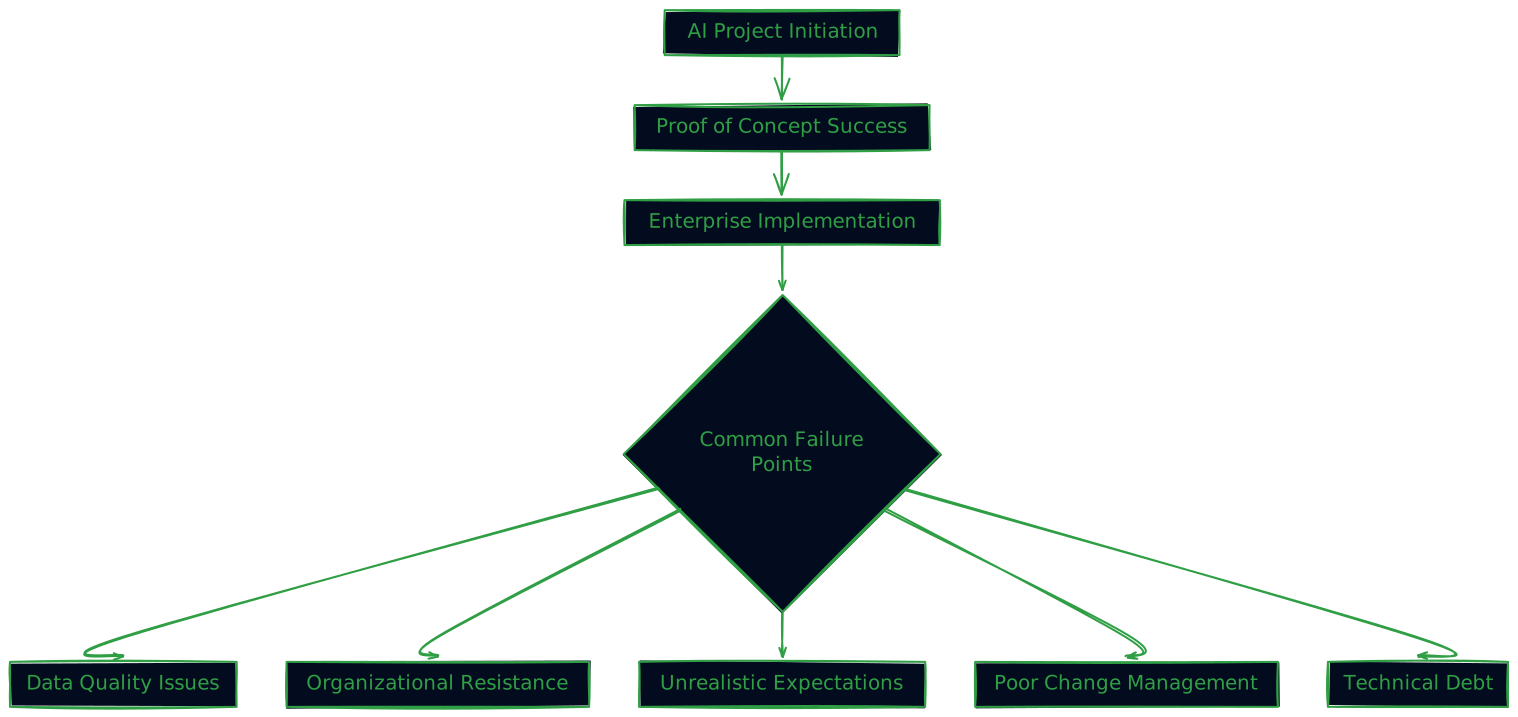
The gap between "AI works in the lab" and "AI works in our messy, complex, legacy-system-filled enterprise" is where most projects die.
The Top Reasons AI Projects Crash and Burn
Data Quality: The Silent Killer
Everyone talks about algorithms and models, but 80% of AI project time is spent on data preparation. Enterprise data is messy, inconsistent, incomplete, and often stored in incompatible systems.
Real Example: A retail company tried to implement demand forecasting AI but discovered their inventory data was stored in 12 different systems with different formats, missing values, and conflicting information. Six months later, they were still cleaning data.
Organizational Resistance: The Human Factor
AI projects often fail because people don't want to change how they work. Employees fear job displacement, managers worry about losing control, and executives get impatient when results don't appear immediately.
Real Example: A manufacturing company implemented AI for predictive maintenance, but technicians continued using their old methods because they didn't trust the AI recommendations. The system sat unused for months.
Unrealistic Expectations: The Hype Problem
Companies expect AI to solve problems that humans have struggled with for decades, often with unrealistic timelines and budgets. When AI doesn't deliver magic, projects get labeled as failures.
Real Example: A healthcare system expected AI to reduce diagnostic errors by 90% within six months, despite the fact that the AI was only trained on a limited dataset and hadn't been validated in their specific clinical environment.
[Image suggestion: Iceberg diagram showing visible AI project challenges above water (technology, algorithms) versus hidden challenges below water (data quality, organizational change, cultural resistance)]
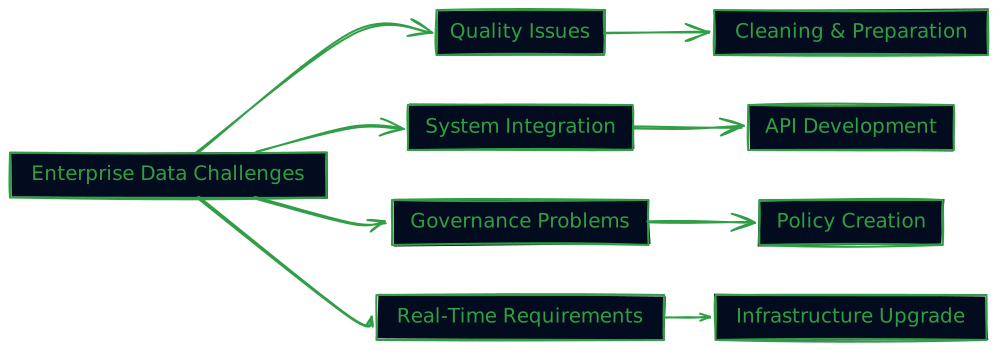
The Data Challenge: It's Worse Than You Think
The 80/20 Rule
In most AI projects, 80% of the effort goes into data preparation and only 20% into actual model development. This ratio surprises organizations that expect to spend most of their time on the "AI" part.
Legacy System Integration
Enterprise data lives in systems that were never designed to work together. ERP systems, CRM platforms, databases, spreadsheets, and cloud services all store data differently.
Data Governance Nightmares
Who owns the data? Who's responsible for quality? What are the privacy implications? These questions become critical when AI systems need access to data across organizational silos.
Real-Time Data Challenges
Many AI applications need real-time data, but enterprise systems often batch process information daily or weekly. Bridging this gap requires significant infrastructure investment.
Organizational Challenges That Kill Projects
The Skills Gap
Most enterprises don't have the AI expertise they need internally. They're trying to implement cutting-edge technology with teams that learned their skills in a pre-AI world.
Change Management Failures
AI implementation often requires changing business processes, workflows, and decision-making structures. Organizations that don't manage this change effectively see their AI projects fail regardless of technical success.
Executive Impatience
AI projects often take 12-18 months to show meaningful results, but executives expect to see ROI in quarters, not years. This mismatch in expectations kills projects before they can succeed.
Siloed Implementation
Different departments implement AI solutions independently, creating incompatible systems and missed opportunities for synergy.
Technical Challenges in Enterprise Environments
Legacy System Integration
Modern AI tools need to work with systems that were built decades ago. Getting a machine learning model to talk to a mainframe system from the 1980s is like trying to plug a Tesla into a horse-drawn carriage.
Scalability and Performance
What works for 100 users might crash with 10,000 users. Enterprise AI systems need to handle massive scale, high availability, and peak load scenarios.
Security and Compliance
Enterprise AI must comply with industry regulations, security standards, and privacy requirements. This adds complexity and constraints that don't exist in consumer applications.
Model Drift and Maintenance
AI models degrade over time as data patterns change. Enterprise systems need robust monitoring, retraining, and maintenance processes.
Success Patterns That Actually Work
Start Small, Think Big
Successful AI implementations often start with pilot projects that have clear, measurable outcomes and limited scope. Success breeds success, and early wins build organizational confidence.
Example: A logistics company started with AI-powered route optimization for a single distribution center before expanding to their entire network.
Focus on Augmentation, Not Replacement
The most successful enterprise AI projects augment human capabilities rather than trying to replace humans entirely. This reduces resistance and leverages the best of both human and artificial intelligence.
Example: A financial services firm uses AI to flag potentially fraudulent transactions for human review rather than automatically blocking them.
Invest in Data Infrastructure First
Organizations that succeed with AI often spend significant time and money building robust data infrastructure before implementing AI models.
Example: A manufacturing company spent eight months building a unified data platform before implementing any AI, resulting in faster and more successful AI deployments.
Build Cross-Functional Teams
Successful AI projects involve business stakeholders, IT teams, data scientists, and end users from the beginning, ensuring alignment and buy-in across the organization.
[Image suggestion: Organizational chart showing successful AI project team structure with representatives from business, IT, data science, and end users working together]
The Implementation Framework That Works
Phase 1: Foundation Building
- Assess data readiness and quality
- Identify high-value use cases
- Build organizational buy-in
- Establish governance frameworks
Phase 2: Pilot Implementation
- Start with low-risk, high-value projects
- Focus on measurable outcomes
- Build technical capabilities
- Learn and iterate quickly
Phase 3: Scaling Success
- Expand successful pilots
- Build reusable platforms and processes
- Develop internal expertise
- Create center of excellence
Phase 4: Enterprise Integration
- Integrate AI into core business processes
- Establish ongoing monitoring and maintenance
- Continuously optimize and improve
- Share learnings across the organization
Common Pitfalls and How to Avoid Them
Pitfall: Technology-First Approach
Problem: Starting with cool AI technology and looking for problems to solve. Solution: Start with business problems and find AI solutions that address them.
Pitfall: Underestimating Data Requirements
Problem: Assuming existing data is ready for AI without proper assessment. Solution: Conduct thorough data audits and invest in data quality before building models.
Pitfall: Ignoring Change Management
Problem: Focusing on technology while ignoring the human side of implementation. Solution: Invest heavily in training, communication, and change management processes.
Pitfall: Perfectionism Paralysis
Problem: Waiting for perfect data or perfect models before starting. Solution: Start with good enough and improve iteratively.
The Future of Enterprise AI
AI-First Organizations
Future enterprises will be built around AI capabilities from the ground up, rather than retrofitting AI into existing processes.
Democratized AI Development
Low-code and no-code AI platforms will enable business users to create AI solutions without deep technical expertise.
Integrated AI Ecosystems
AI will become embedded in all enterprise systems, creating intelligent, adaptive organizations that continuously optimize themselves.
Ethical AI Governance
Successful enterprises will build robust governance frameworks that ensure AI is used responsibly and ethically.
Your Action Plan for AI Success
1. Start with Strategy, Not Technology
Define clear business objectives and success metrics before choosing AI solutions.
2. Assess Your Data Reality
Conduct honest assessments of data quality, accessibility, and governance before launching AI projects.
3. Build Internal Capabilities
Invest in training existing employees and hiring AI expertise. Don't rely entirely on external consultants.
4. Choose Your Battles
Start with use cases that have clear value, available data, and organizational support.
5. Plan for Change
Develop comprehensive change management strategies that address both technical and human factors.
The Bottom Line
Enterprise AI implementation is hard, but it's not impossible. The organizations that succeed are those that approach AI as an organizational transformation, not just a technology deployment.
The key is understanding that AI implementation is 20% technology and 80% everything else: data preparation, change management, organizational alignment, and cultural adaptation.
The companies that master enterprise AI implementation will have a significant competitive advantage. But success requires patience, investment, and a willingness to change how the organization operates. There are no shortcuts, but there are proven paths to success.
Enterprise AI success isn't about having the best algorithms, it's about having the best implementation strategy. The technology is ready, the question is whether your organization is.
References
- What are the Challenges of Ensuring Data Quality for AI?, 2023, DataGaps [https://www.datagaps.com/blog/what-are-the-challenges-of-ensuring-data-quality-for-ai/]
- Overcoming Data Challenges Related to AI, 2023, Ahead [https://www.ahead.com/resources/overcoming-data-challenges-related-to-ai/]
- Artificial Intelligence, 2023, Confluent [https://www.confluent.io/use-case/artificial-intelligence/]
- AI Talent Gap Widens, 2023, St. Louis Federal Reserve [https://www.stlouisfed.org/publications/regional-economist/2023